Manglisi
In the dual interests of a) seeing as many places in Georgia as possible before we leave and b) getting more familiar with our vehicle (now christened Dora the Explorer) before beginning our long drive to Italy, we decided on a Sunday drive to Manglisi, west of Tbilisi. The sunny morning was not yet too warm as we bumped along the gravelled road above Vake Park, down to Chavchavadze Avenue and out the Baghebi Highway. In just a few minutes we were climbing fast toward Tskhneti, a summer resort in the hills, past old Georgian dachas and new holiday villas behind stucco walls. Turning off to the west, we passed through rolling green countryside and small villages, still climbing steadily but more gradually.

Somewhere just west of Orbeti it occurred to me to glance at the fuel gauge, which read half full. Good enough for a short jaunt, surely, but in deference to my chronic PTSD (pre-traumatic stress disorder), Jim agreed to stop and gas up at the next filling station. We were through the next town, Didi Toneti, before we knew it, having seen no place to buy gas; still, the gauge stood at half full, so we’d be fine.
One of the urban attitudes we adopted while living in Washington, DC was a serene disregard for the gas gauge of our Toyota Corolla. We so rarely drove the car more than once a week, and then just to the supermarket and back, that six weeks could elapse before we needed to fill the tank, at any one of the many convenient gas stations in the city. Tbilisi is a similar urban environment, and we use our Explorer much as we did the Corolla—for short hops around town, rarely more than once a week. Significant and important differences do exist, however, and they ought not to be ignored: the Ford is not a fuel-efficient Toyota; gas stations are not so common in rural Georgia as they are in the greater DC region.
As we began our climb into Manglisi, I took another glance at the fuel gauge, now near E for empty. I remarked on this, remembering suddenly the idiosyncratic tendency of Dora’s fuel gauge to jump from half-full to empty in seconds. Probably some trick of a float in the fuel tank or a minor malfunction of some computer nano-chip. No matter the cause or the inconvenient timing of my sudden recollection, we were about to run out of gas.
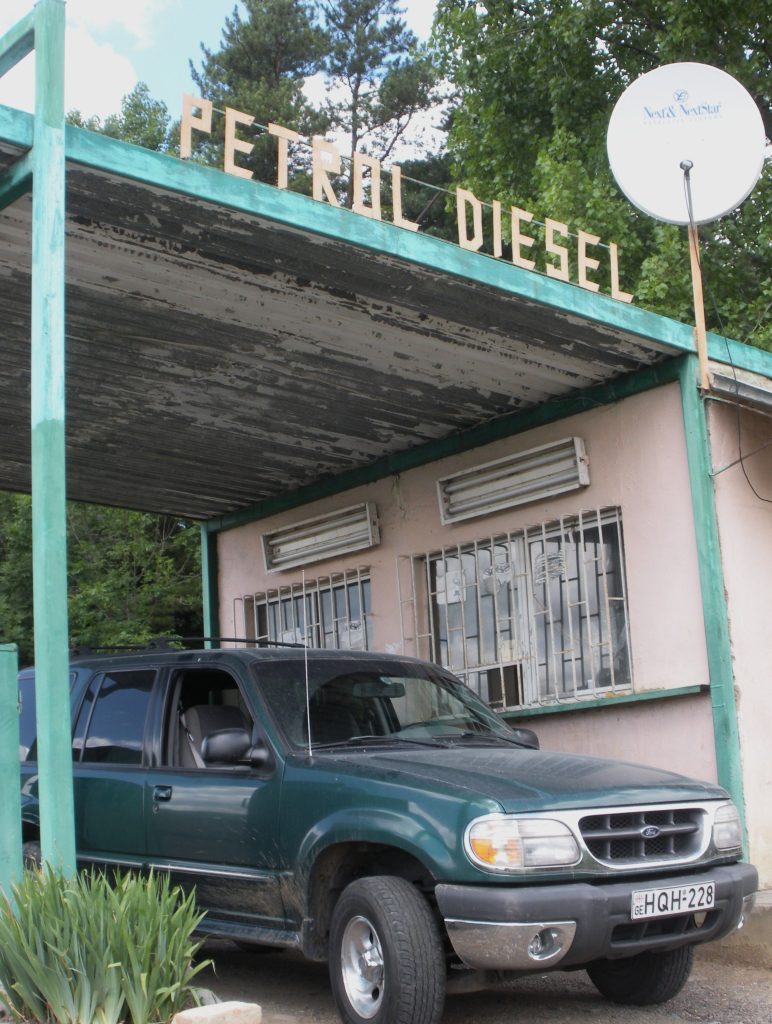
Topping the first rise into Manglisi village, we passed a small, deserted-looking frame building painted the pale green of mint ice cream. A little portico sheltered twin windows, tightly shut with blinds drawn, and cast a patch of deep shade just large enough for a single car. An old sedan sat parked in this shade, and then a man slammed shut the trunk, got into the car and drove slowly away. I noticed all this in the few seconds as we drove past; I also noticed tall green-painted letters atop the portico: PETROL DIESEL. We continued up the road into the village, and I looked back at the little house. It seemed deserted. The lettering on the other side of the portico was in Georgian, and I didn’t make the effort to sound out the words. We drove on, arriving at a T intersection where we faced a double storefront with a grocery on the right and a newsstand/tobacconist on the left. Three women were walking away from the grocery; I called to them and asked for the nearest petrol station. One woman waved her hand vaguely back down the hill, the way we had come. Jim turned the car and down we went, thinking perhaps we’d missed the turning for the village center. We turned right and drove just far enough to see we were now heading out of town, reversed again and drove back toward the little green building. Having nothing to lose at this point, we pulled into the shade of the portico. Instantly one of the windows slid up and a man looked out at us. “Petrol?” we asked. “Da, petrol,” he replied. “Really??” we asked again. “Da, da,” he said again, smiling now at our amazed relief. In seconds he was outdoors, opening the Explorer’s gas cap, calling out to an unseen assistant. A younger man appeared around the corner of the little building, carrying a tall, metal gas can. He placed it on the ground and went back for a second can, while our benefactor produced a funnel and deftly poured fuel from the can into our tank. After draining both cans, he replaced the gas cap and, wiping his hands on a rag, asked where we came from.
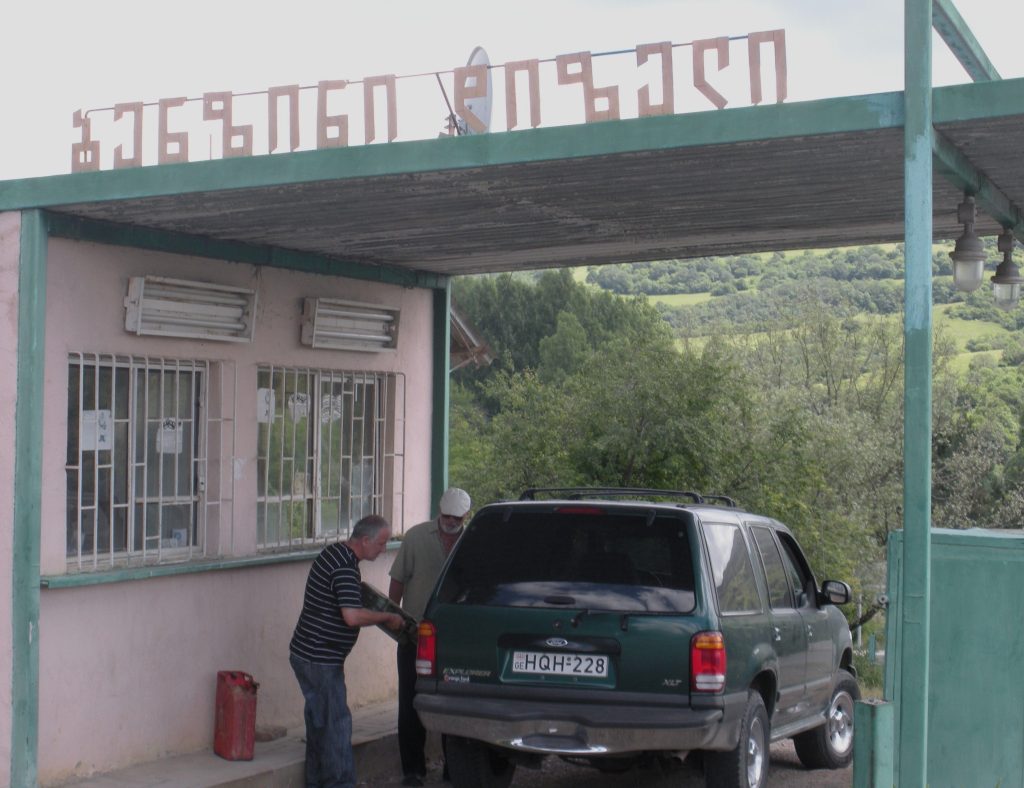
We exchanged information and compliments on our national affiliations: “America good! America strong!” “Sakartvelo lamazi aris! Kartveli dzalian k’etili arian!” (Georgia is beautiful! Georgians are very kind!). We thanked the men repeatedly, paid close to one hundred dollars for the gas, and drove away smiling and waving. We were definitely getting to know our vehicle; now we could enjoy the rest of our day in Manglisi.