Piccola castagnata
There’s always something food-related going on here–in Piemonte it seems the seasons exist to bring on the next good thing to eat. After the bounty of summer comes funghi season, the woods all around full of foragers with baskets over their arms, hunting wild porcini mushrooms. Tartufo season follows, but truffle hunters tend to be a bit more secretive, pretending to be out for a casual walk with the dog, who has a nose for locating the fragrant nuggets at the base of certain trees. Tartufi are a rare and precious delicacy, and those who know where to find them guard their sources closely.
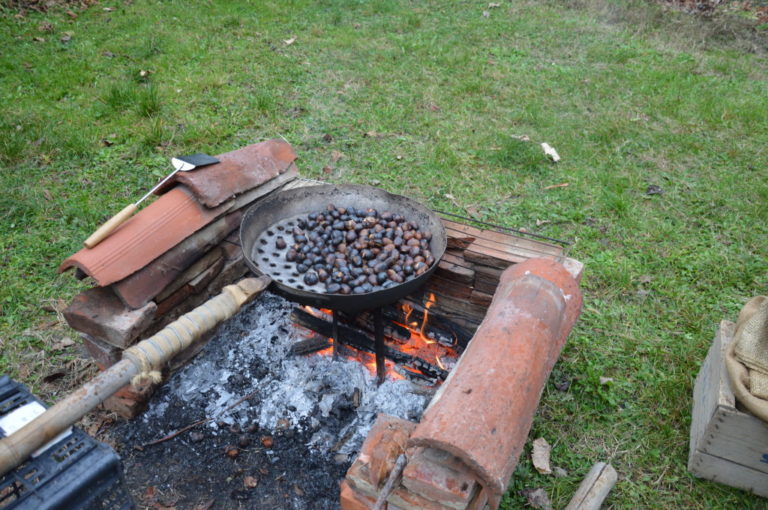
Now we’ve come to the castagnata, or caldarroste–the ritual of roasting chestnuts. Chestnut trees grow everywhere and the nuts are thick on the ground–you can pick up kilos during a walk in the woods. Some friends who actually cultivate a few trees gave us a huge sackful, and we roasted them on Sunday with our friend Paolo.
Paolo brought the padella, a big, heavy pan with perforations that allow the nuts to roast over an open fire, and instructed us in the ways of the castagnata:
Prepare the chestnuts by cutting a small slit in each shell. This prevents the nuts from bursting when exposed to extreme heat. (Well, that’s the theory. We had a few nuts burst, leaping out of the skillet like popcorn.)
While roasting, toss the chestnuts in the padella so they cook evenly. After 20-30 minutes, when the shells are blackened and the nuts are caramelized, with a texture like a perfect baked potato, pour them into a burlap sack to keep them warm.
Slip the chestnuts from their shells as soon as you can handle them without burning your fingers; while they are warm eat as many as you can–rich, sweet, and smoky, few other things are as delicious. The traditional accompaniment is vin brule’, mulled wine with spices, but we had a thermos of espresso instead.