A Funeral in the Clouds
Sunday I felt better after a bout of flu and Jim wanted a drive, so we set off mid-morning to visit Jvari, a sixth-century church and monastery above Mtskheta, the ancient Georgian capital, a 20-minute drive from Tbilisi. After missing the mark (“is THAT the road???”) and doubling back, we got on the right track and jounced six kilometers up steep and winding, pitted asphalt. Along the way we passed a cowherd, gender obscured by thick layers of clothing, feeding evergreen boughs to two long-haired beasts.
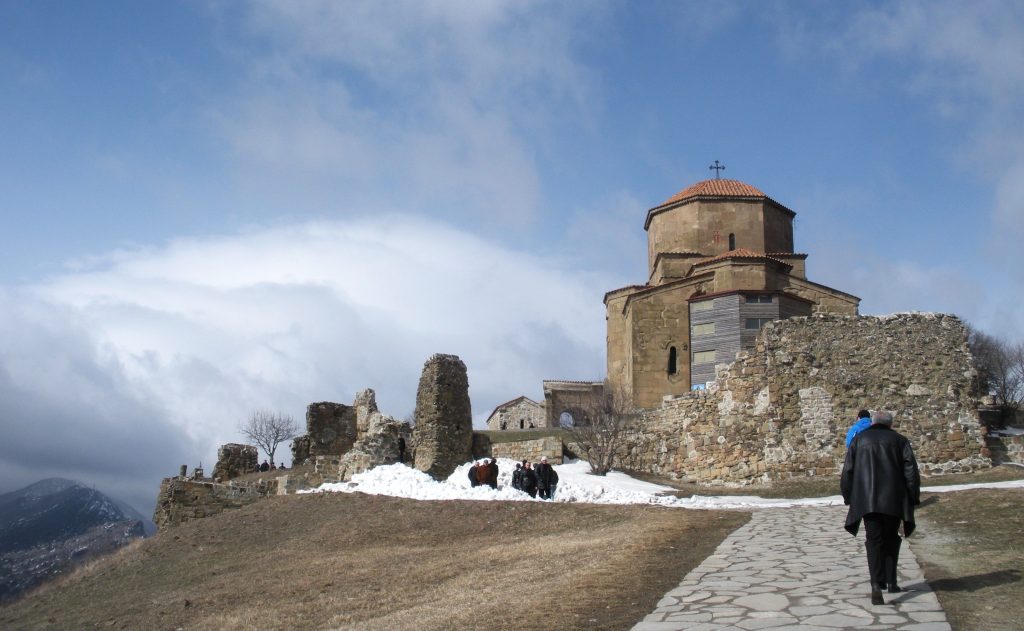
We crested a hill and saw the church directly ahead; it seemed suspended in the air, somewhere between mountain and cloud. Then we noticed the parking lot, definitely terrestrial and crowded with a tour bus, sedans, and SUVs, all parked without regard for geometry or cardinal direction. Jim parked at the far edge of the crush and we picked our way over puddles of mud and snowmelt to the steep walkway leading to the church.

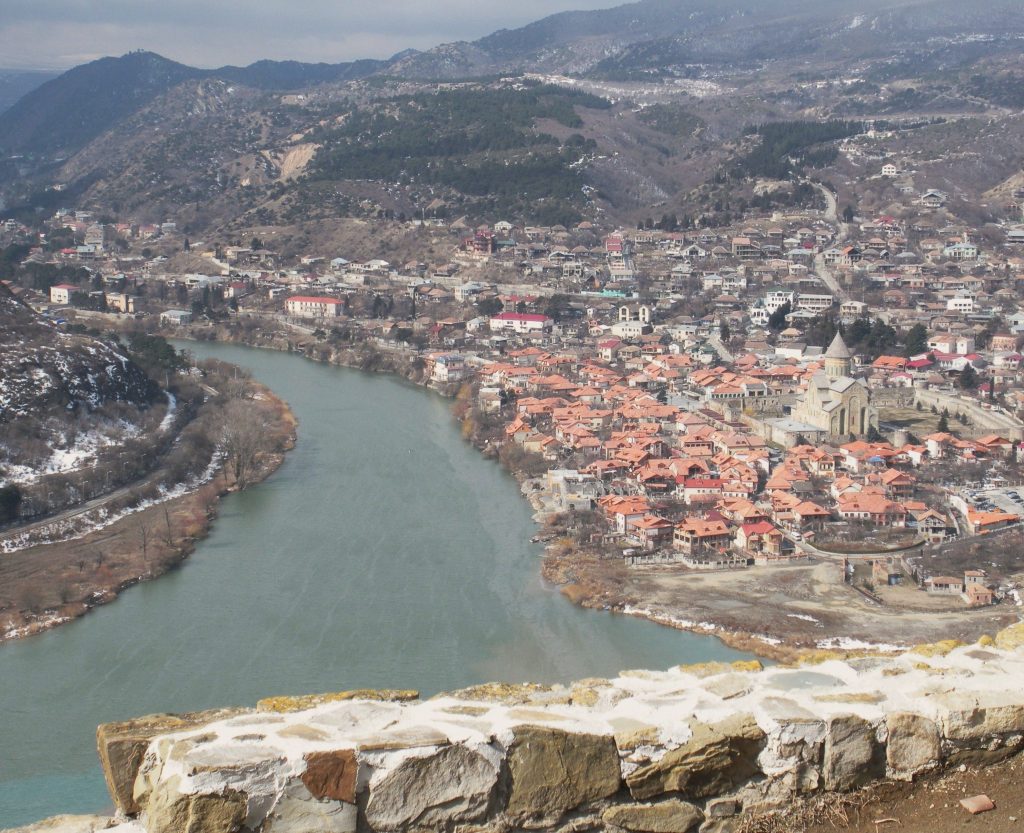
The stone pathway was well trafficked, groups of young men in open jackets lighting cigarettes on their descent; couples and families climbing together, holding hands; a slow-moving, solitary man blowing his nose on a plaid handkerchief as he mounted the pavement. I turned and snapped a few photos of the Kartli Range, snow caught in folded valleys and peaks marching northeast toward Tusheti, the wild country along the Chechen frontier. The wind blew colder and stronger the higher we went; near the top of the hill we veered off the path and across the pale grass to admire a view of the River Mtkvari and the red roofs of Mtskheta.
Chilled and windblown, we sought the shelter of the church but could move no further inside than the doorway. The sanctuary was filled with people, all standing and most holding lighted candles–small, thin tapers of sweet-smelling beeswax. Frankincense perfumed the air, and polyphonic chanting, an unseen choir of female voices, rose into the rough stone vaults and the dome above. Jim motioned that he would wait outside, but I stayed a few minutes more, breathing the sanctified atmosphere and taking the music into my heart. As I turned to leave, beside the door I saw an assortment of headscarves hung from simple wooden pegs; in Orthodox churches, women cover their heads and men remove their hats.
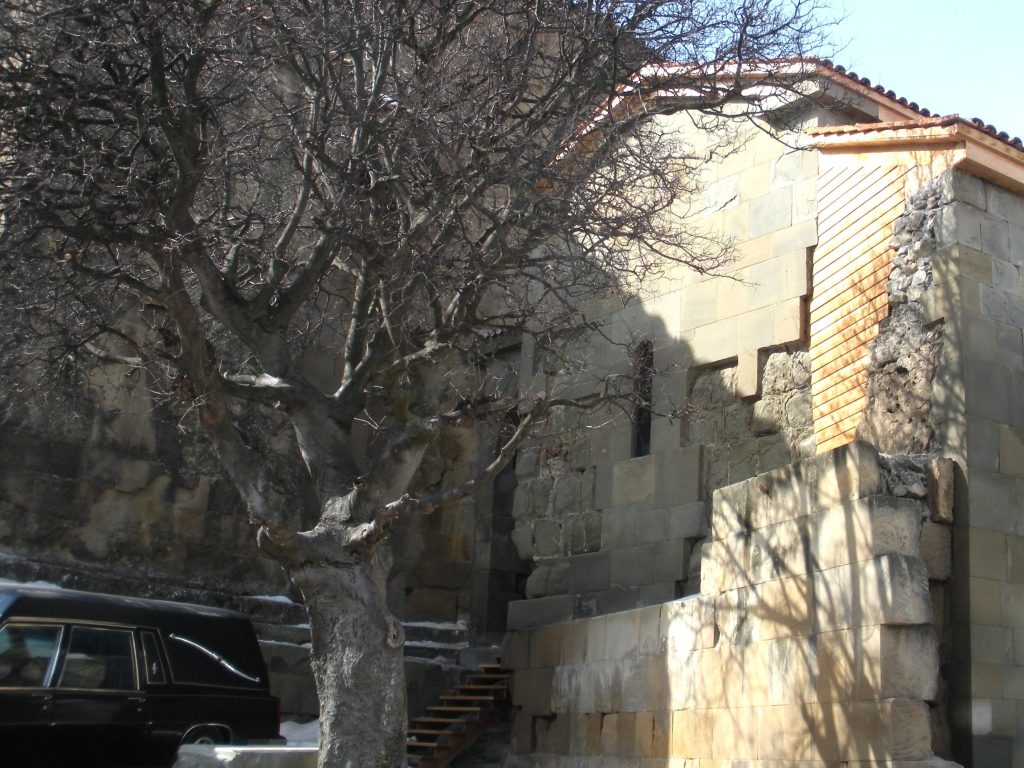
I found Jim in a sunny corner out of the wind, a trio of other men standing nearby, smoking and talking in low tones. “I think it’s a funeral,” Jim said quietly, and the details fell into place – so many young men, in groups or alone, among the crowd; the hushed solemnity; the constant traffic in and out of the church – these were mourners, not sightseers or regular Sunday worshippers. After that we walked around to the rear of the church, where we admired the restoration work being carried out by the Georgian Patriarchate, UNESCO, and others. We saw a hearse drawn up at the foot of a stone stairway. Yes, a funeral.
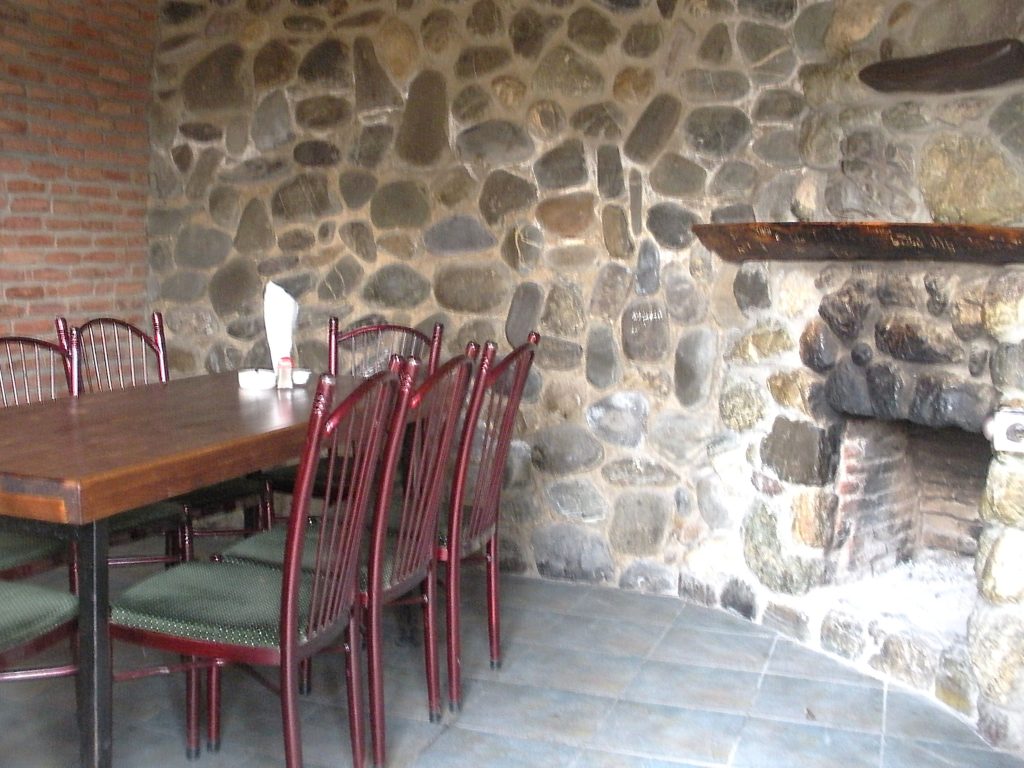
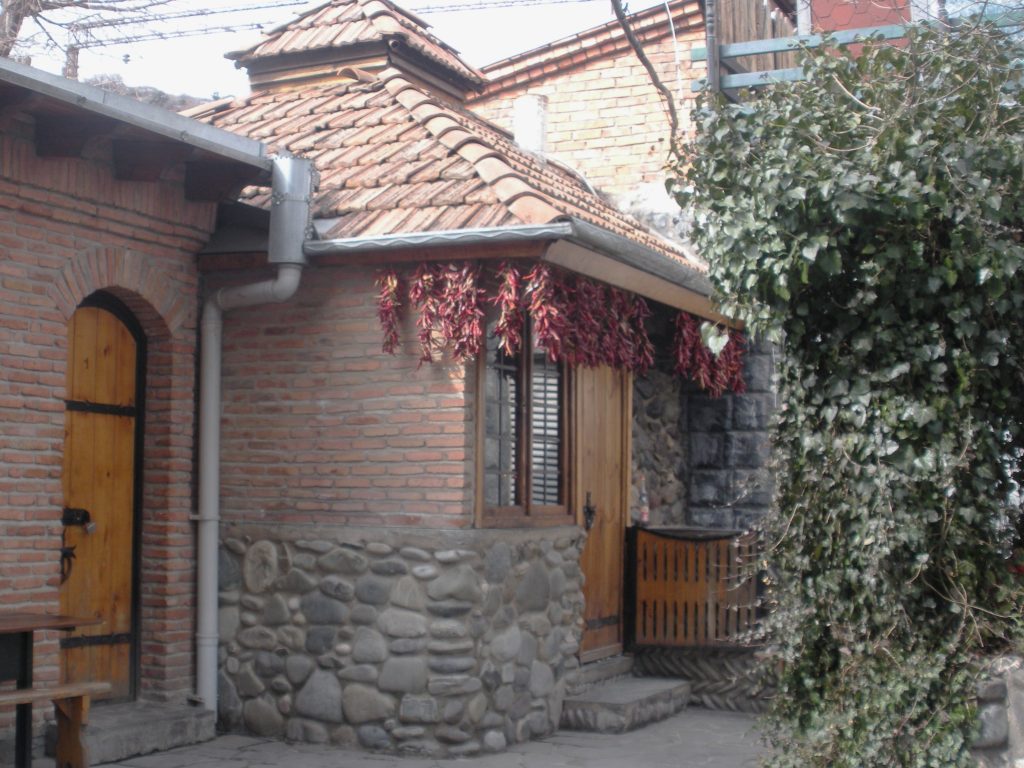
We took another long look at the cloud-ringed mountains, climbed back into our truck and drank mint tea from a thermos while we looked at maps to get our bearings. Then we drove back down the long hill (the cowherd and cattle had made some progress toward the high pasture) toward Mtskheta, looking for lunch. The place we found was a typical Georgian roadside restaurant with several indoor dining rooms, outdoor terraces for warm weather, and ranks of small private dining huts, each with its own fireplace, table, and up to eight chairs. We sat indoors near a fireplace on low, three-legged stools and ordered all our favorite Georgian specialties: lobio, a spicy soup of red beans; tomato and cucumber salad; roasted eggplant; shashlik, shish kebab of pork or beef with grilled onions; and just a few khinkhali, big steamed dumplings filled variously with minced meat, buttery sautéed mushrooms, salmon mousse, potato, or kasha. Georgians order them by the dozen and eat them with nothing but beer or wine, but we like them as part of the full smorgasbord. Jim settled the check, which came to less than $20, and we strolled the empty terraces before turning toward Tbilisi, our own fireside, and a Sunday nap.