Notes from Tusheti

[In early June we learned that we would be leaving Georgia soon; my husband’s job wasn’t working out. We decided to explore one of the wilder regions of the Caucasus before we left and applied ourselves to finding an experienced guide to plan our expedition to Tusheti, on the Chechen border. Koba Kobra came highly recommended by some friends, so we met him for coffee one morning to arrange details of the trip. We would be five days out, Koba would organize lodging, day trips, all transportation. He was a man to inspire confidence, capable and with excellent references. Also, as our friend had said, he did not talk too much (although he proved to be good company–knowledgeable and an excellent raconteur). We agreed on a price, a departure date, and parted ways. My notes from the trip are just that—rough notes scribbled on any bit of paper at hand, often bouncing along mountain tracks in a Jeep.]
DAY ONE – Tbilisi to Omalo
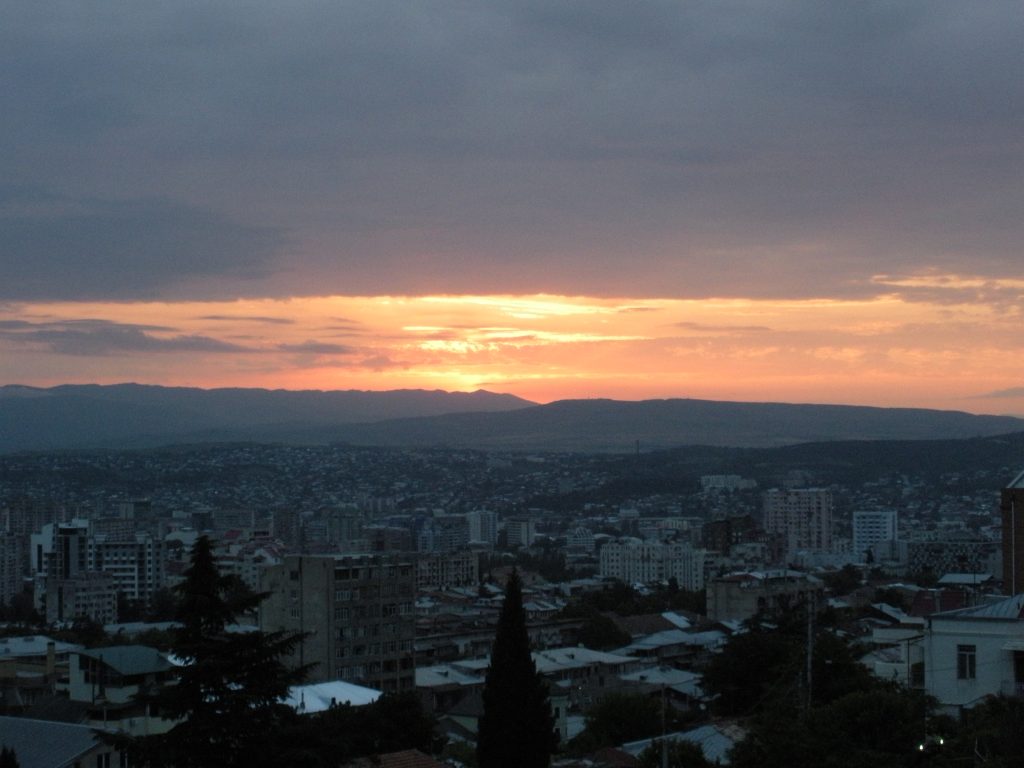
We departed Tbilisi as the sun rose.
Koba says Basques migrated from this part of Georgia – languages similar, shape of head, sheep herding tradition
A man in the world: once, in order to import a vehicle from Denmark, Koba drove 900 km between Trabzond – Archivah (Azerbaijan) four times—colleague brought car to Trabzond, got import stamp on his passport, then asked Koba to drive car to new owner in Azerbaijan. On the way he passed through a war zone, Kurdish partisans fighting Turkish army. Army border guards told him not to go on but he went anyway, met Kurdish patrol that took him back to their camp and plied him all night with vodka. When he arrived Azerbaijan, authorities would not let him leave the car, demanded 500 USD. Back to Trabzon for cash, back to Azerbaijan and back again. A two-day errand took 10 days and Koba’s wife still won’t believe he wasn’t shacked up in Antalya with a Russian floozie.
Koba says: a cow will stand in the middle of the road because the breeze from passing cars sweeps away flies.
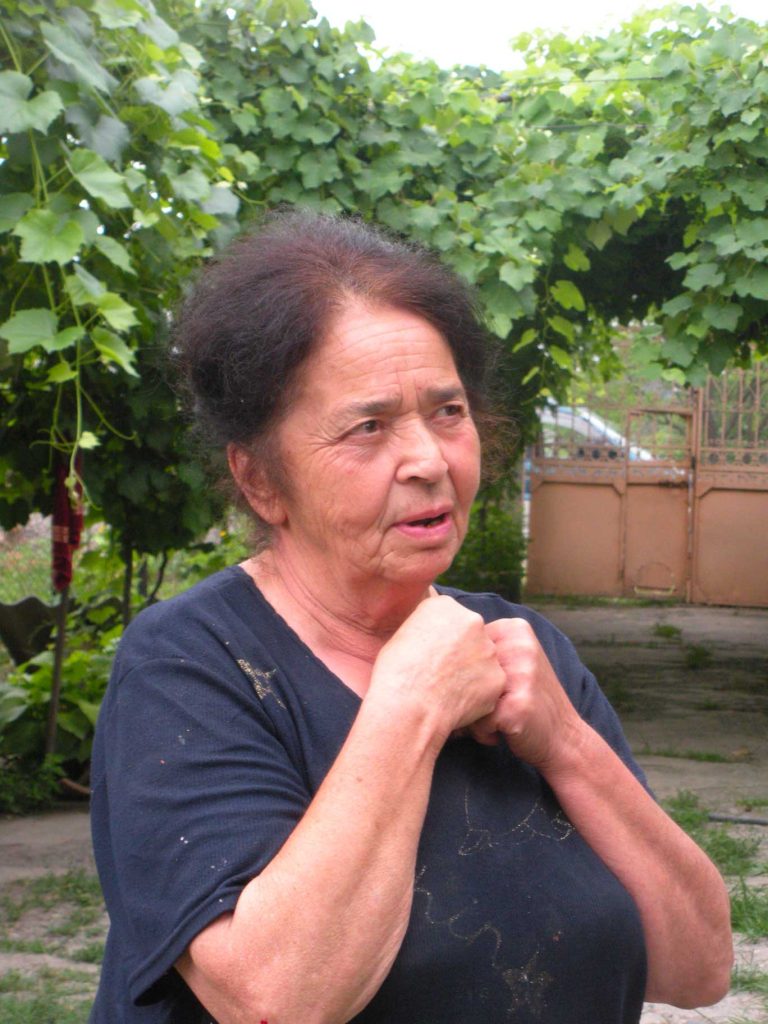
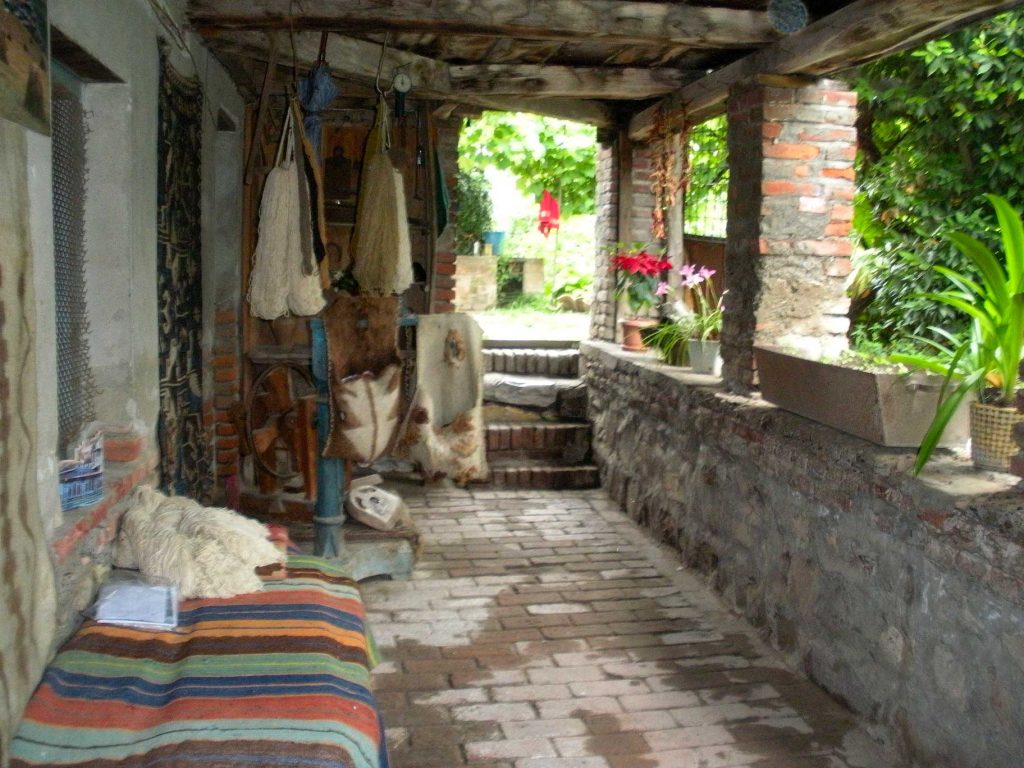
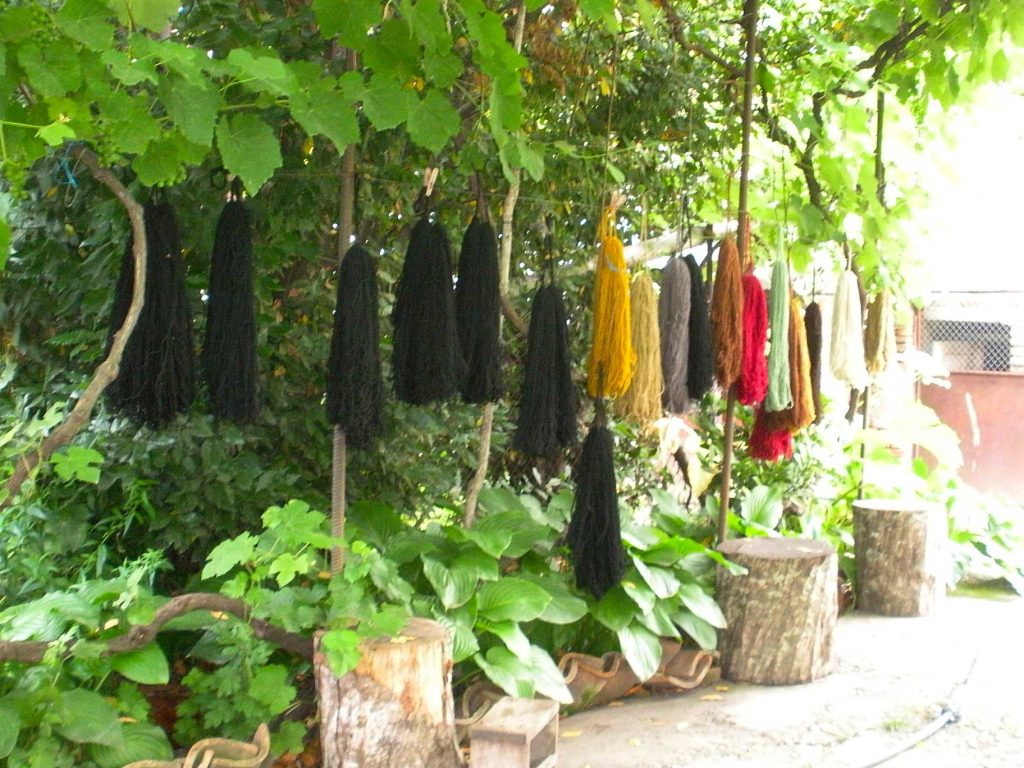
We stop to visit Lili in Alvani: she has degrees in pedagogy, psychology, art. Textile artist and teacher, recipient of $10K World Bank grant for teaching & preserving traditional Georgian arts/crafts: spinning, vegetable dyeing, weaving. Organized a group of 70 local women who assist her in producing woolen products: rugs, wall hangings, hats, slippers, clothing. Lili says wool from Tusheti sheep has healing properties and has been proven (cited a German study) to cure many diseases, including cancer. I bought slippers, which she said will help any troubles I have with feet, legs, etc. Lili is in line for a second World Bank grant of $50K to renovate an existing building as a guest house for students. She beat the branches of her apricot tree to bring down fruit for us, poured home made fruit-and-honey flavored vodka, served khatchapuri.
We stopped for fresh shoti before leaving Alvani – two young guys in the bakery enjoyed our company and would not let us pay for the bread.
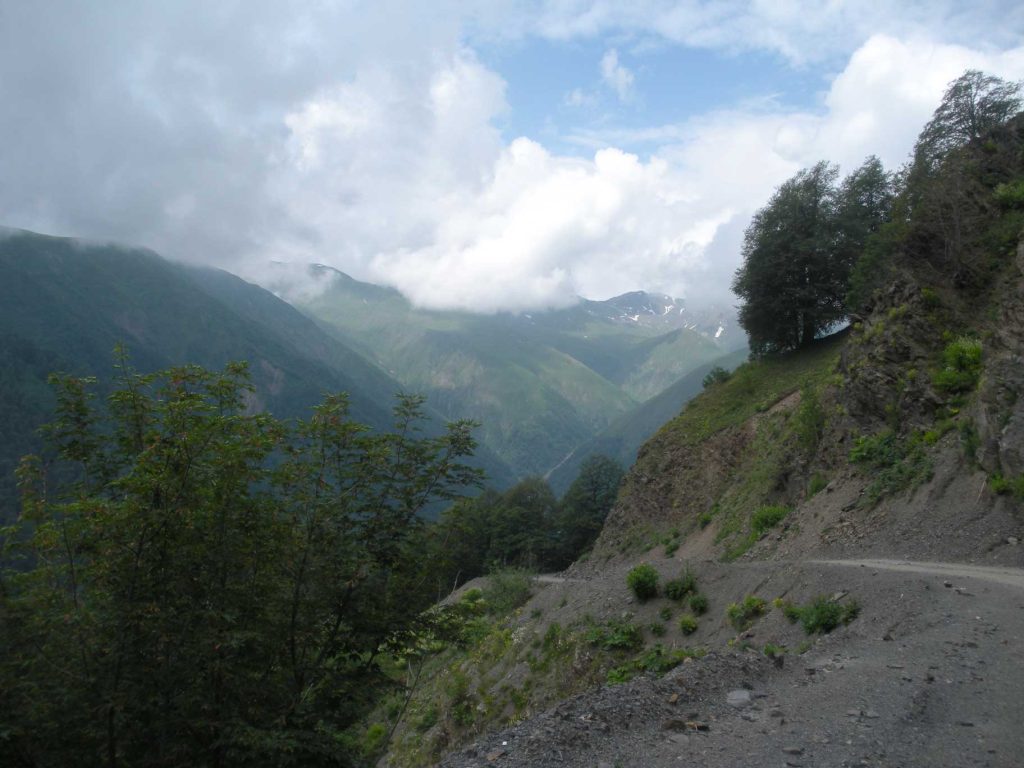
We left the main road and began climbing 72 km to Omalo. River Alazani gorge below, road a narrow and stony track with rusted Soviet electricity towers at regular intervals. Beehive boxes stacked on truck trailers for bees to plumb chestnut tree blossoms in the forest. Three old men and a red Lada under a rocky outcrop where a pipe spills icy water from the snowmelt above.
Koba says if you ironed out all the folds in Georgia’s topography the resulting land area would be larger than Russia’s.
Fellow travelers along the road included a skinny cowboy on horseback, complete with Stetson-type hat and bedroll; one white van; a white “jeep;” a tan SUV—at this point I realized the track was not nearly as little-travelled as I thought, and I gave up counting. We passed a long, low wooden building flying the Georgian flag, with a privy several meters further down the road—a herders’ hostel where several men stood about and gaped as we passed; a low road forked away to a small bathhouse built over hot sulphur springs.
Approaching the treeline, the rocky upper slopes are cloaked in soft green turf with patches of old snow.
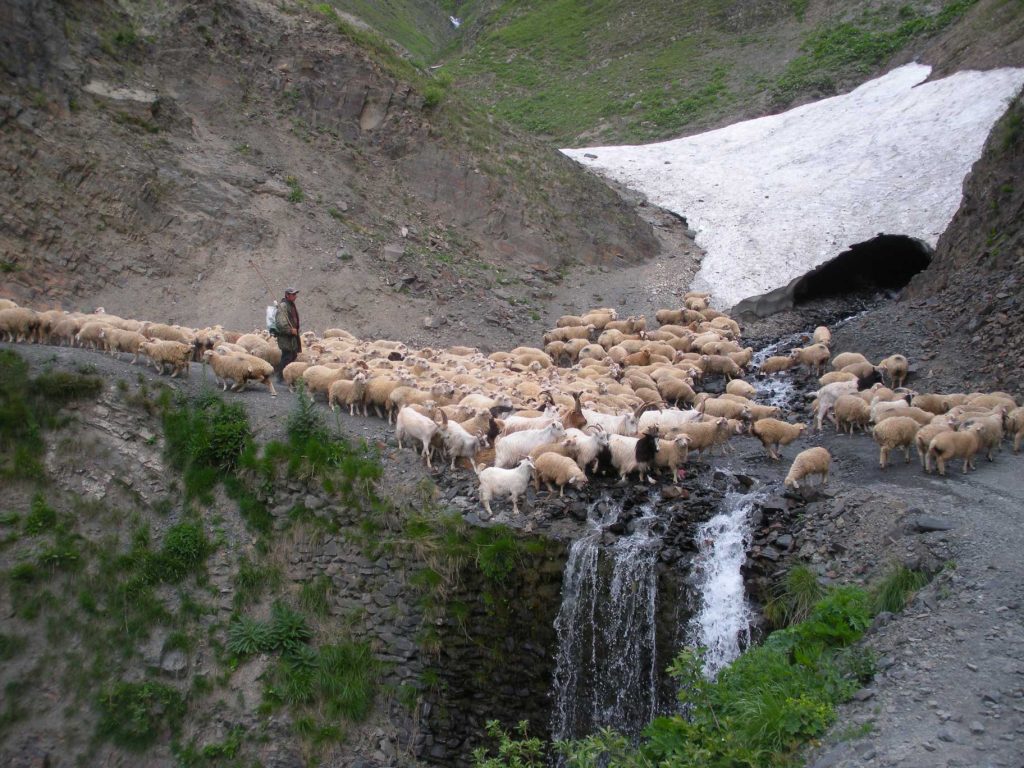
A flock of sheep moving downhill clogged the road, stopping to drink the melt running from the glacier. Big-horned goats led the sheep and three dogs followed, herding several stragglers limping on broken limbs. The single shepherd stopped to fill two brown plastic bottles with icy water.
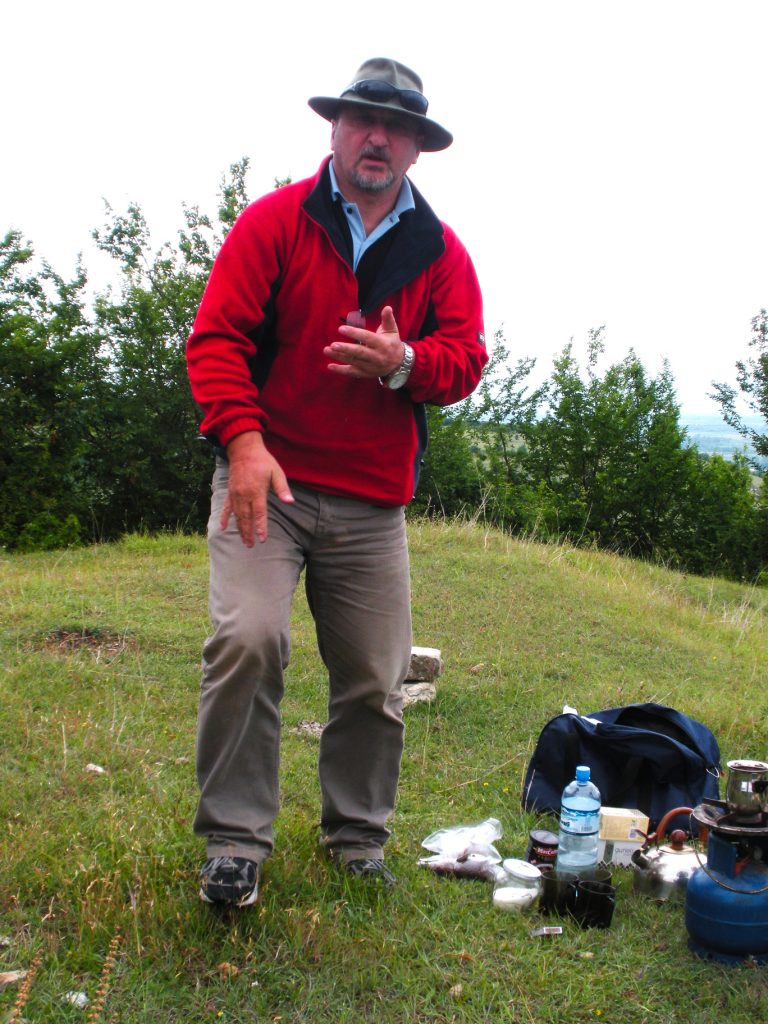
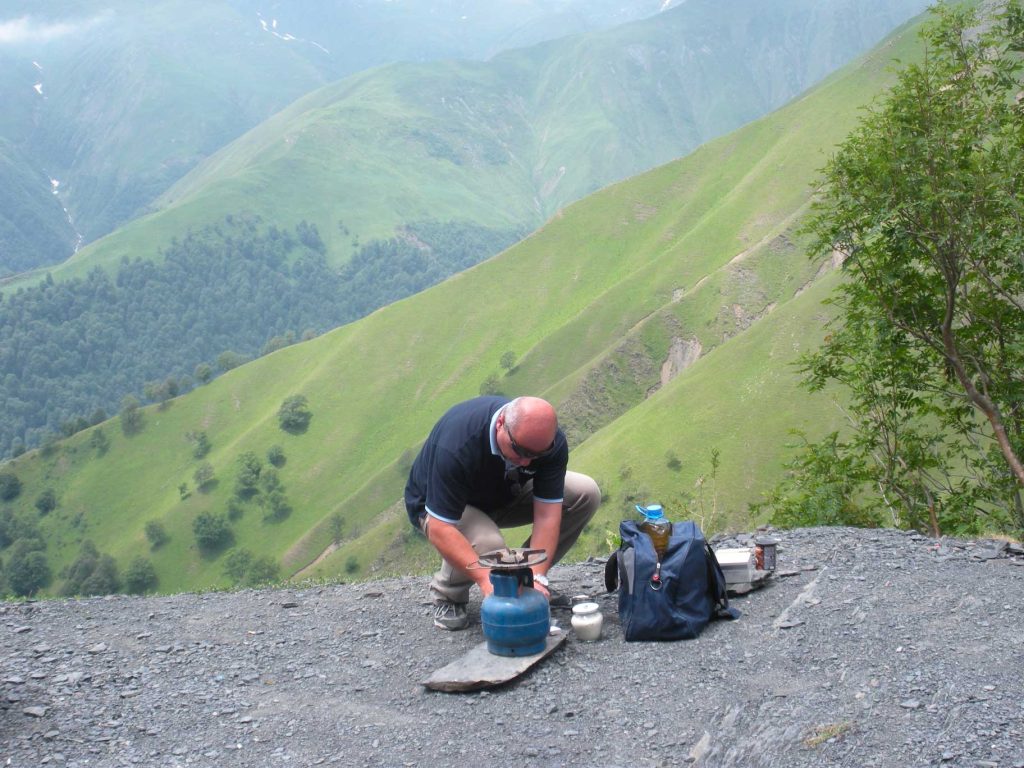
At signpost 36 (our halfway point, two hours from Alvani) we stopped at a place where two pipes ran with snowmelt. Koba filled a kettle and prepared sweet Turkish coffee on a single propane burner while I walked up the road a bit to pee. Just as I started to lower my pants, I saw a car approaching. Started to zip up again but realized it would be at least a full minute before the car would wind around to where I stood, so lowered away and was finished before the car passed. Three other vehicles passed while we took our break; all stopped for water from the rock.
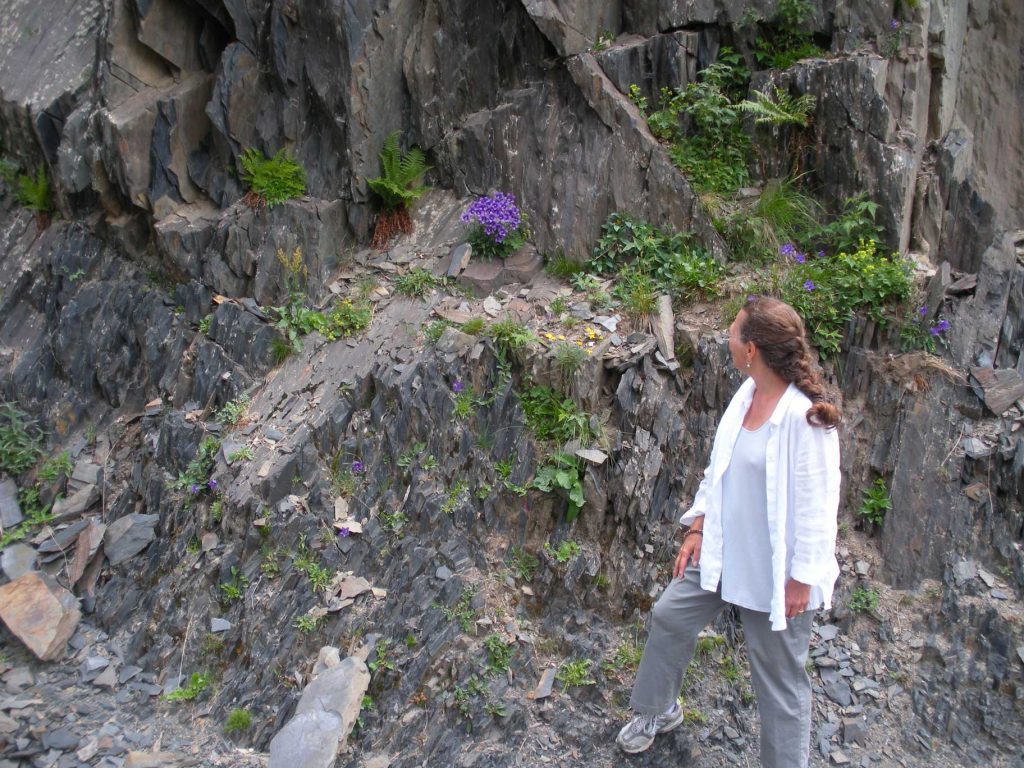
At the 39 km marker the world below falls away, obscured by clouds. All we see is gauzy mist, a few meters of road ahead, bare rock face of the mountain; the only direction is up. Koba tells us he once descended this road by night, says it’s easy when all you can see is the bit of road directly ahead. When a friend needed some auto parts Koba drove up and back in a day.
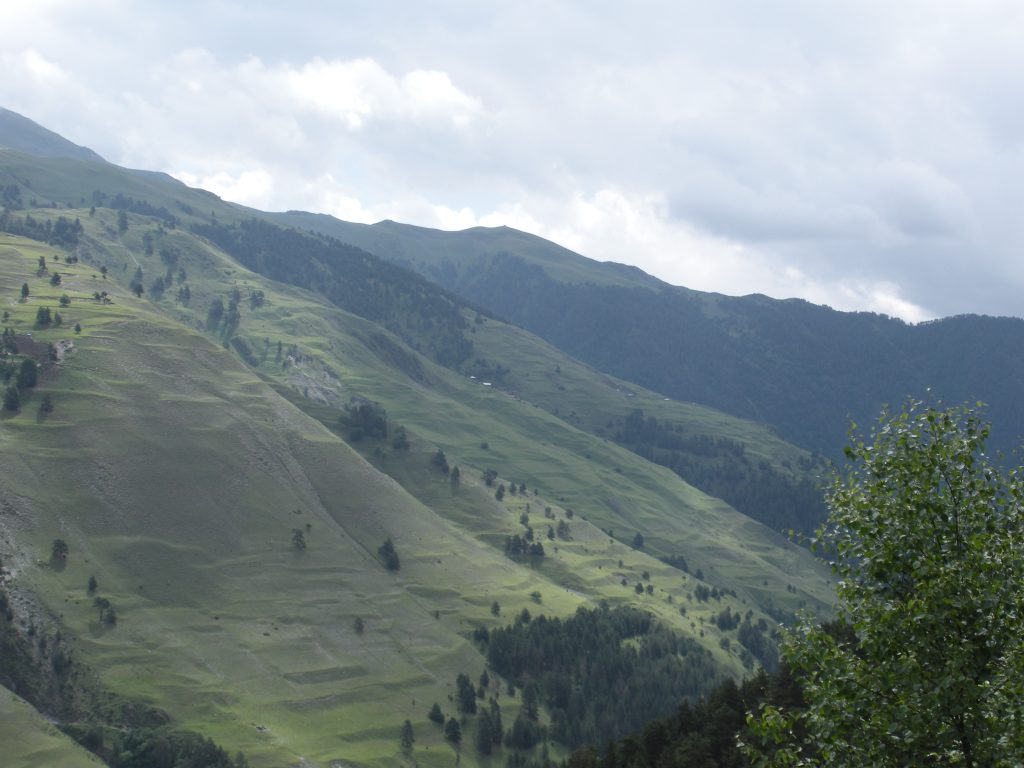
At a summit (Diklos/Juras Pass), we see materials for construction of a new church. About km 43 we begin our descent toward Omalo. Across the valley is Chechnya, black slopes showing fresh snow. Here the stone is black and glossy, a dramatic change from the grey-blue shale and brown clay below. The gentler slopes are overlaid with a mat of mosslike, soft green turf, three inches thick. The steep faces are bare and slick with courses of rubble and rivulets of water in the deepest folds. Here the temperature is 19 Celsius; in Tbilisi yesterday it was 37.
At 49 km we are down along the riverbank; we pass two cars carrying perhaps 12 people—fellow tourists? Koba shifts out of 4WD. At 52 km we pass a Ranger Station built of slices of rock stacked mortarless into walls, with a fine verandah of wood across the front. At 54 km we are down among trees again; we pass two riders on horseback, white sacks of some tall, wilted greens slung behind their saddles. The road widens and flattens but is potholed and rough; the water runs clear and blue grey beside us. At 56 km, in the distance stands a great black peak, sharp with fresh snow white in the folds running down from the summit. At 57 km we pass through a settlement of some two dozen houses, with a water-powered electric generating station and a sawmill on the riverbank; Koba says the power station is a World Bank project and the settlement is called Dzveli (Old) Khakhabo. Akhali (New) Khakhabo stands a bit further up.
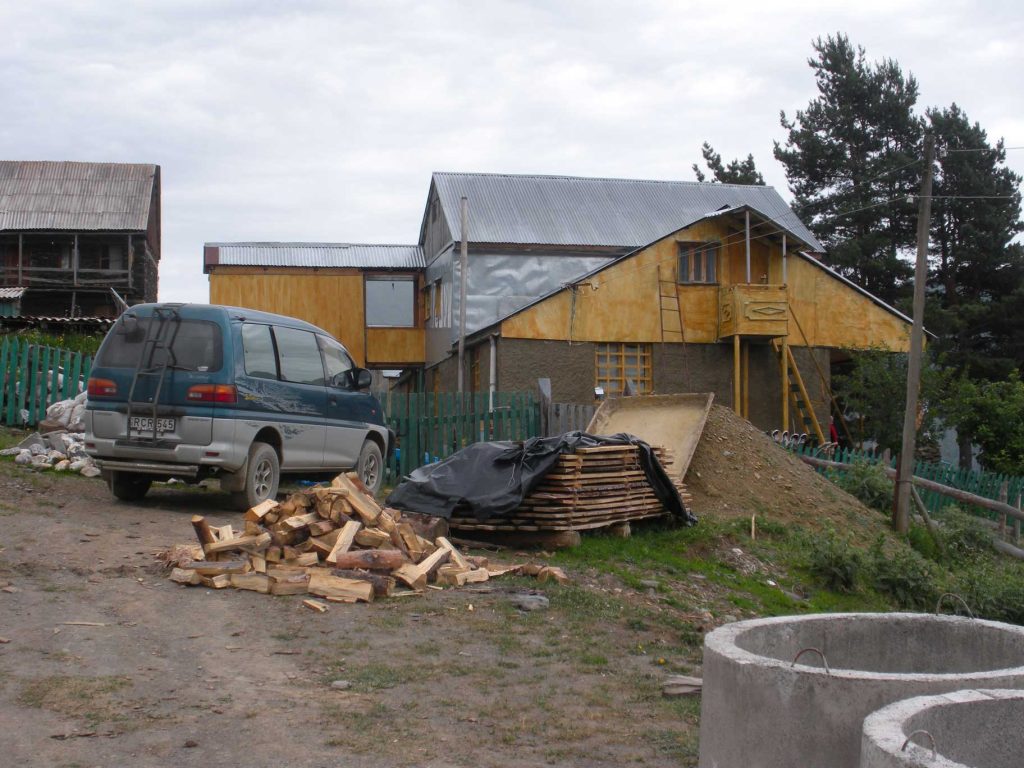
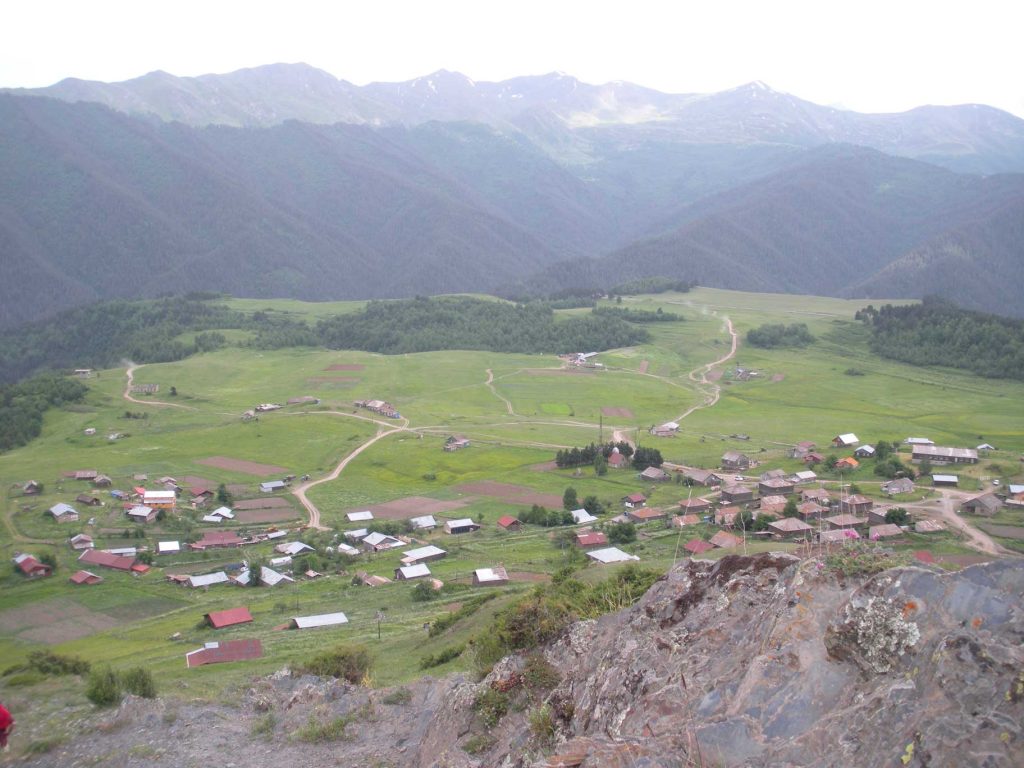
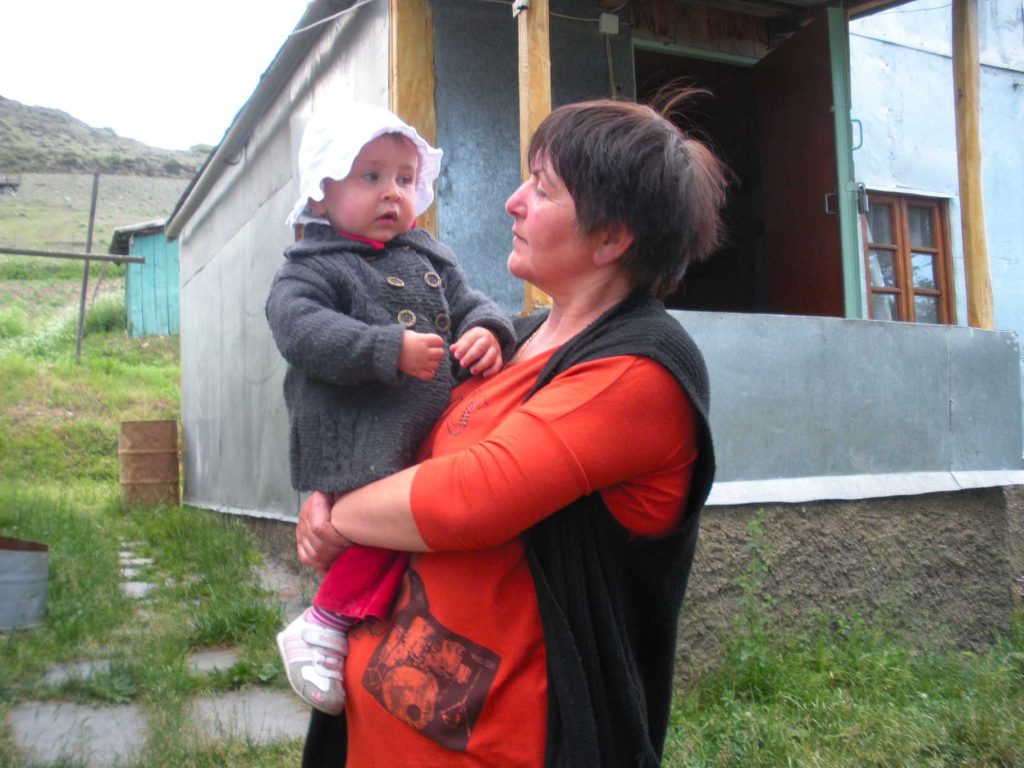
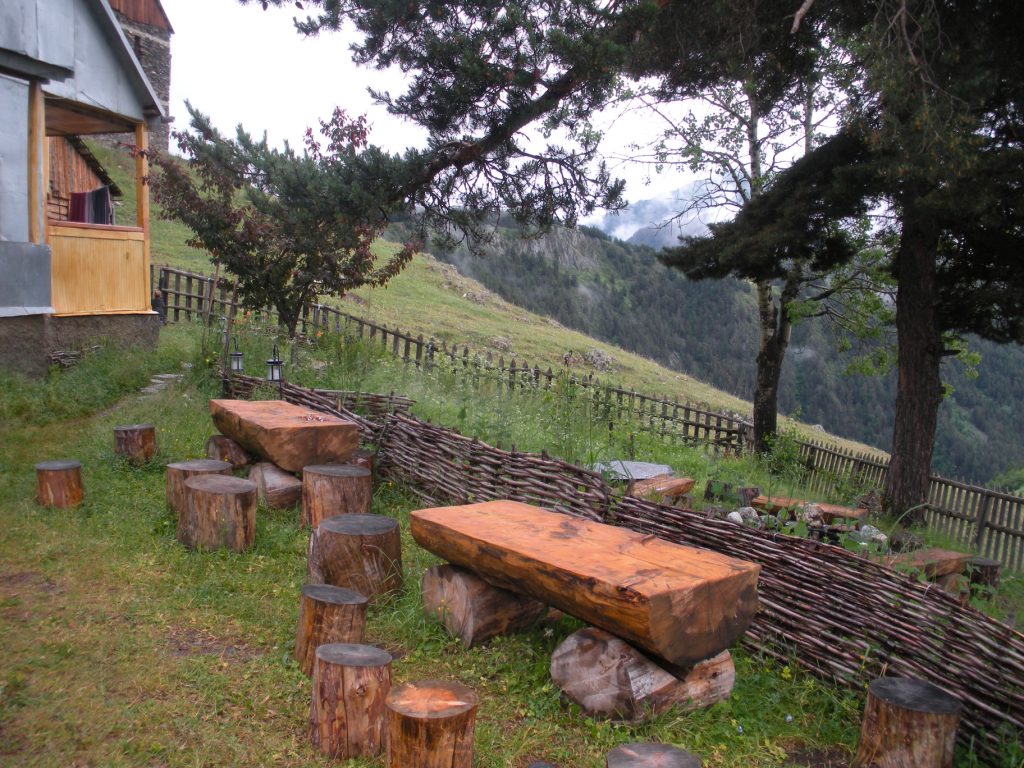
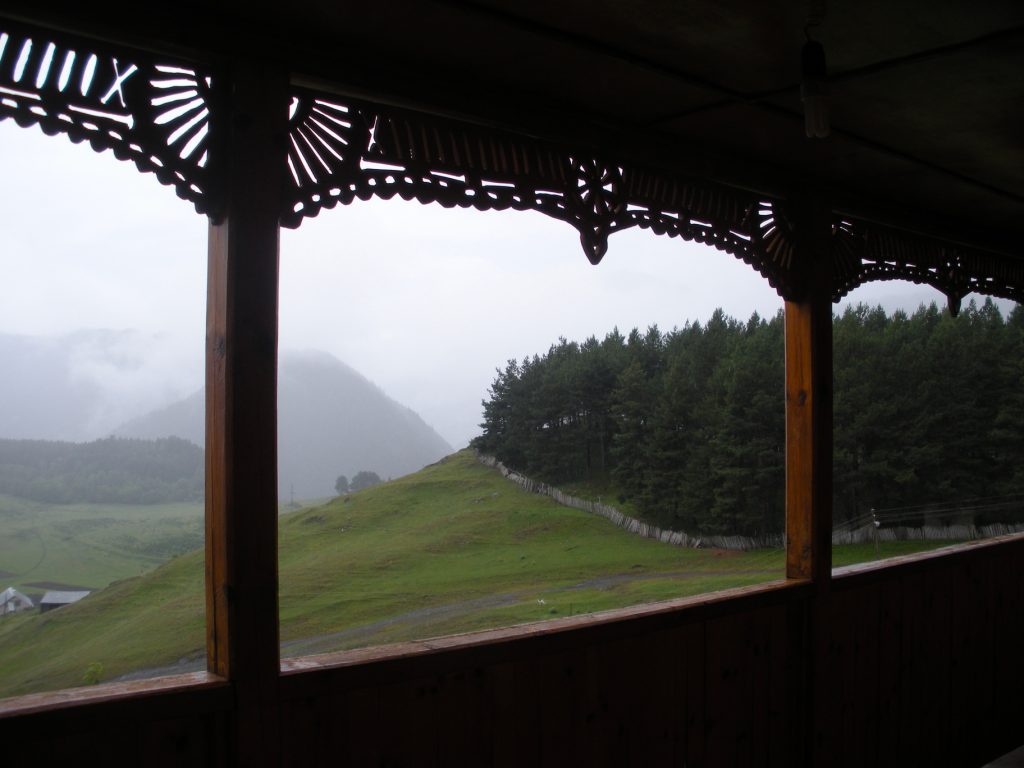
At 62 km the mountainside changes again to softer shale, monumental boulders thrown down from the heights, stacked on end and sheared off. Brown clay clouds the river, which widens and slows here, flowing smoothly with unbroken surface. At 64 km, a sign for Kumelaurta, about 15 houses stacked and scattered across a tiny valley above the road. Here the road is all soft dust, the low hillsides entirely barren. And then Omalo opens in a wide green valley, snow shines on the surrounding peaks, evergreens crowd the sides of the valley, and sighing meadows lie over every inch of semi-horizontal ground, profuse with wildflowers—white clover, pink vetch, blue gentians, bright butter-and-eggs. We stop before an unpromising collection of buildings–a rustic wooden house perches on a little knoll above the main complex, a geometric hodge-podge faced variously in stone, stucco, wood, and sheet metal that appears hand-rubbed with mustard stain. An old green Lada has died at the gate and piles of stone and wood lay about with no apparent purpose or design. Cow pies, from well-aged to fresh, are thick on the patchy turf. Nino greets us, a babe in her arms, and shows us to the rooms: up a steep open stair to a wooden porch, then through a door into an anteroom with two doors to the bedrooms and another door at the far end, which leads to the lavatory—a sink and mirror in a stone-floored breezeway—and the linoleum-floored bathroom beyond—a toilet and then the shower, separated by a flimsy white and blue shower curtain and a single strip of wood for a lip across the floor. I choose the bedroom with a view of the hill behind the house—twin beds, a handmade shelf between, an open cubby with four wooden pegs and one shelf, a bentwood chair and a tiny wooden stool. A single enviro-fluorescent bulb does for light; a socket will allow us to charge our phones and camera battery but not my netbook.
DAY TWO – Omalo, Shenako, Diklo
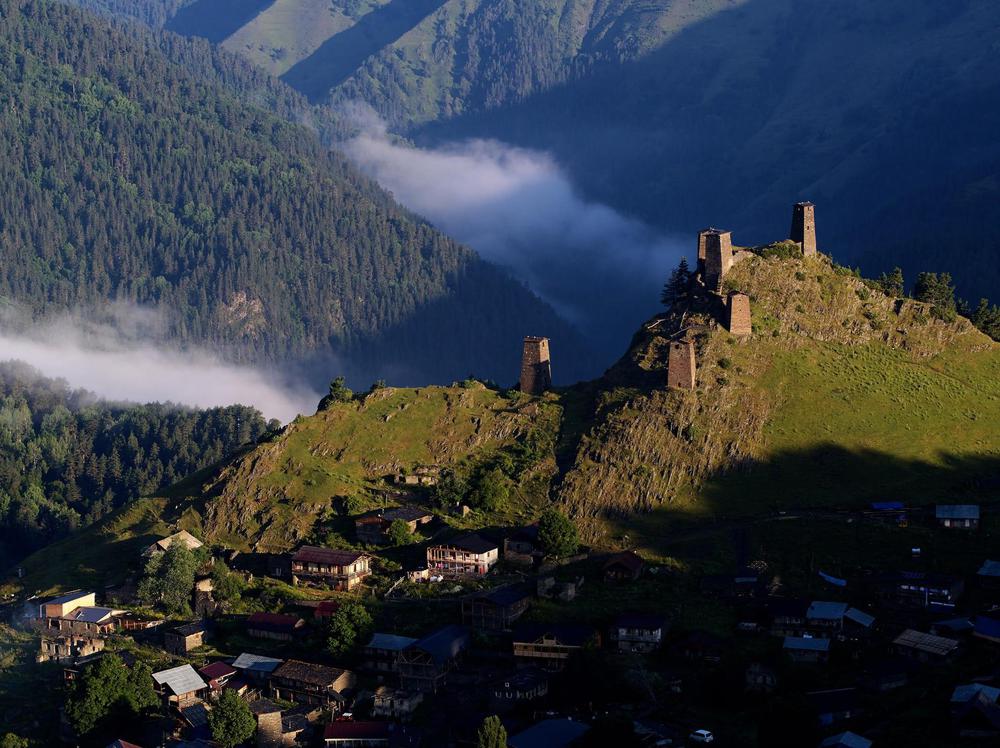
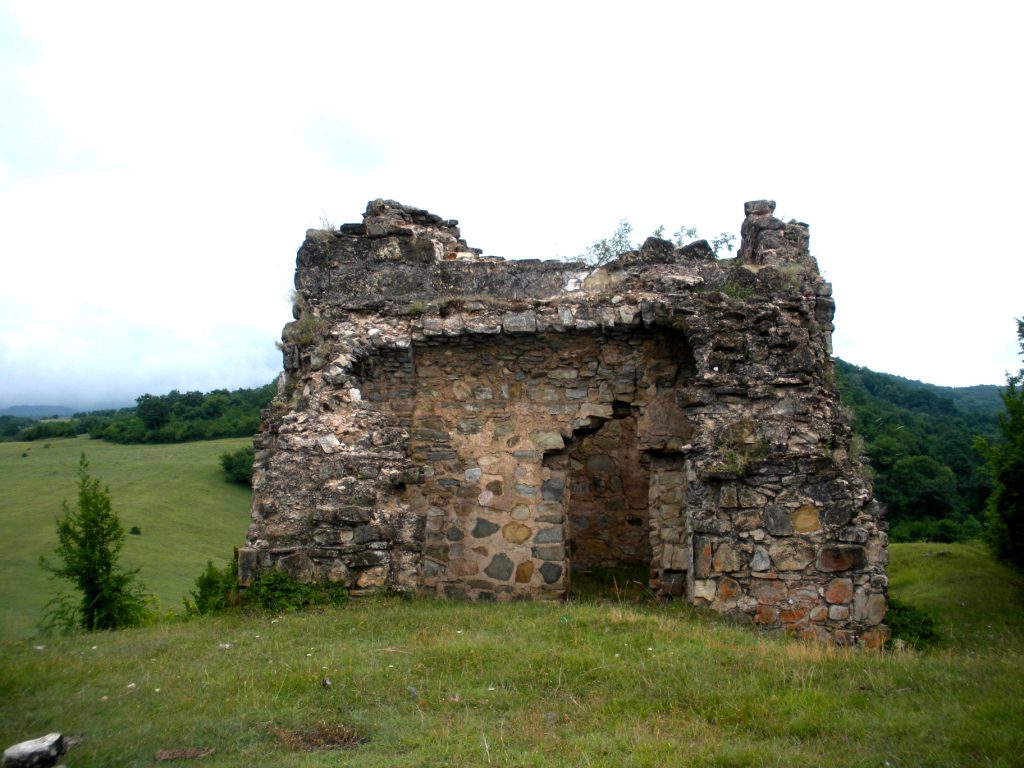
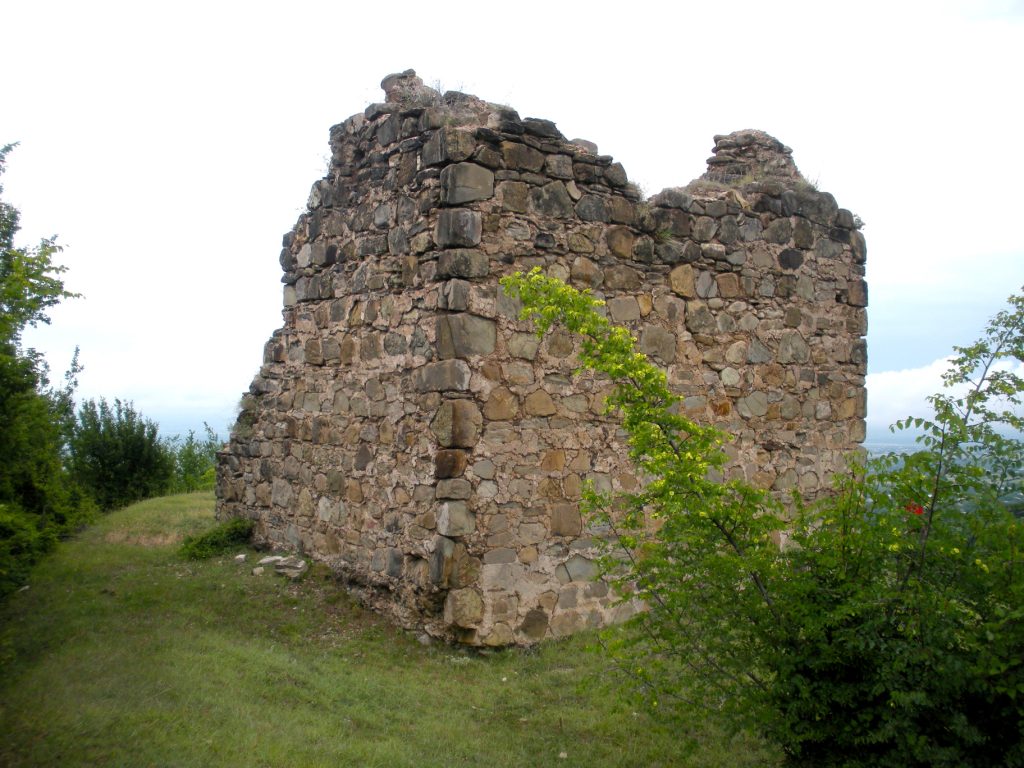
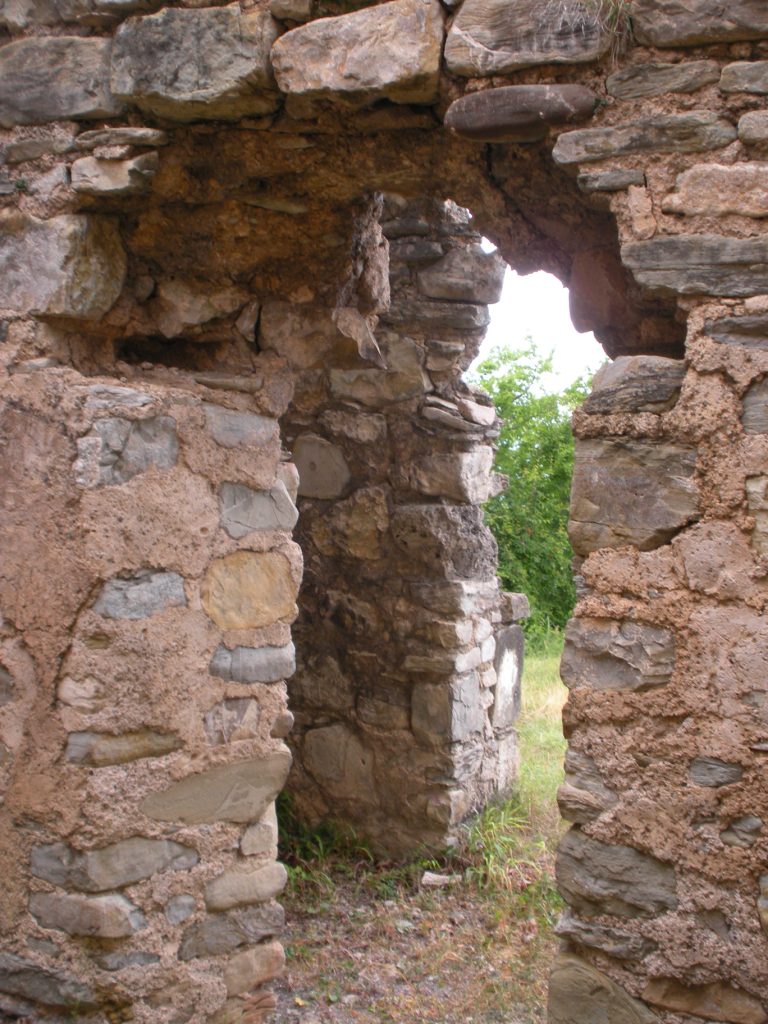
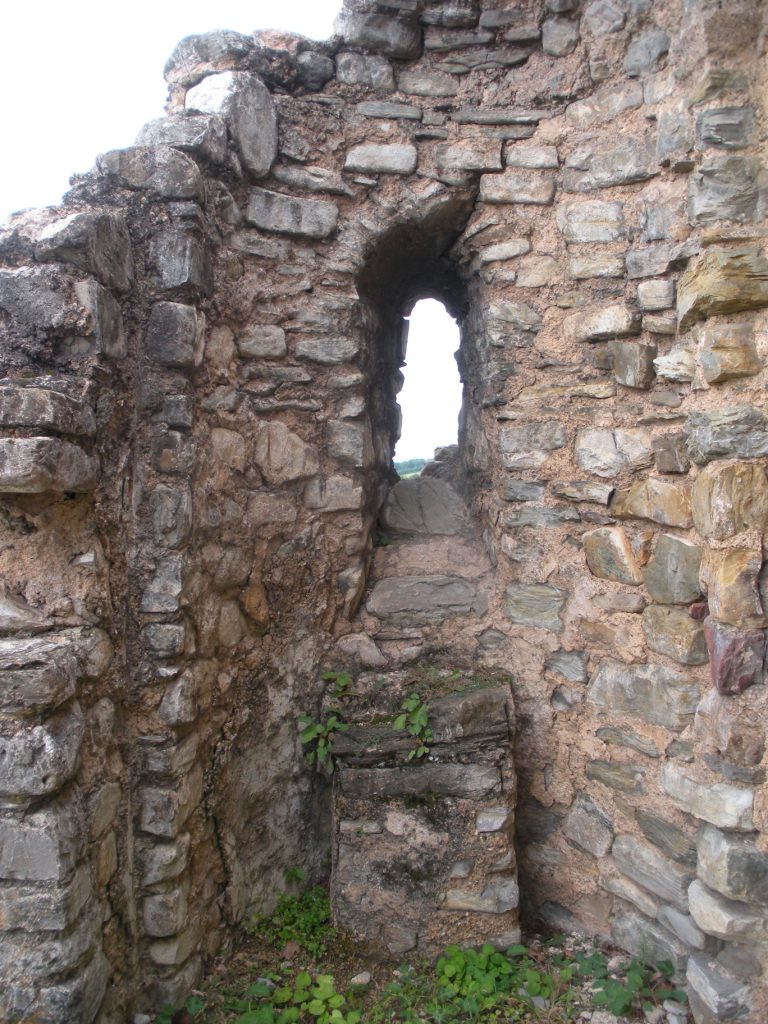
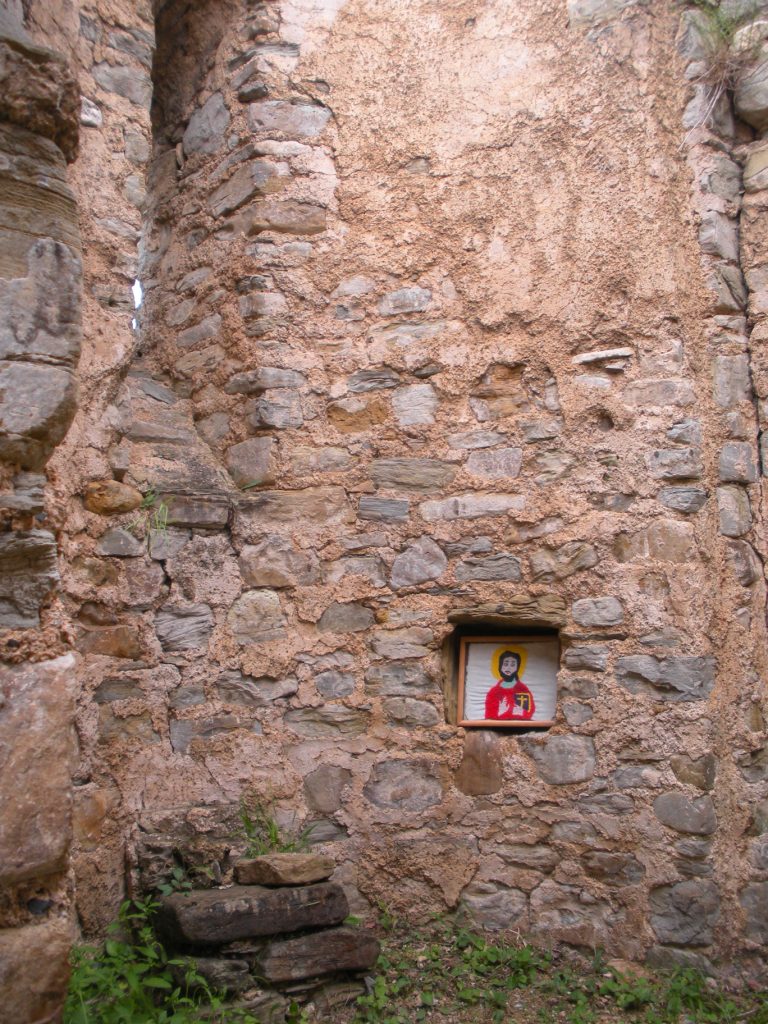
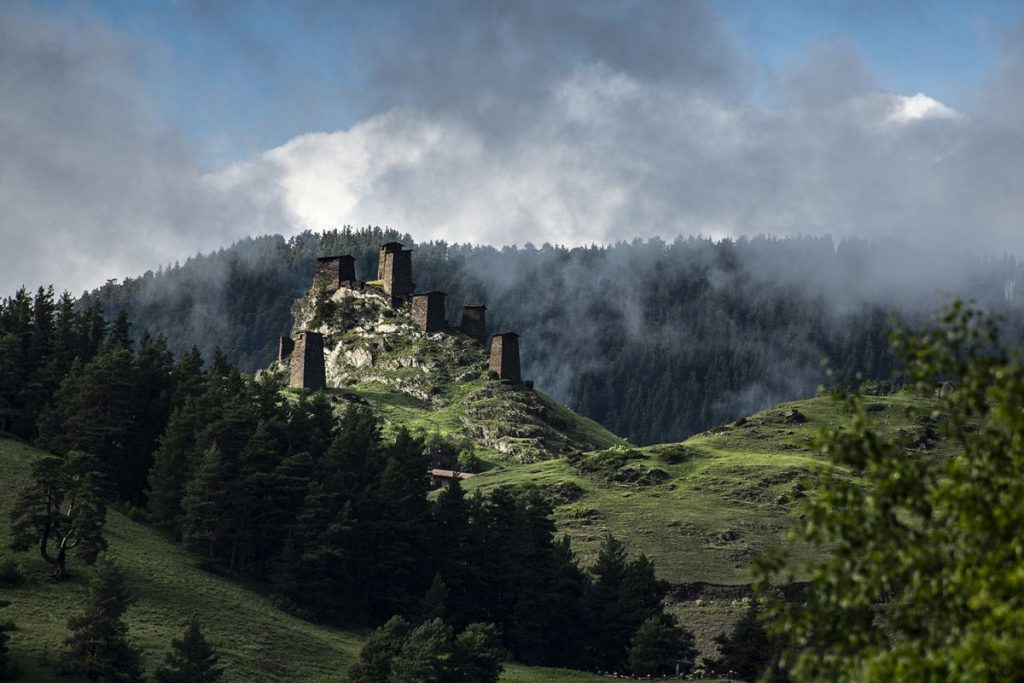
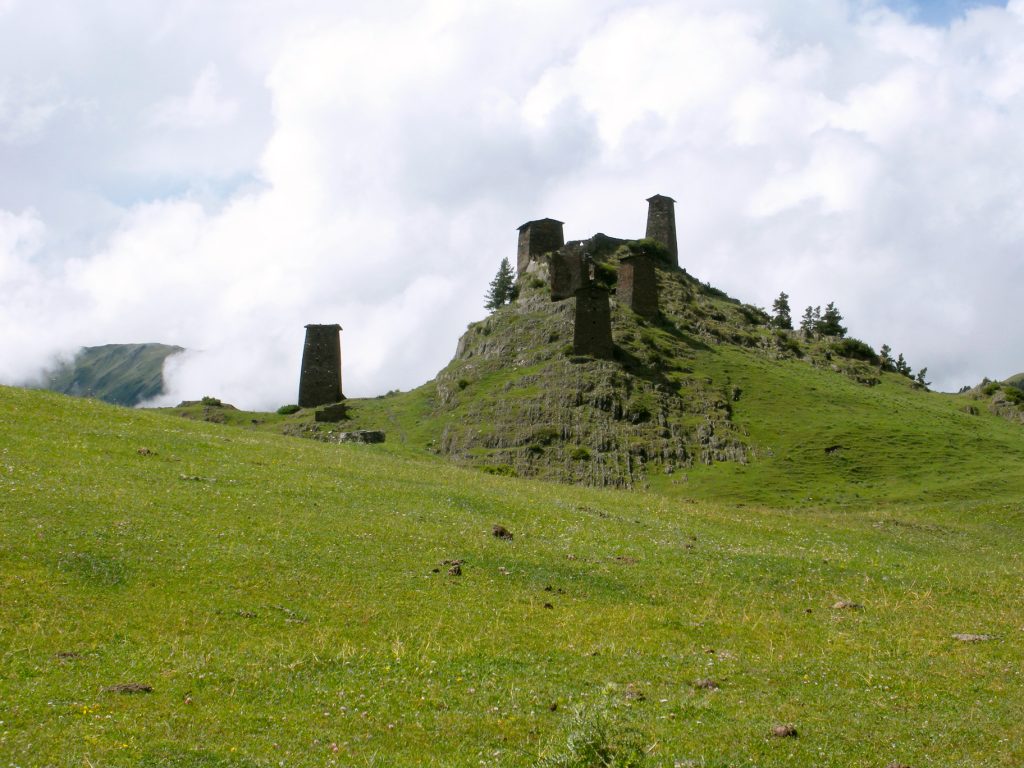
Omalo Castle towers above, constructed 13th century, reconstructed 2011 with Dutch funding. Brass plaque on a high tower, a slab of blue slate with graffiti: “Slovaks, Czechs, Gruzines;” “forever young, Ann.” Koba climbs straight up, we follow in what will become a pattern throughout the next four days—he scampers or strides ahead, rarely showing any sign of effort, while we trail behind, stopping to catch our breath, wiping sweat from our faces. I often take a couple of photos during these breaks, partly to save face, which is rather silly but a nearly involuntary show of solidarity with Jim, who suffers all the climbing, having spent the past nine months sitting long hours at a desk while I have rambled the streets and the heights of Tbilisi. Using a shard of slate, I scratch the date and our names, in Georgian letters, in a parapet stone.
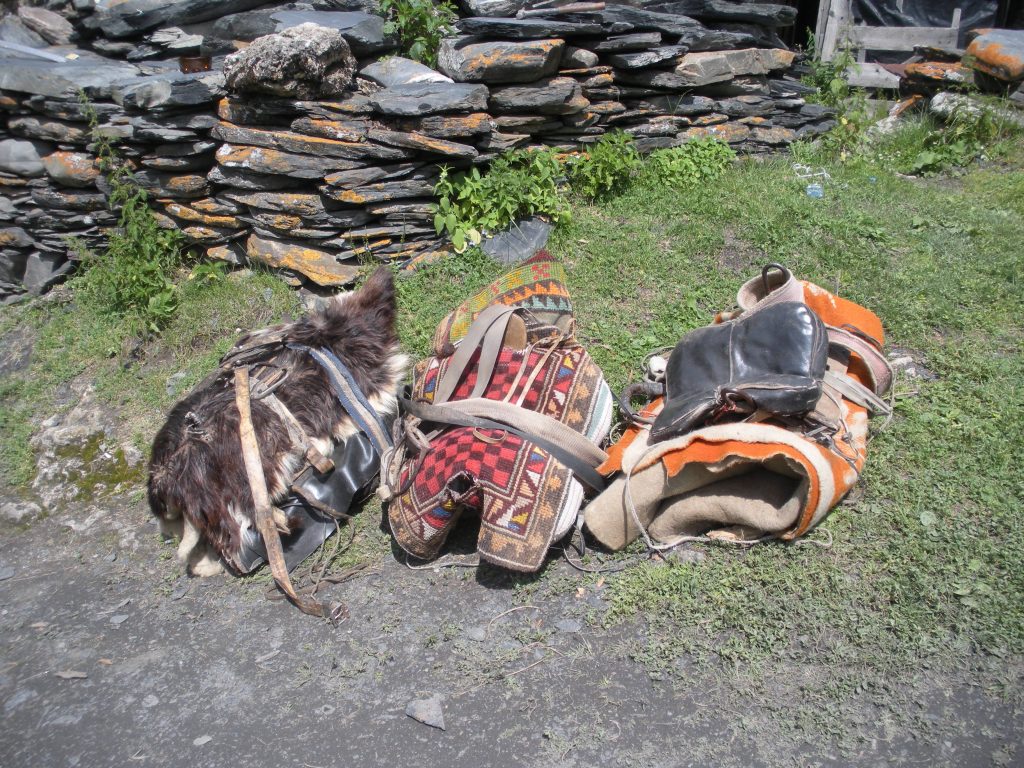
In Upper Omalo village new hotels, guest houses under construction. We meet a half-dozen or so Frenchwomen saddling horses for a trail ride today; then a five-day trek. One young Georgian woman coordinating all efforts, speaking French and Georgian with equal authority to tourists and to wranglers, hostelers, grooms preparing horses—shoeing, saddling. Thick black leather cushions atop traditional Georgian blankets and saddles with silver trimmings.
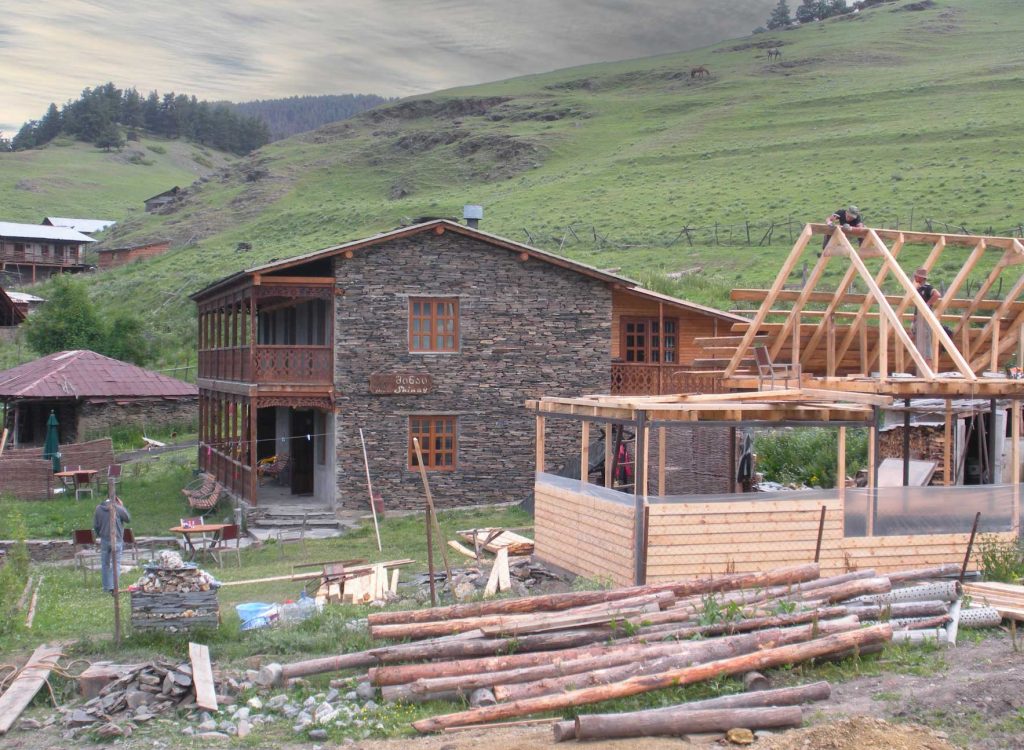
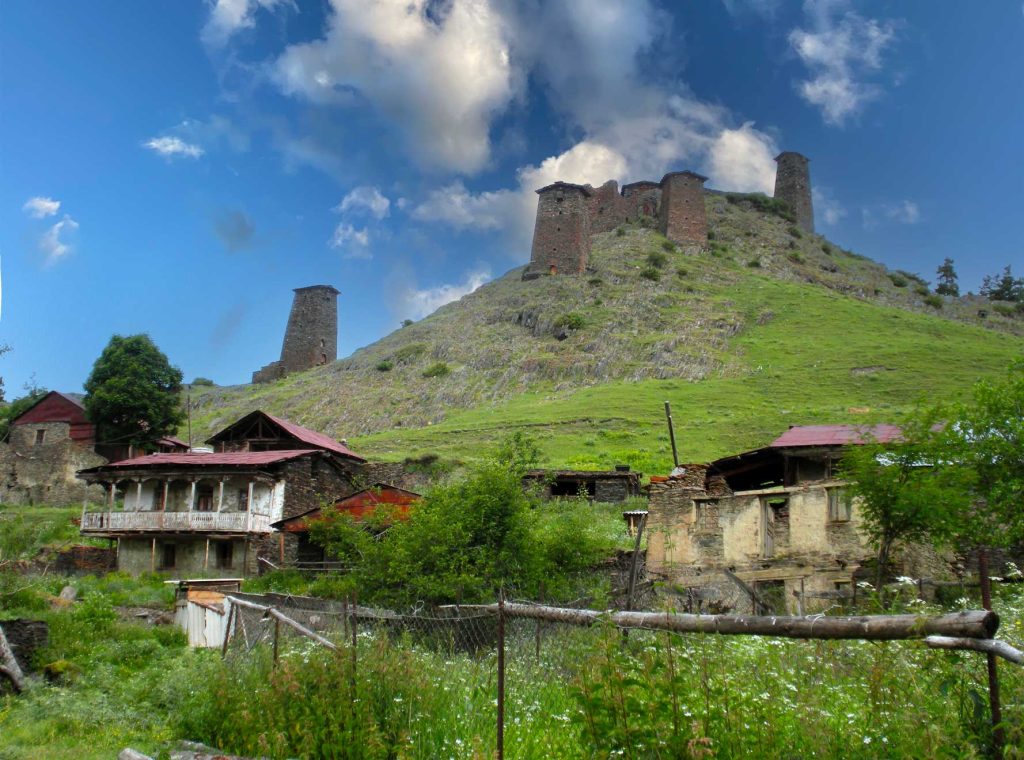
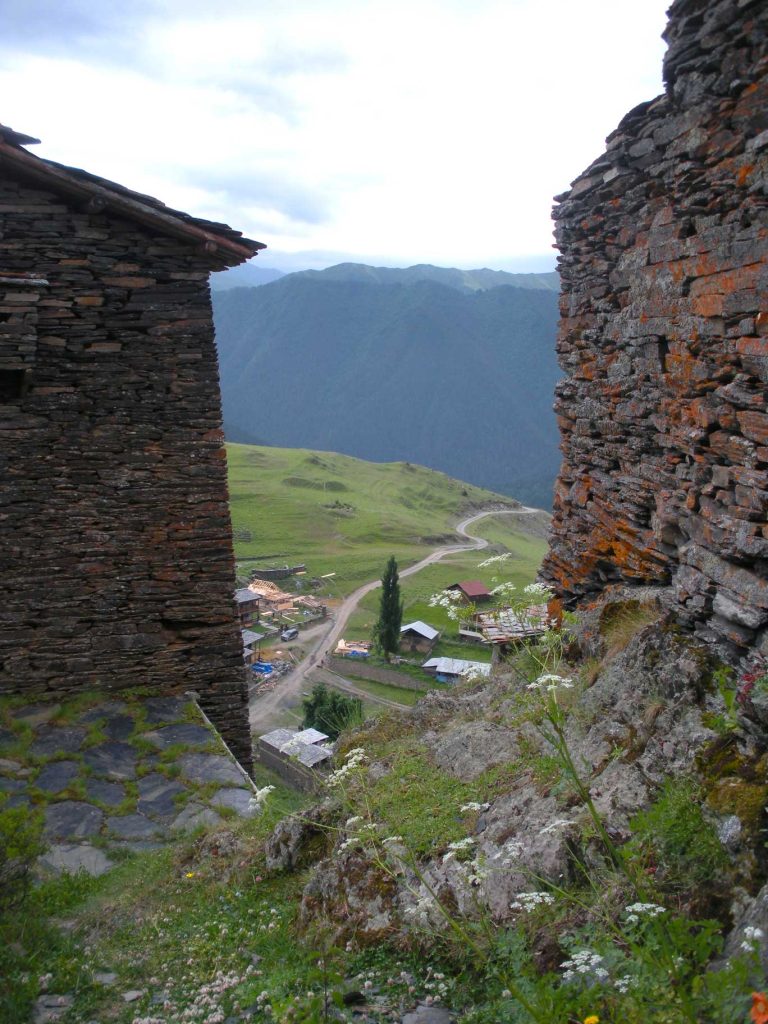
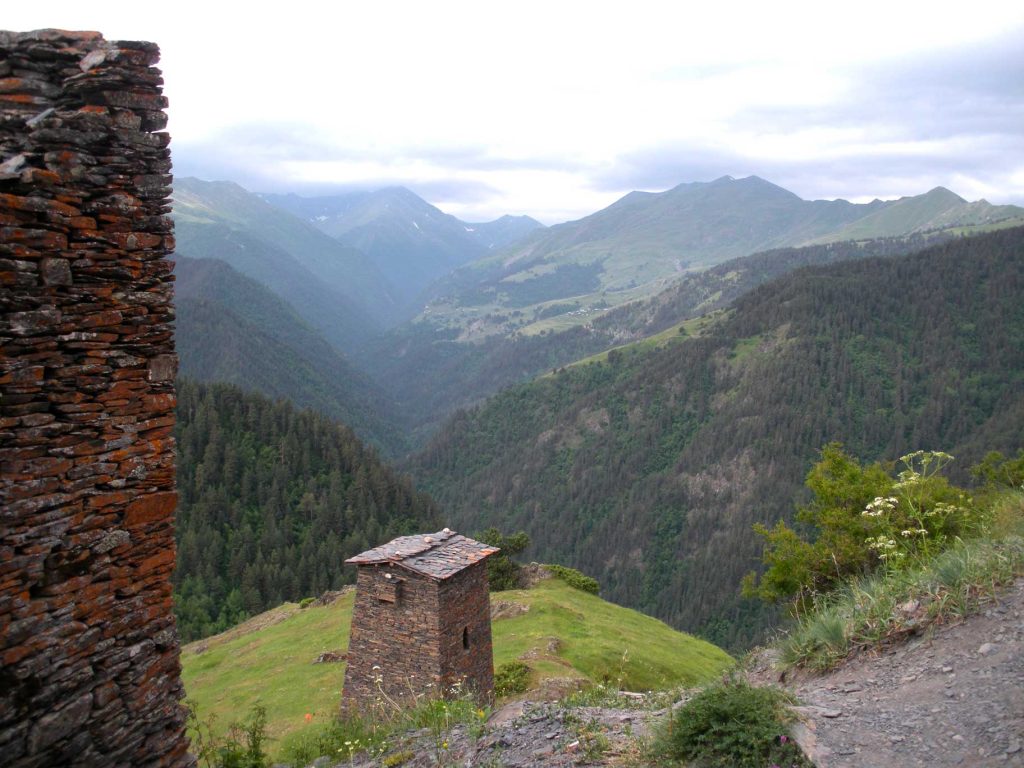
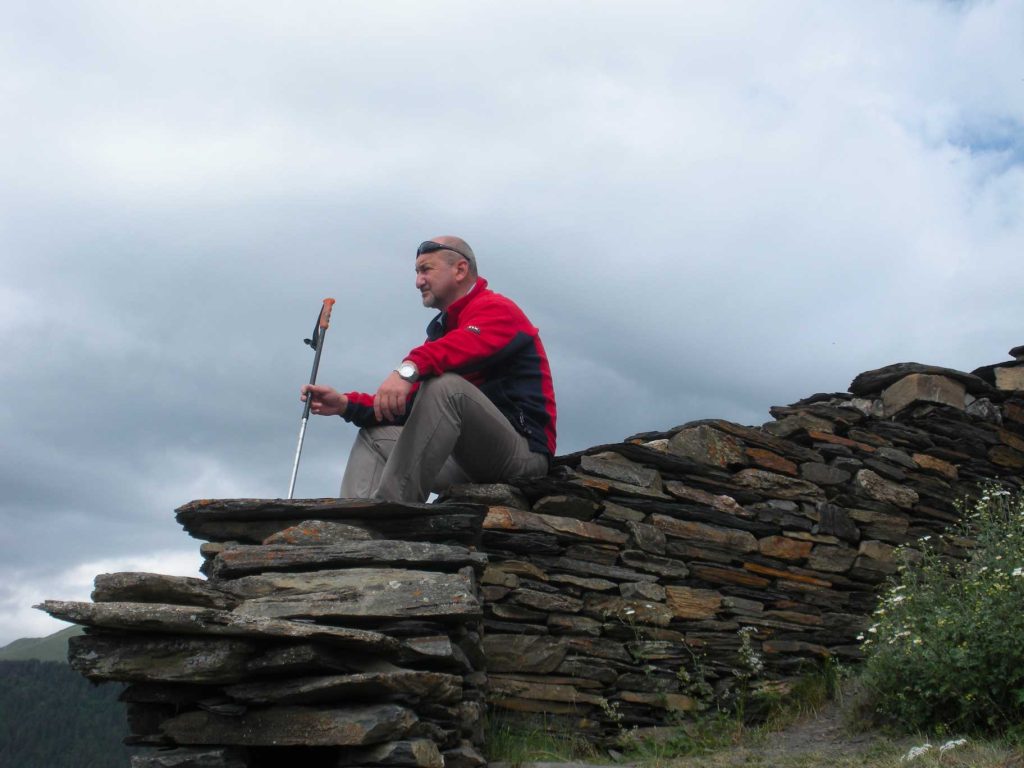
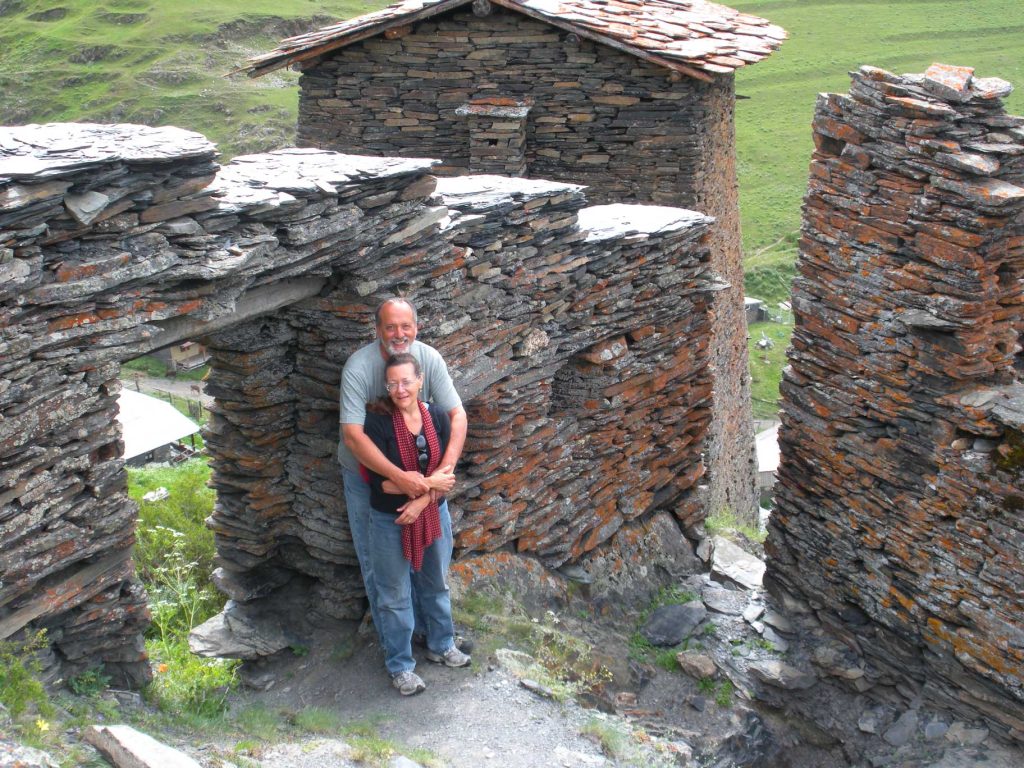
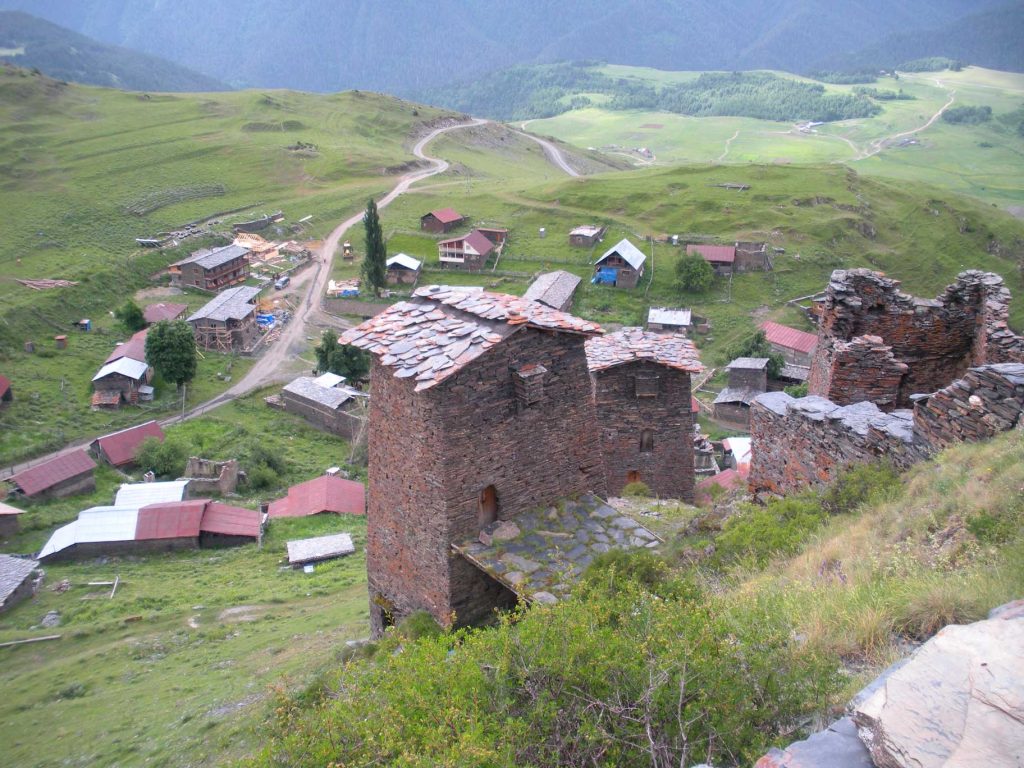
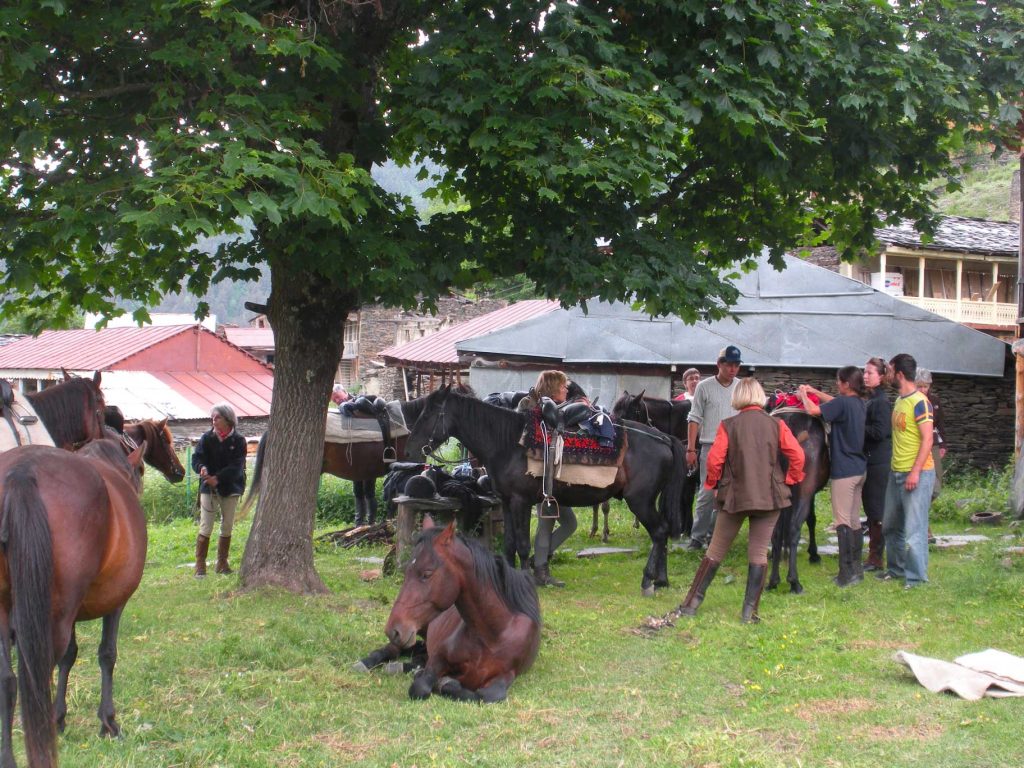
Driving down through dense forest to the river, deep ruts in the road, steep and narrow, dirt instead of rock and easy to imagine this impassable mud with just a little rain. New bridge of poured concrete, buttressed with wire cages of stone. It’s only a few years old; Koba used to drive through the river to reach Shenako. I am glad of the bridge, as the river is deep and fast and I would not like to drive through the rushing water. Then up out of the valley to Shenako. Smell of wild rose bushes thick in the woods.
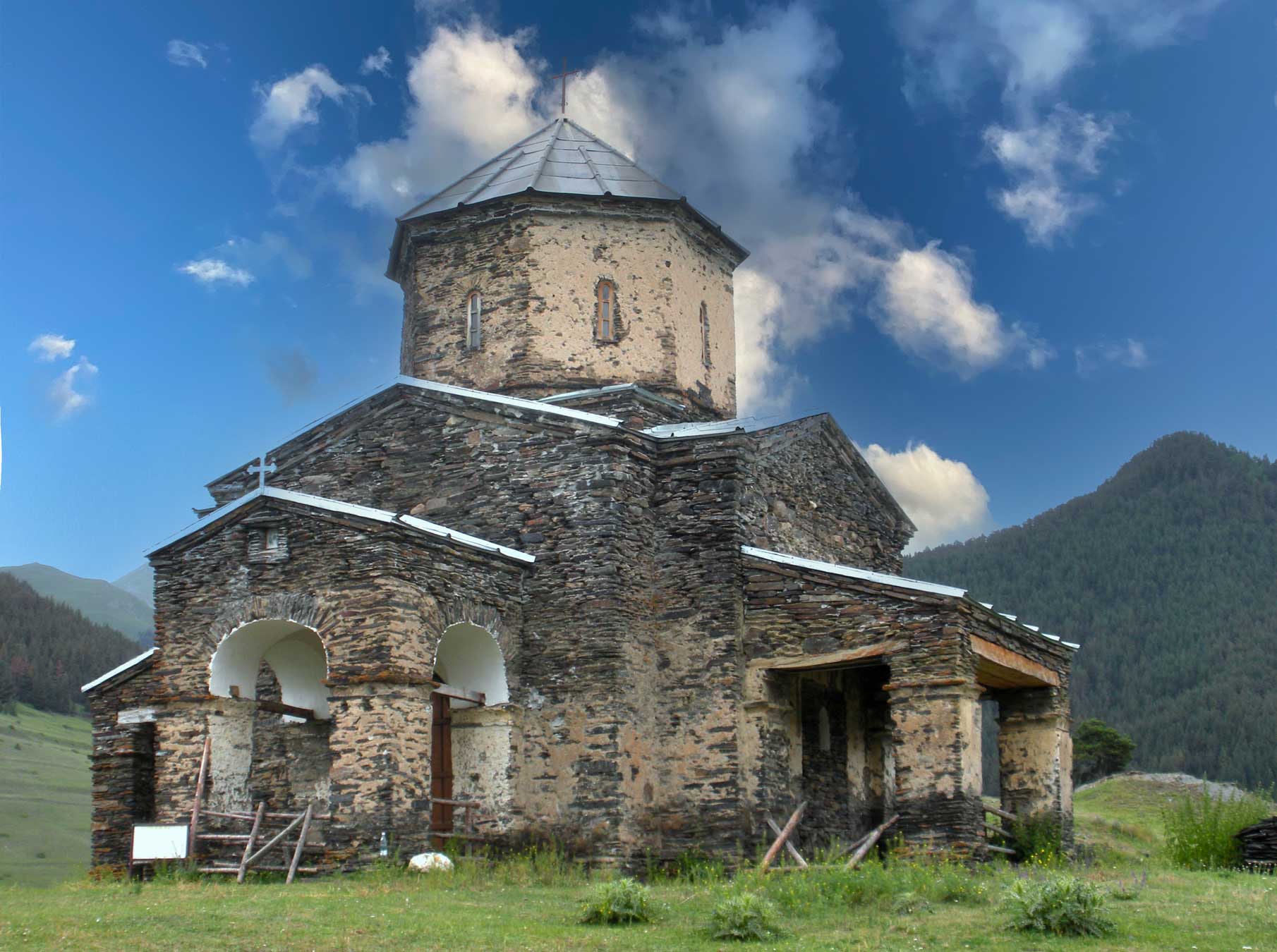
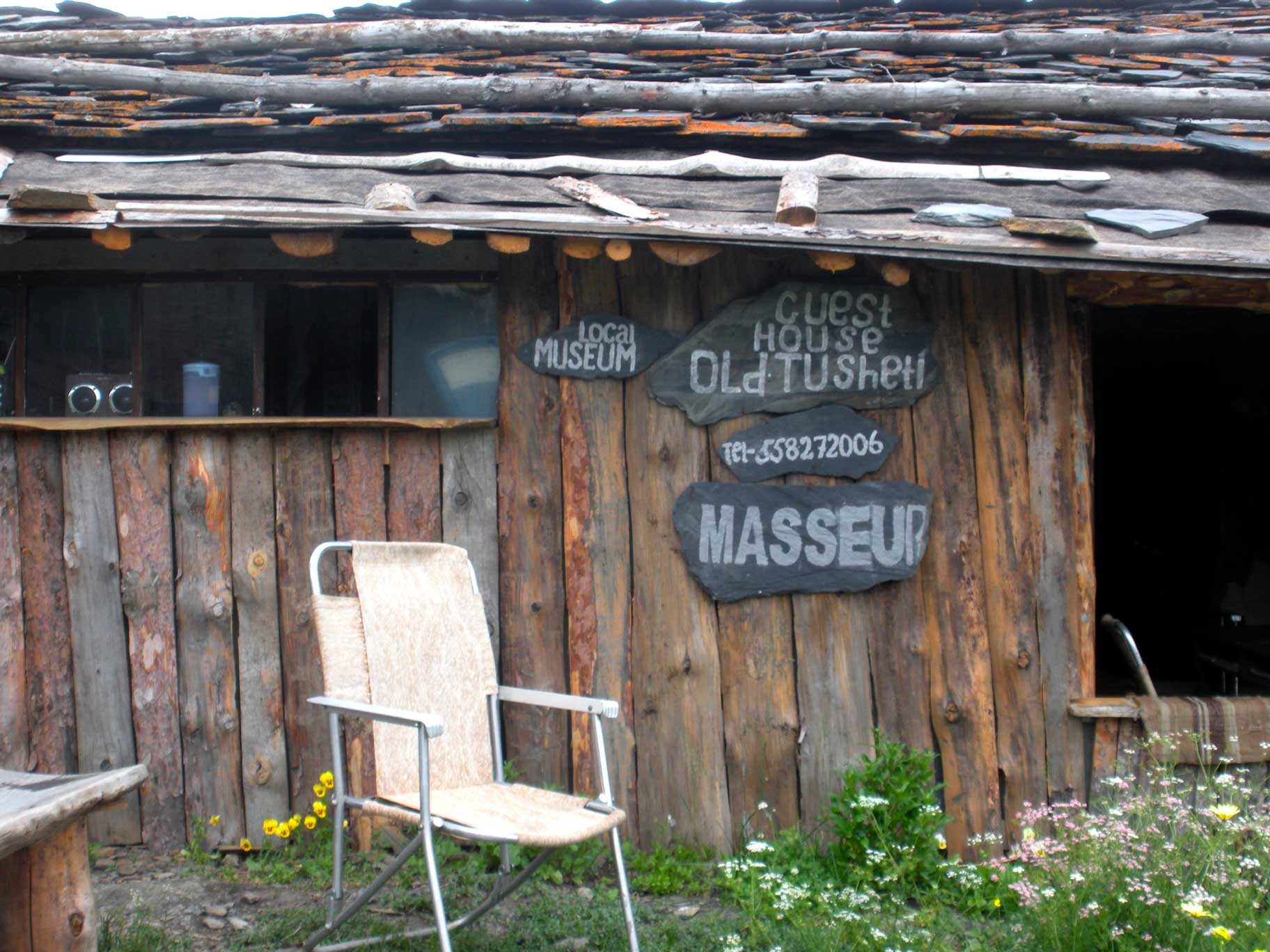
Leave car at church at Shenako (dedicated to Virgin? Annunciation?), stop at hotel to arrange lunch, which we will share with Nathalie Grolleman (a friend from Internatl Women’s Assn) and her family. We buy two hats—mine a hand-knit red cloche, Jim’s traditional Tusheti “bowl” hat of grey felt with black braid trim and tiny tassle on a string from the crown. Hotel-keeper is herbalist, bread-baker, masseur, and will prepare our lunch himself.
Steep walk out of village along narrow dirt paths bordering yards, gardens, hen houses. Road to Diklo climbs fast in places, less steep in others but at all times uphill. We are working hard and lagging behind Koba, who steps lightly along. Good weather for walking—cool and overcast, just a sprinkle of light rain now and then. Evidence of light logging in forest on our left; on our right green, turf-covered slopes where cows are grazing.
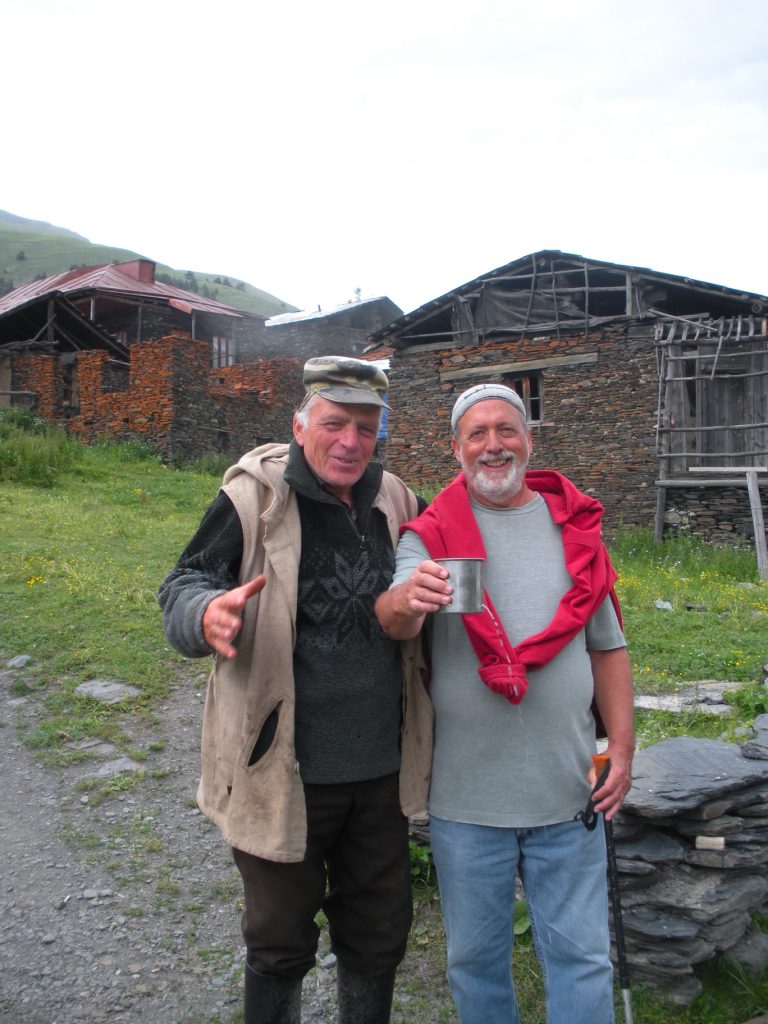
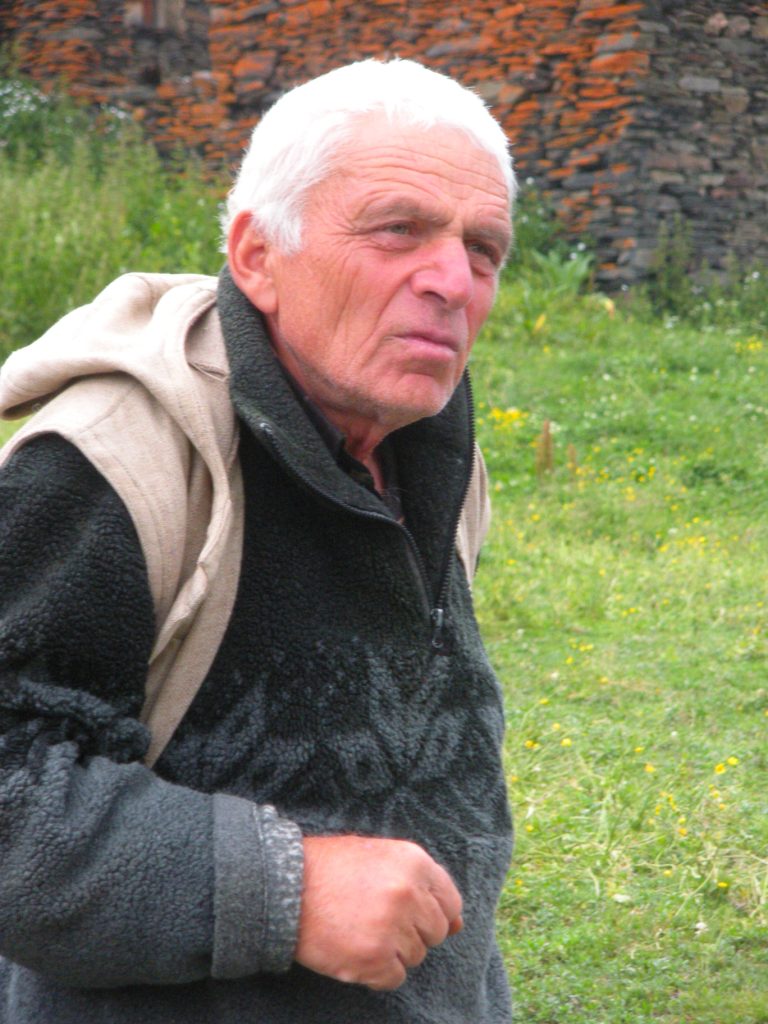
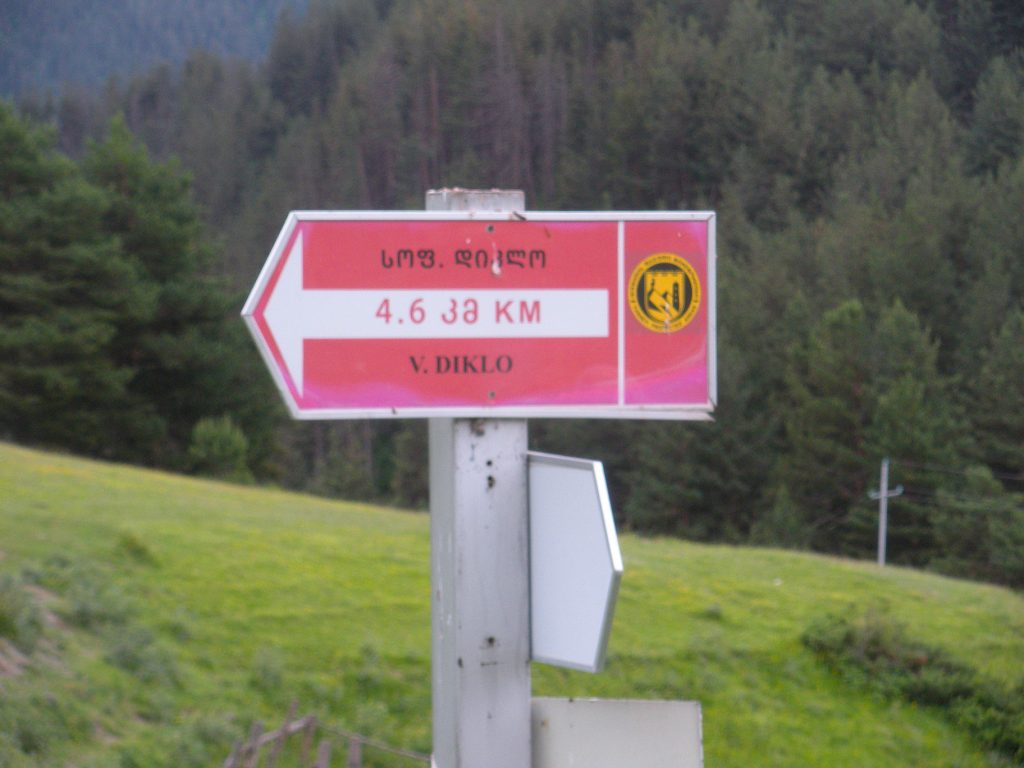
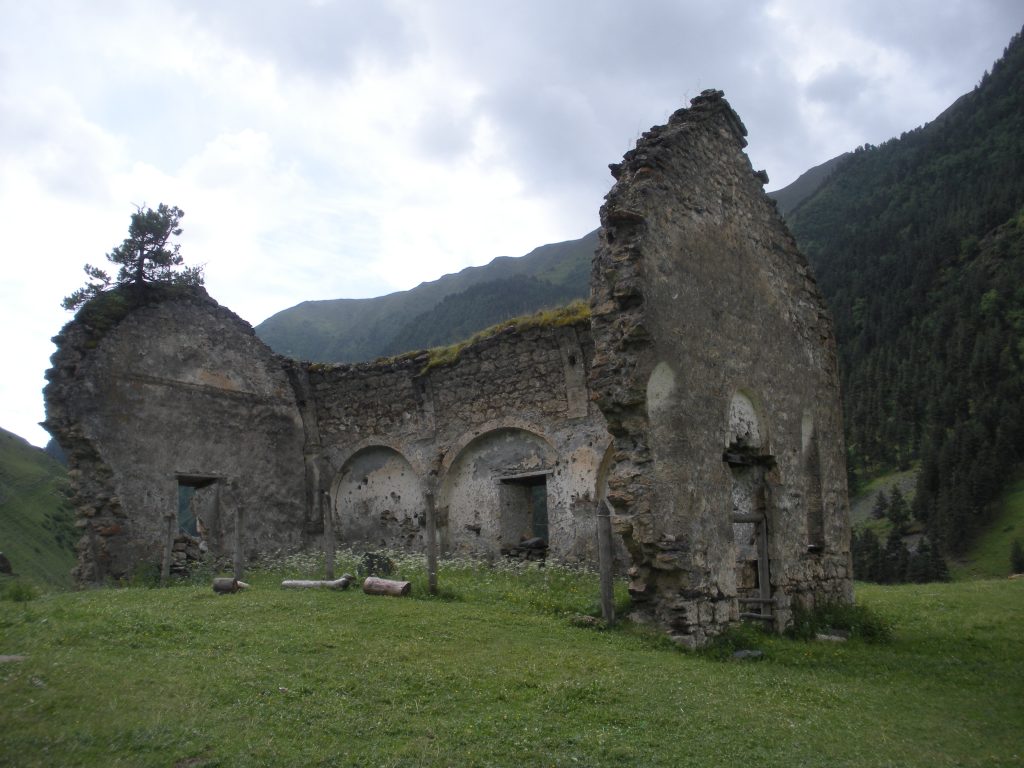
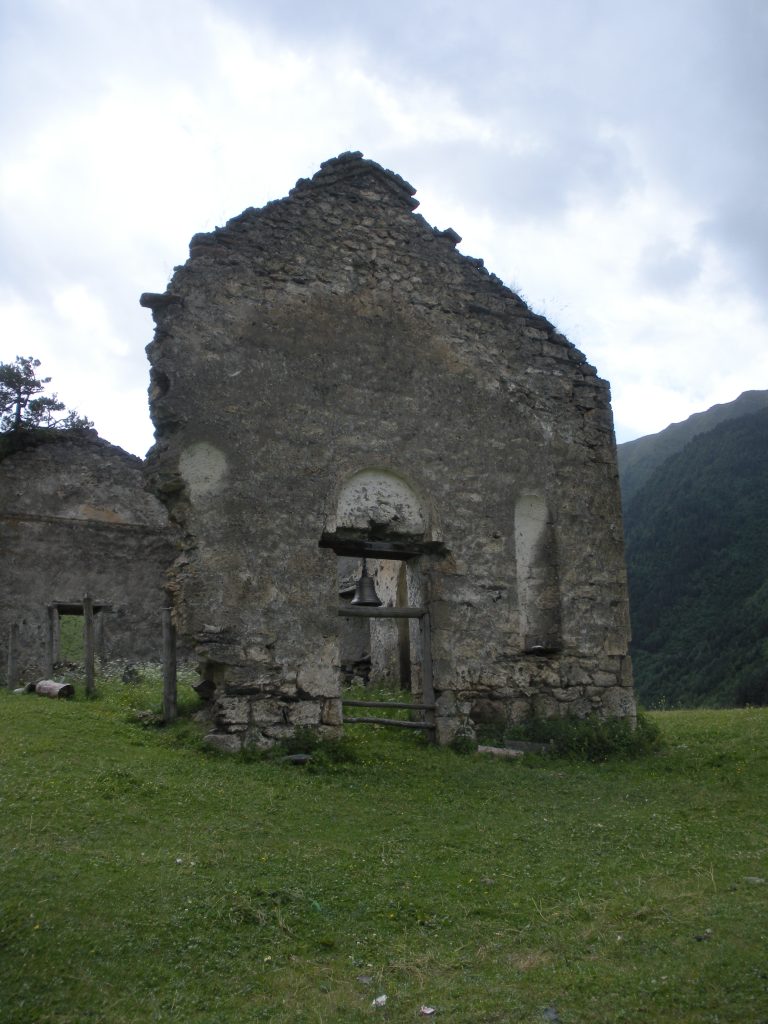
At Diklo we meet Kristofor, keeper of a pump that pipes icy fresh water into two hollowed-log troughs. K’s former profession was engineering milking systems, now he is unofficial caretaker of what remains of the village. While we share sweet water from a battered tin cup, he tells us 60-70 families once lived here the year around, winters with up to three meters of snow, temperatures of 20 -40 below zero. They shoveled snow from roofs to stop them collapsing. Today the place seems deserted, we enter through a gate and wander about, Koba talks with two men just inside. So close to the border, Koba tells us later, there’s always a chance of incursions by Chechen rebels or other troublemakers.
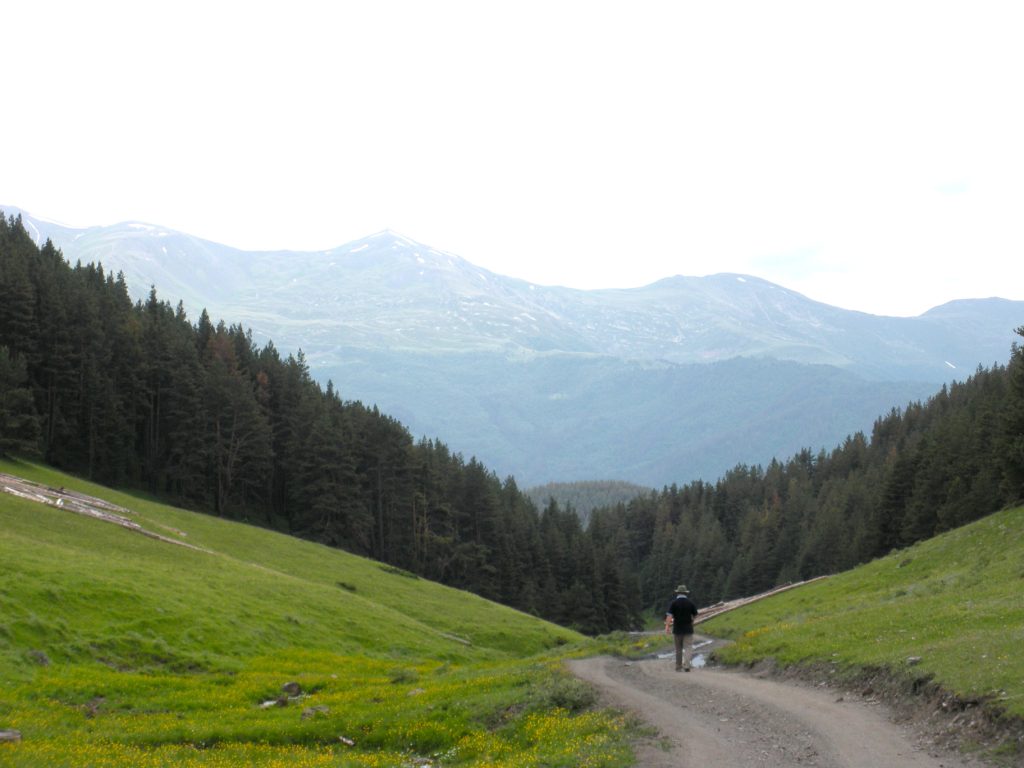
Back toward Shenako and lunch, the hour’s walk is easier, music of the stream running alongside.
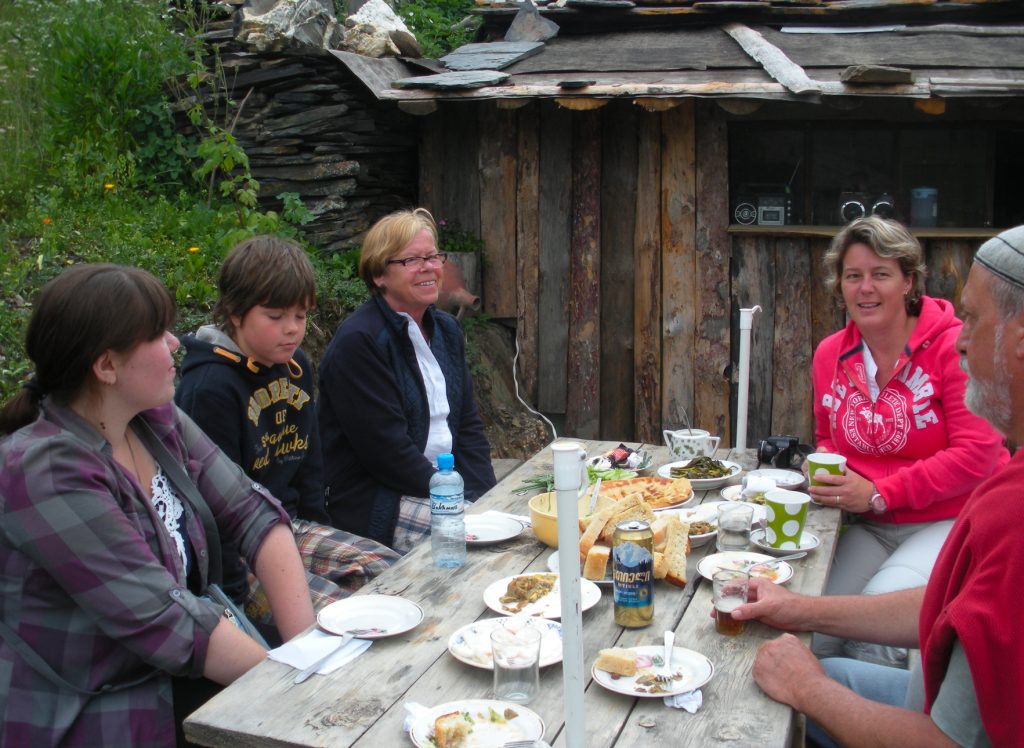
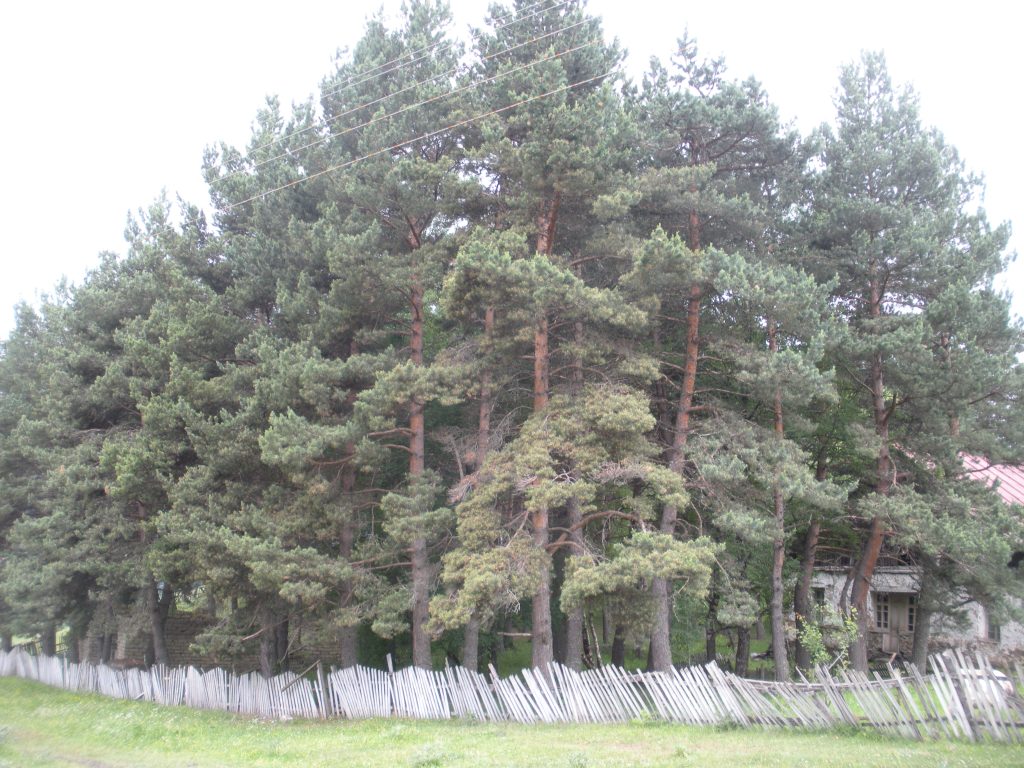
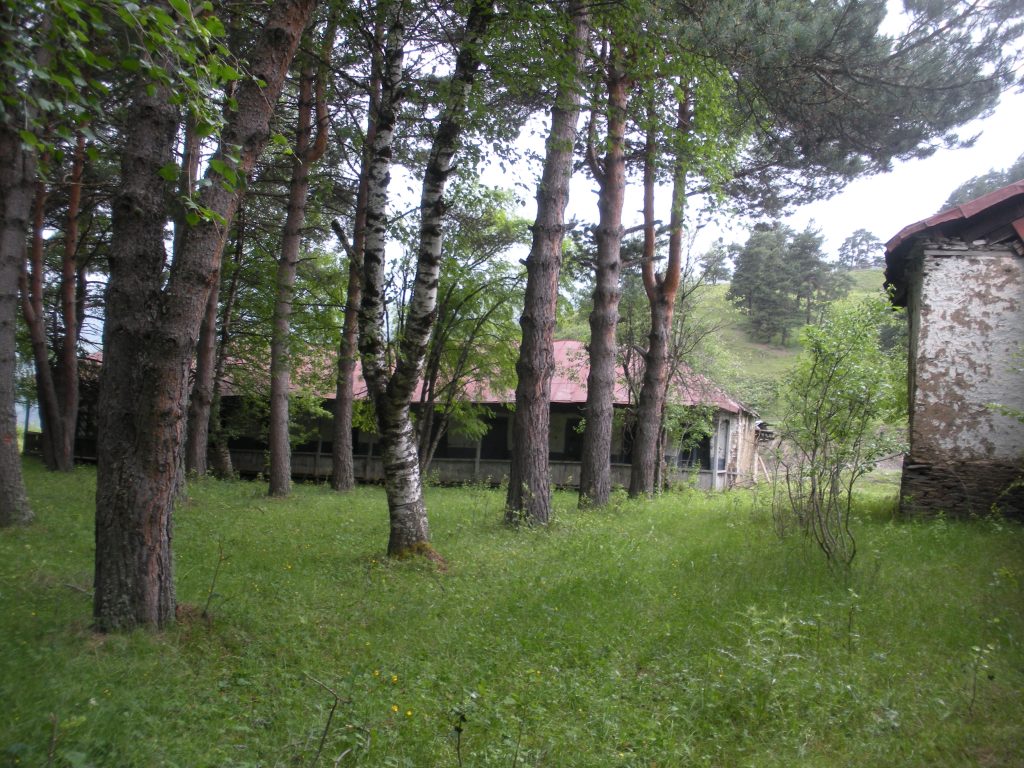
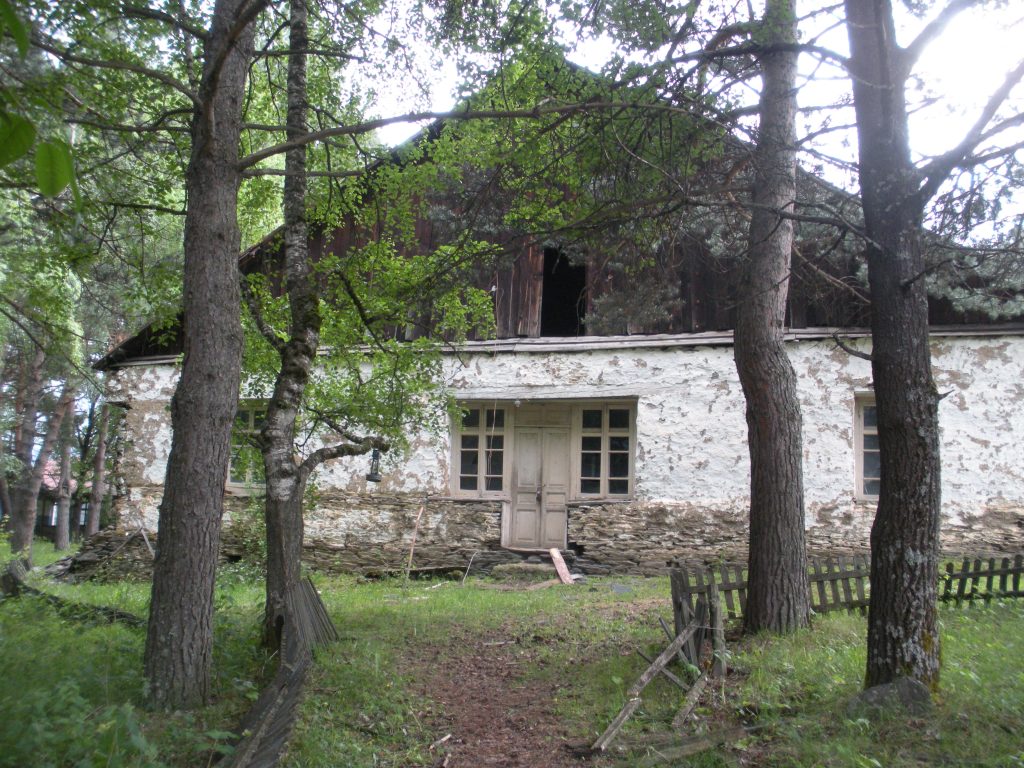
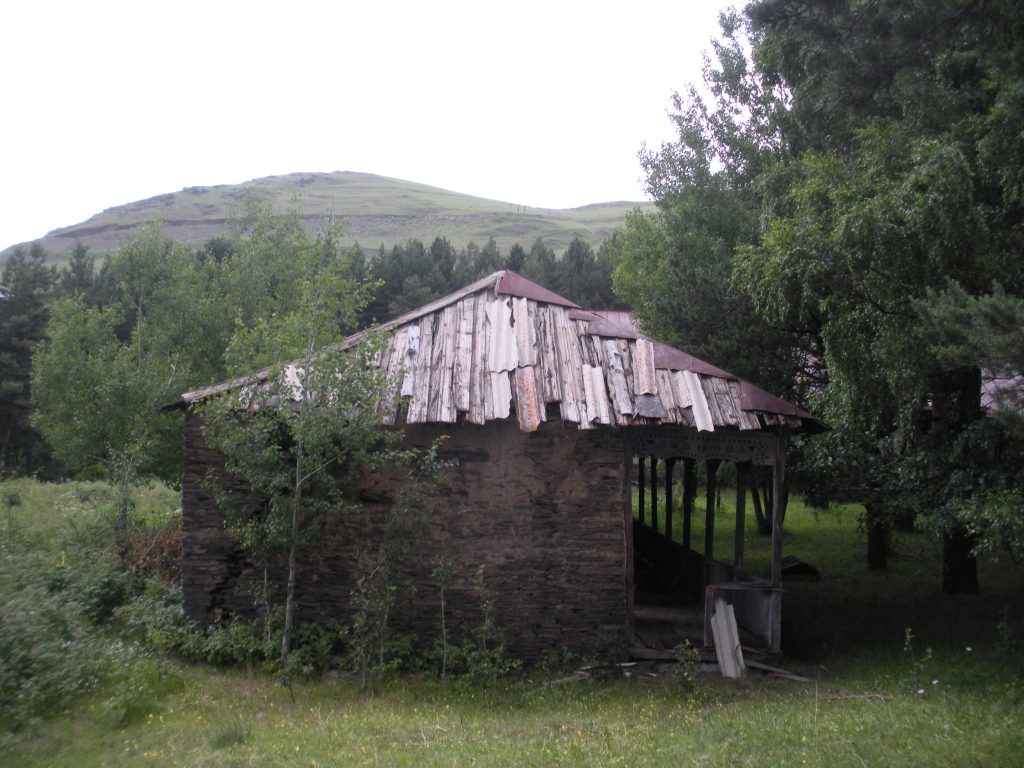
“Home” again at Omalo by 3 pm, we crash—a two-hour nap. We shower, have dinner, walk in nearby pine forest to find two huge, empty Soviet-era buildings—main lodge, other classrooms? School, camp, artists’ retreat? Must ask Nino. Clouds rising all around, raining again. Koba says no horse trek tomorrow to Dartlo.
DAY THREE – Omalo, rained out
Cold and damp, breakfast 8 am, chat with Koba, go back to bed to read and nap until 11:00. Down to kitchen where we join the family and assorted shepherds for tea—Omari, Roland, and three others eat cheese, bread, jam, and khatchapuri that Nadia has warmed over. I play with baby Nino, Omari goes and the three men walk downhill as rain begins again.
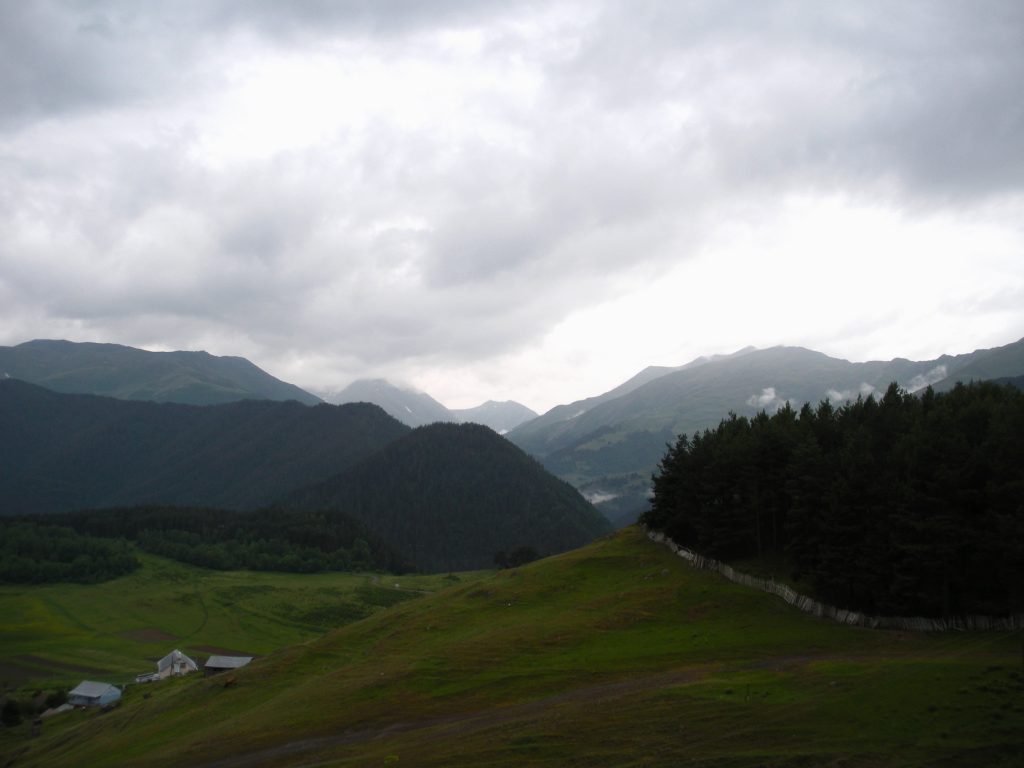
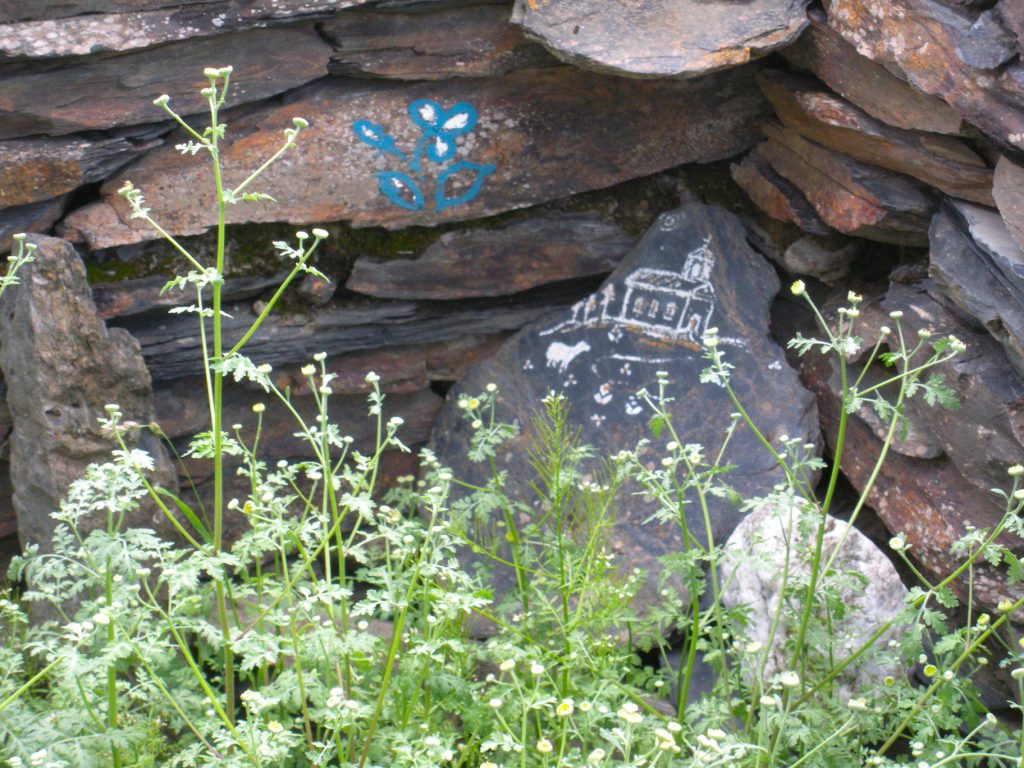
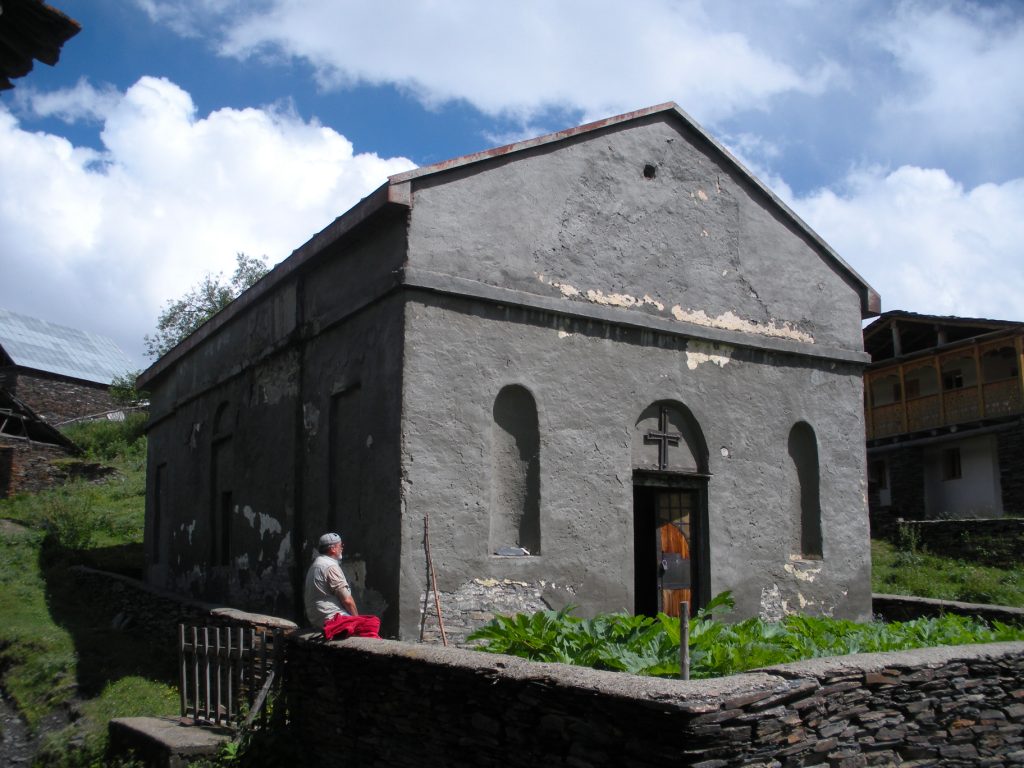
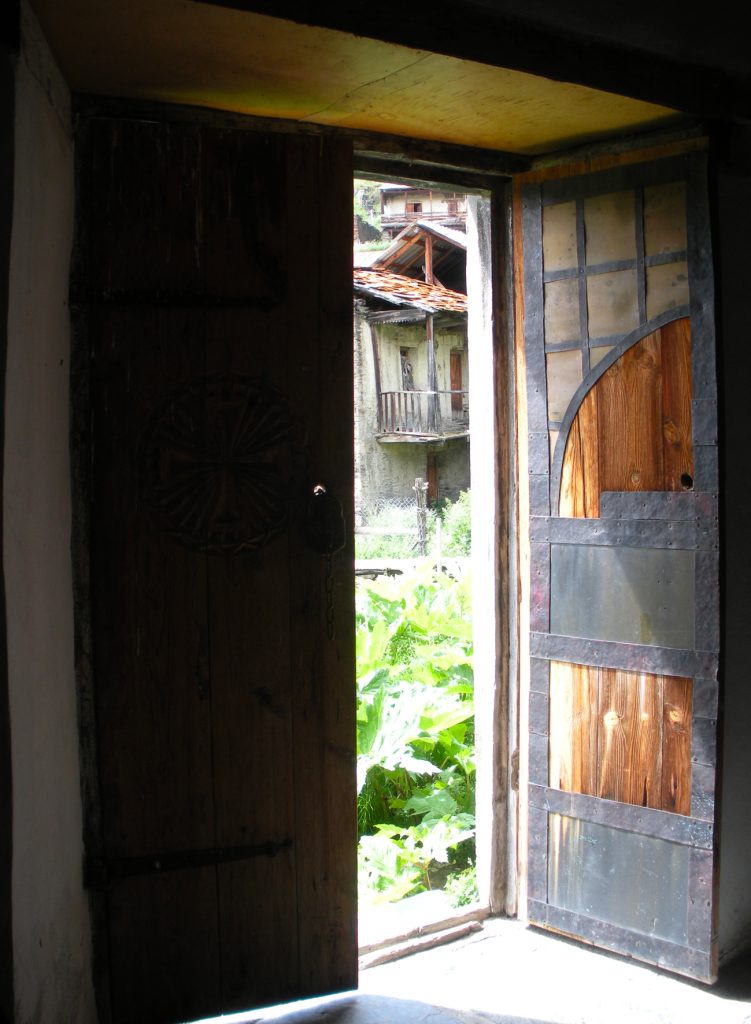
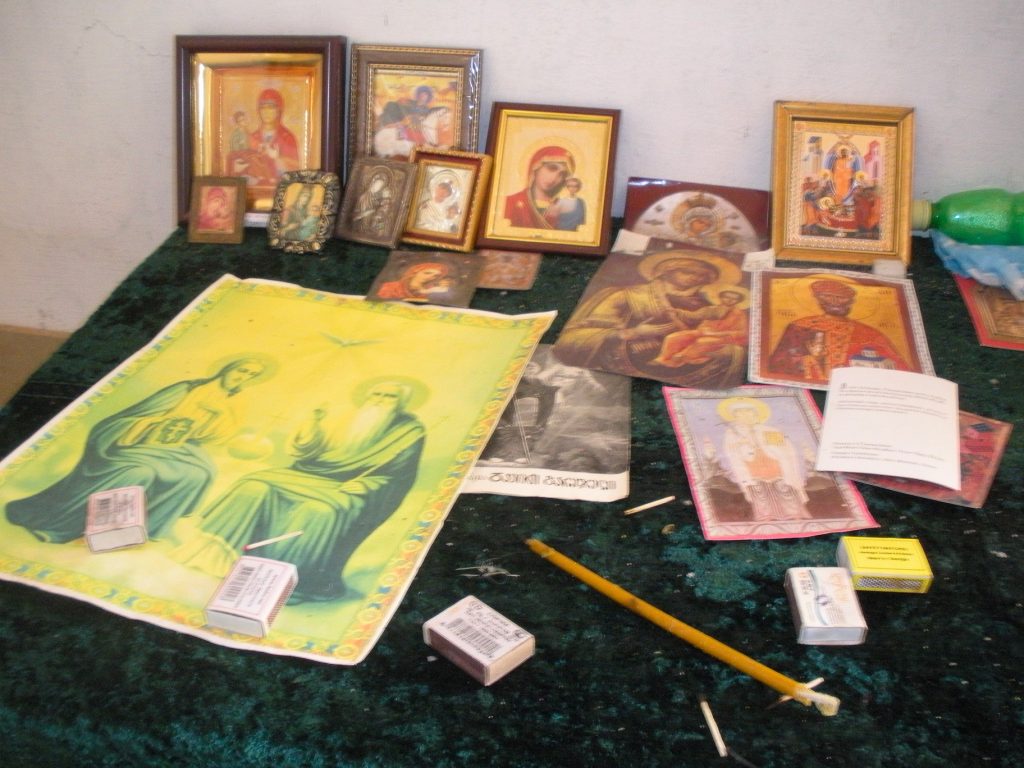
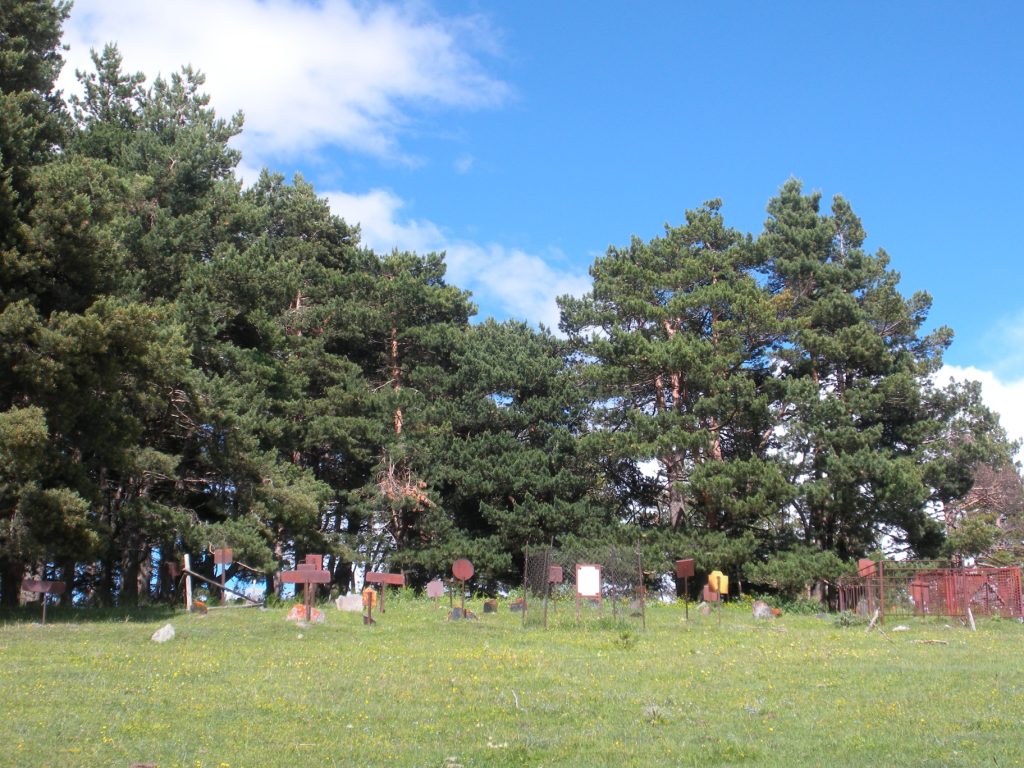
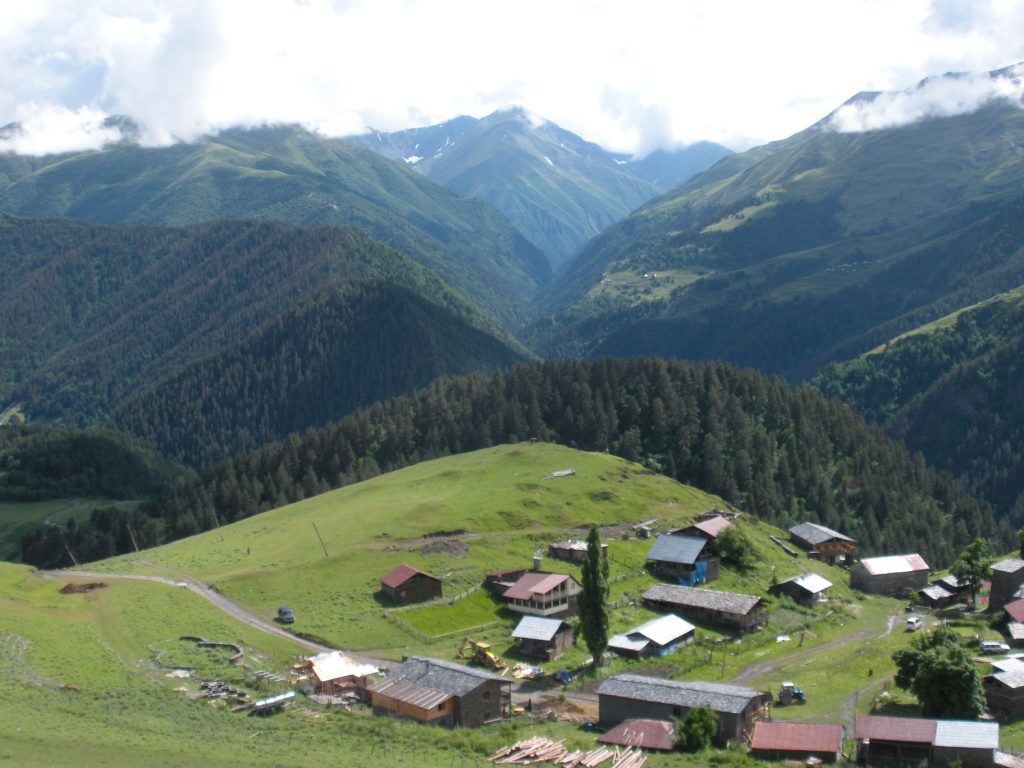
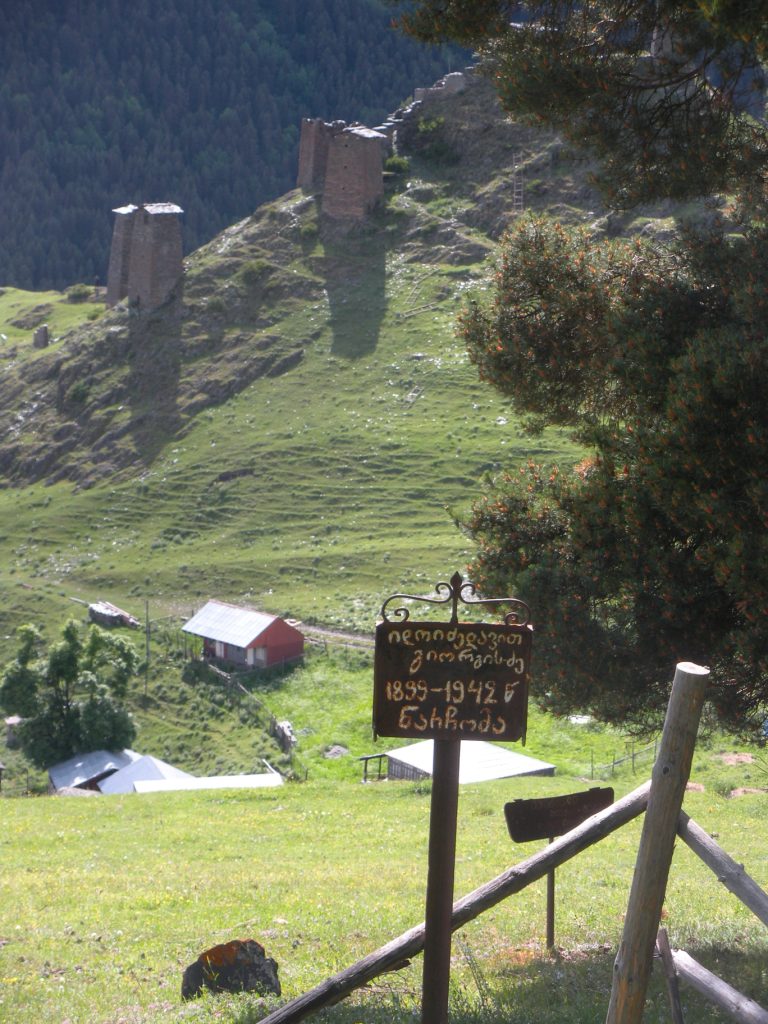
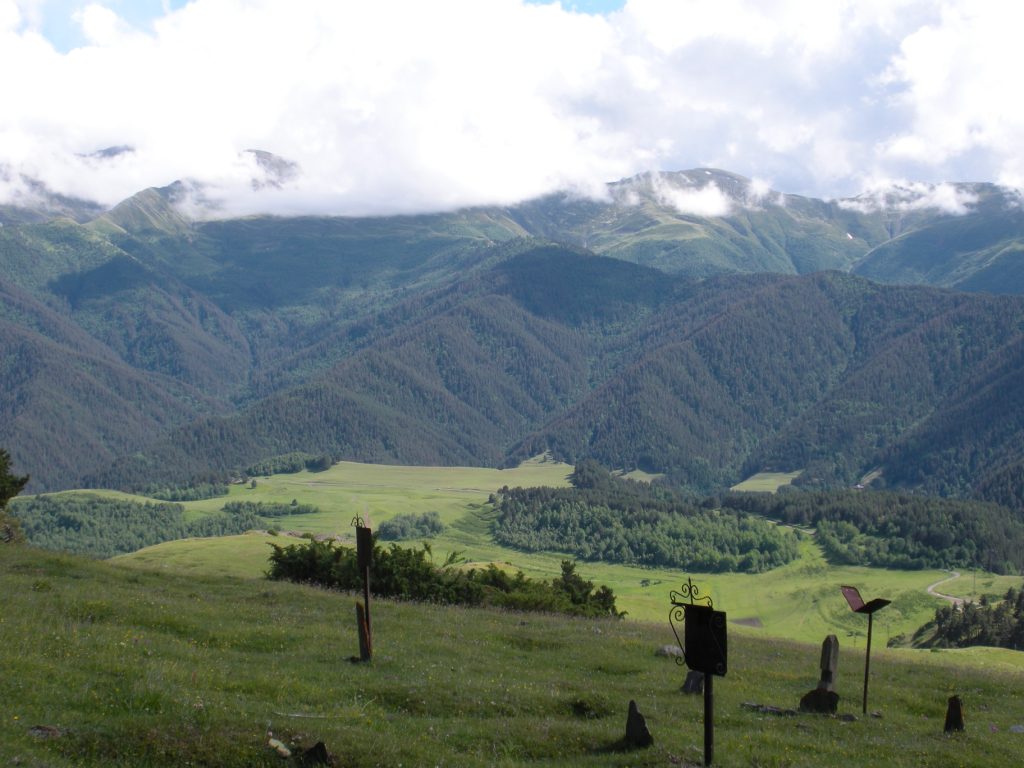
Later in bright sun J & I hiked to Upper Omalo, found church in village and graveyard on a high ridge sheltered in pine grove. Woman hanging laundry at guesthouse near church pointed our way to cemetery, approved and thanked me for my few words of Georgian.
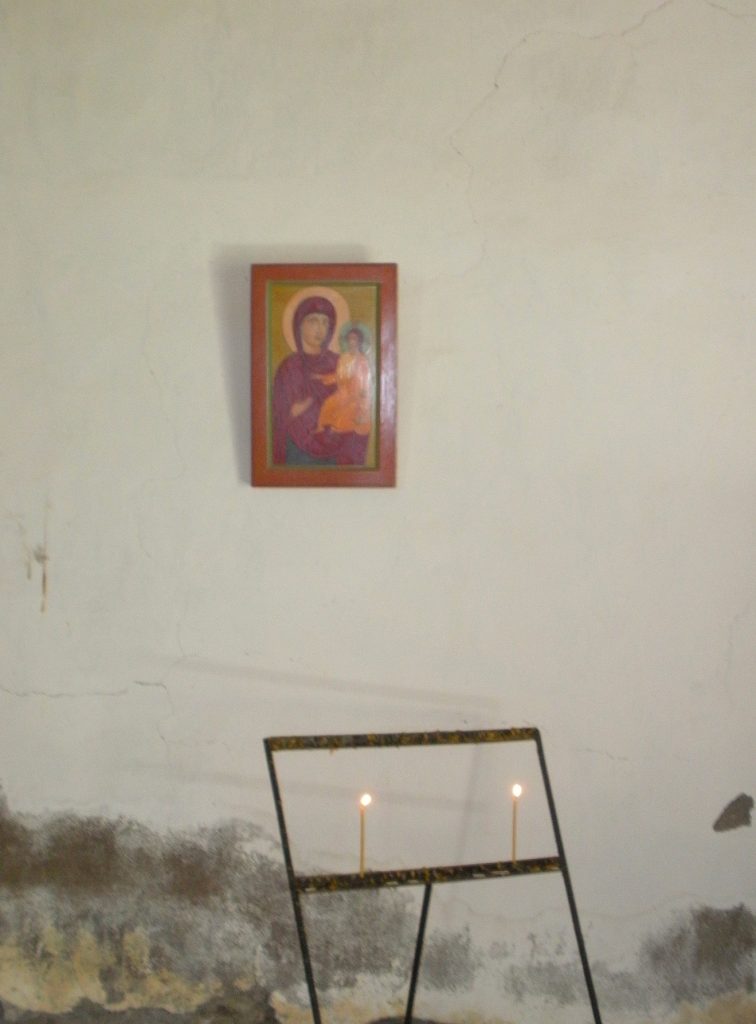
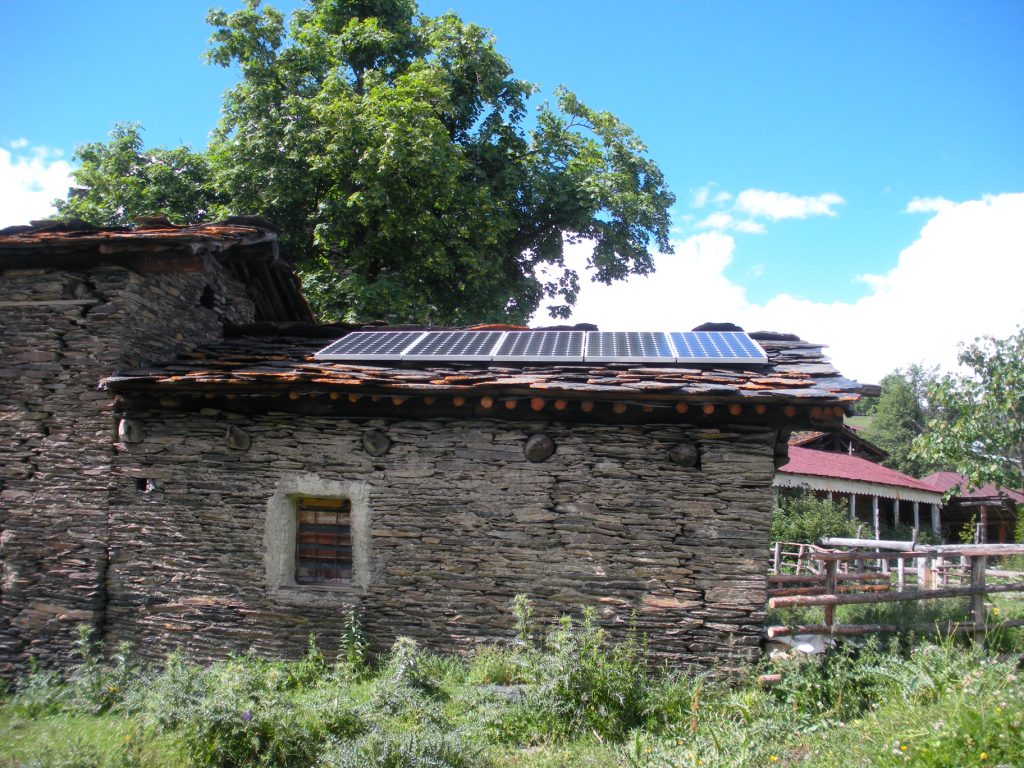
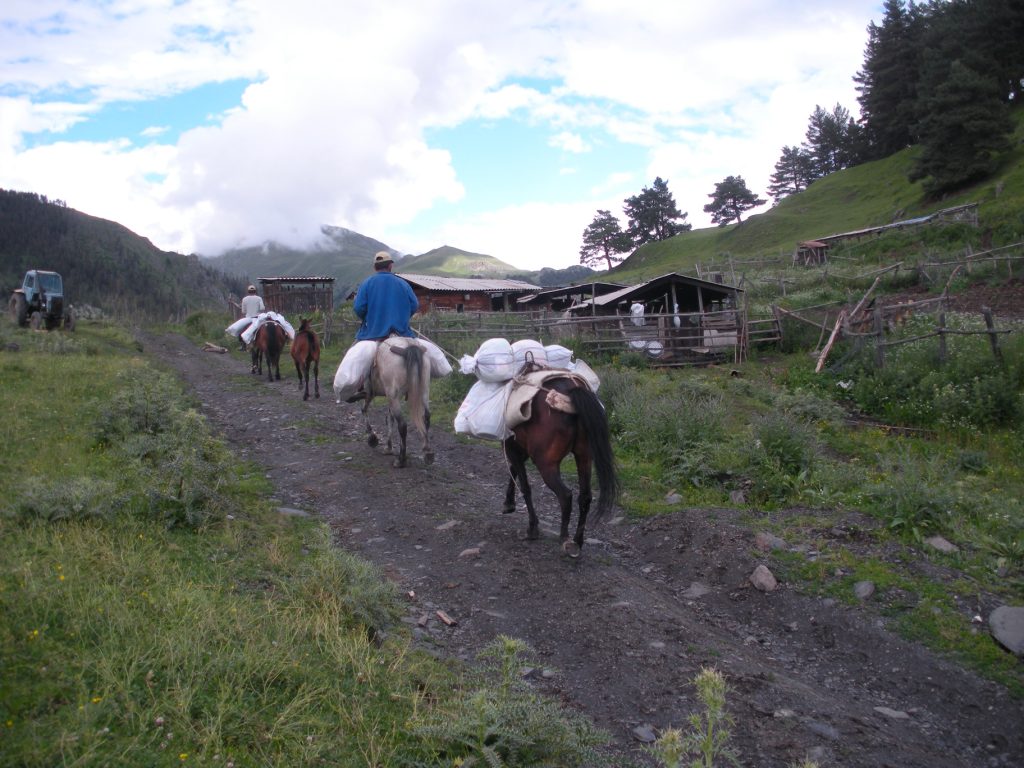
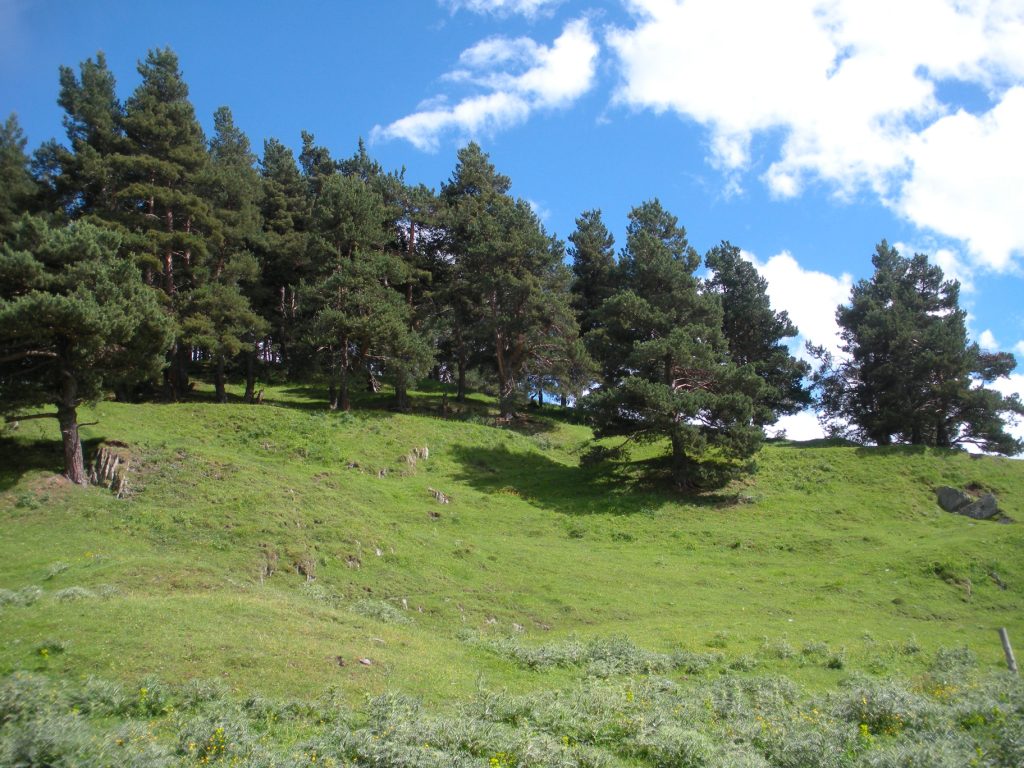
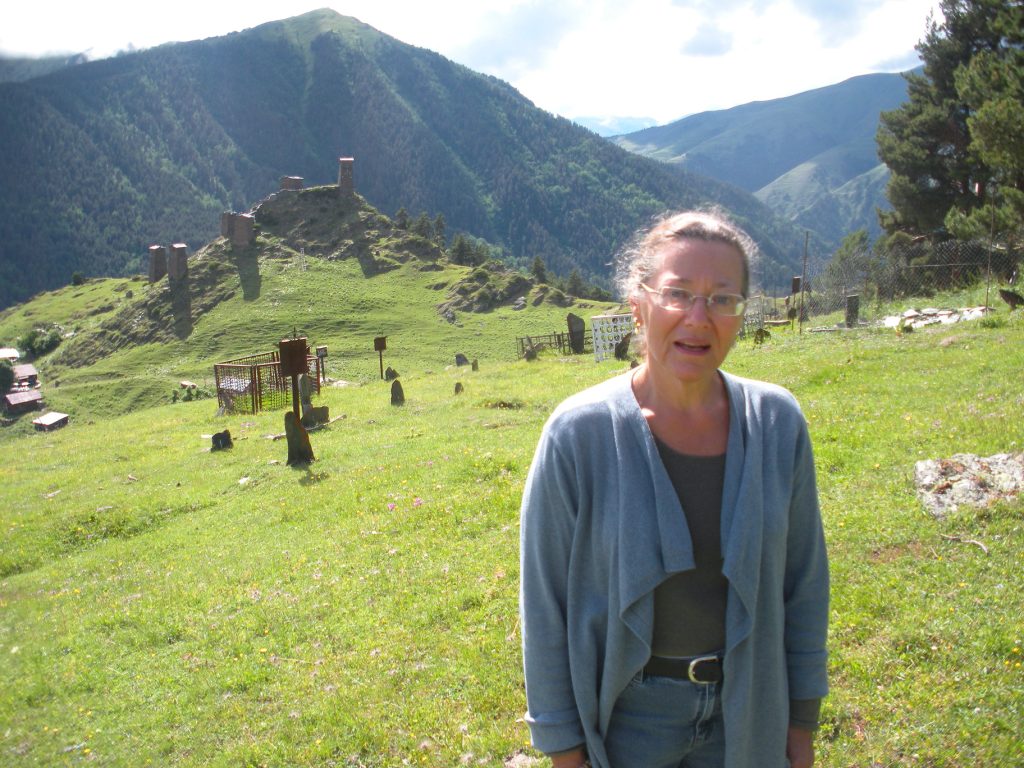
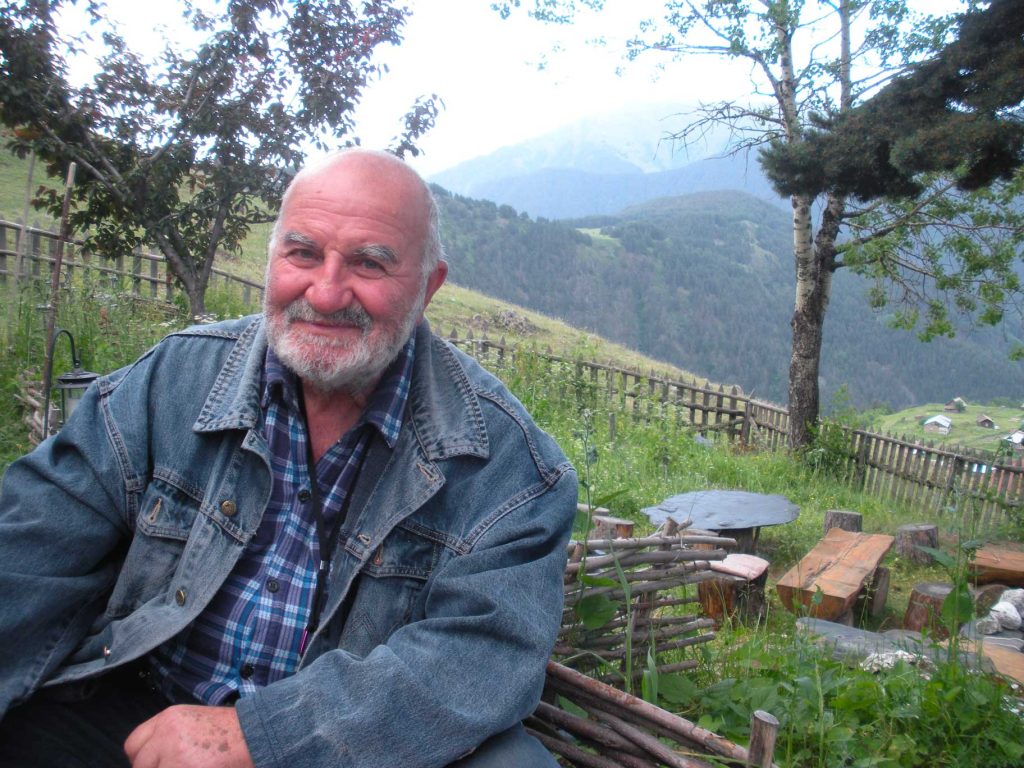
Down again, sat in the sunny garden with Koba chatting, eating salami and pistachios. I made a small watercolor. Shower, dinner, bed.
DAY FOUR – Dartlo on horseback
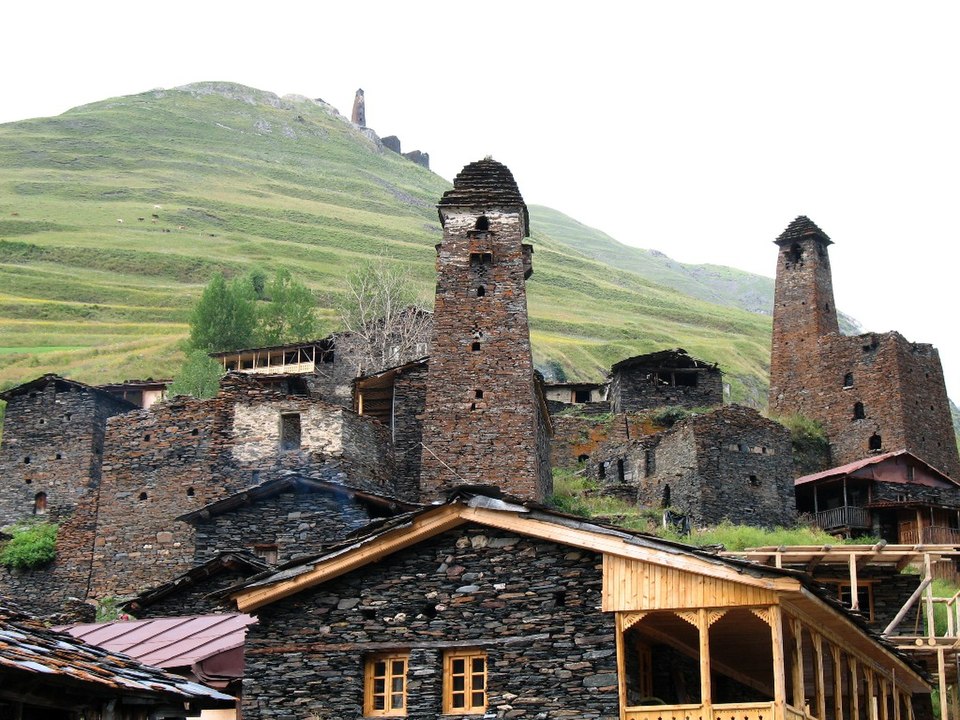
[My notes from this day are very sparse and disjointed; some words I thought at the time would remind me of unforgettable experiences are today incomprehensible: “blini” “buttery” “Bollywood on location.” Unfortunately none of the photos from the day can help recover the memories behind those cryptic notes. I do remember vividly our trail ride from Dartlo along the Pirikitis Alzani River to Chesko, a fine lunch, and making khinkali with the family back at our guesthouse. My photos have helped me to fill in some details.]
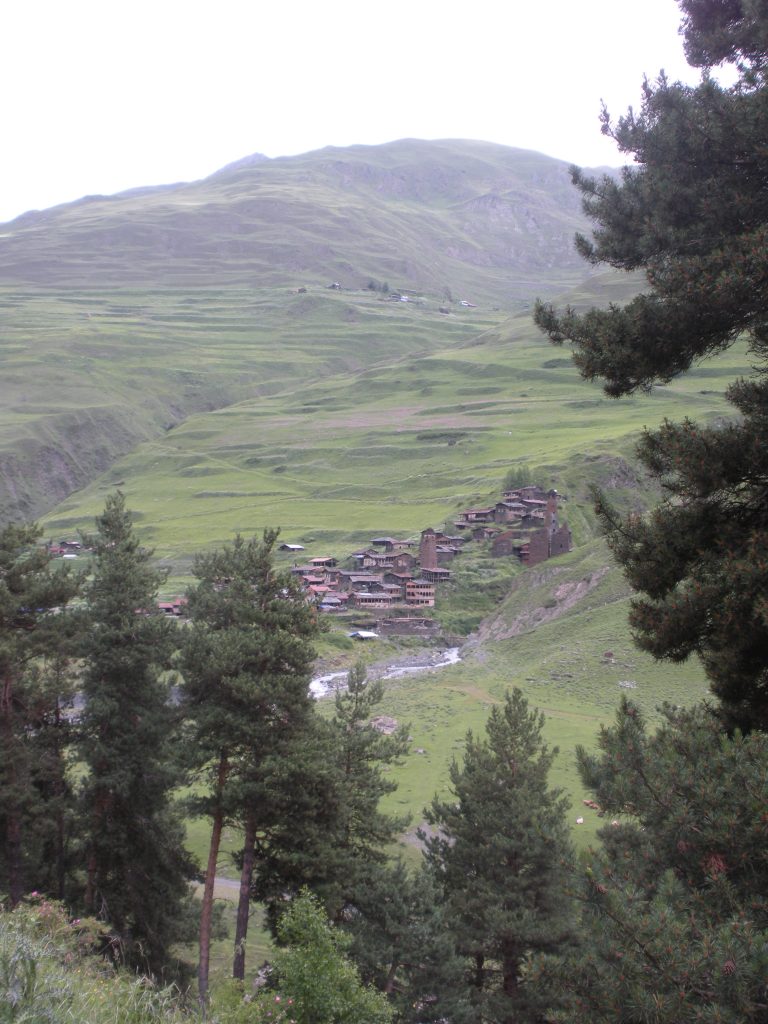
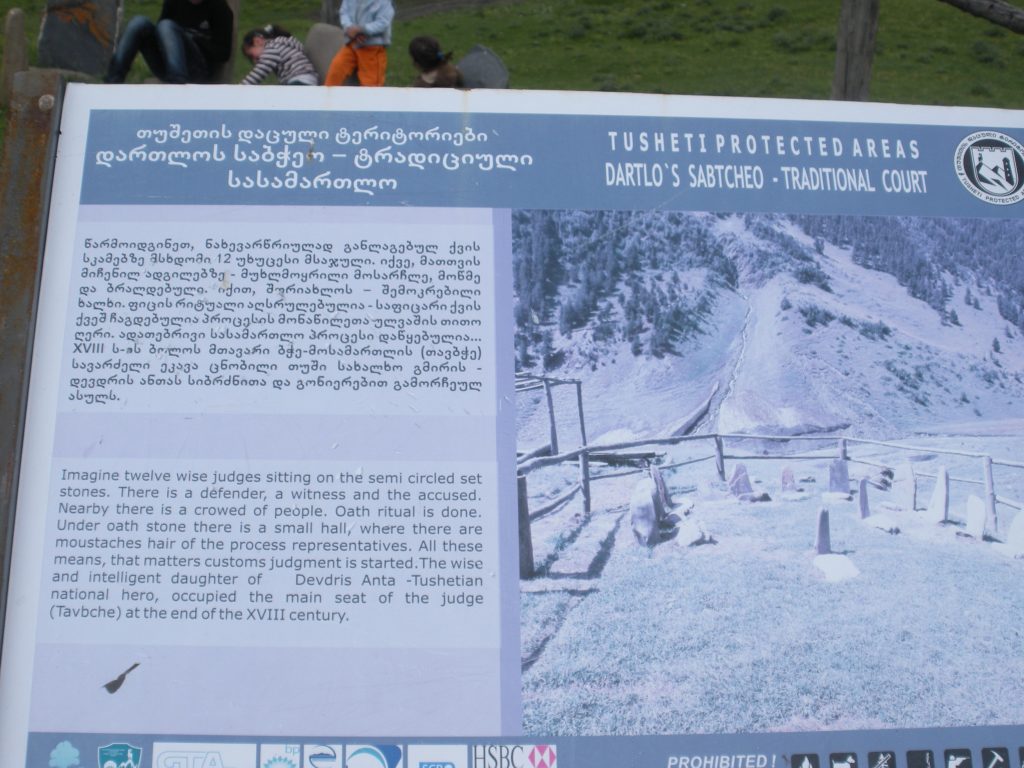
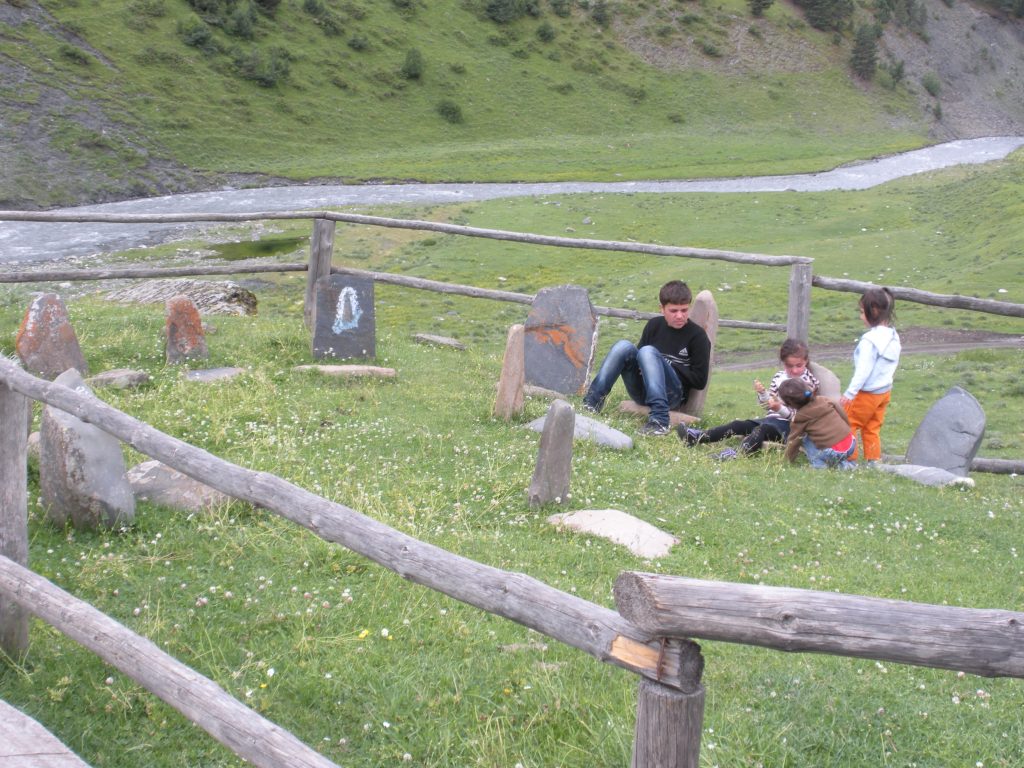
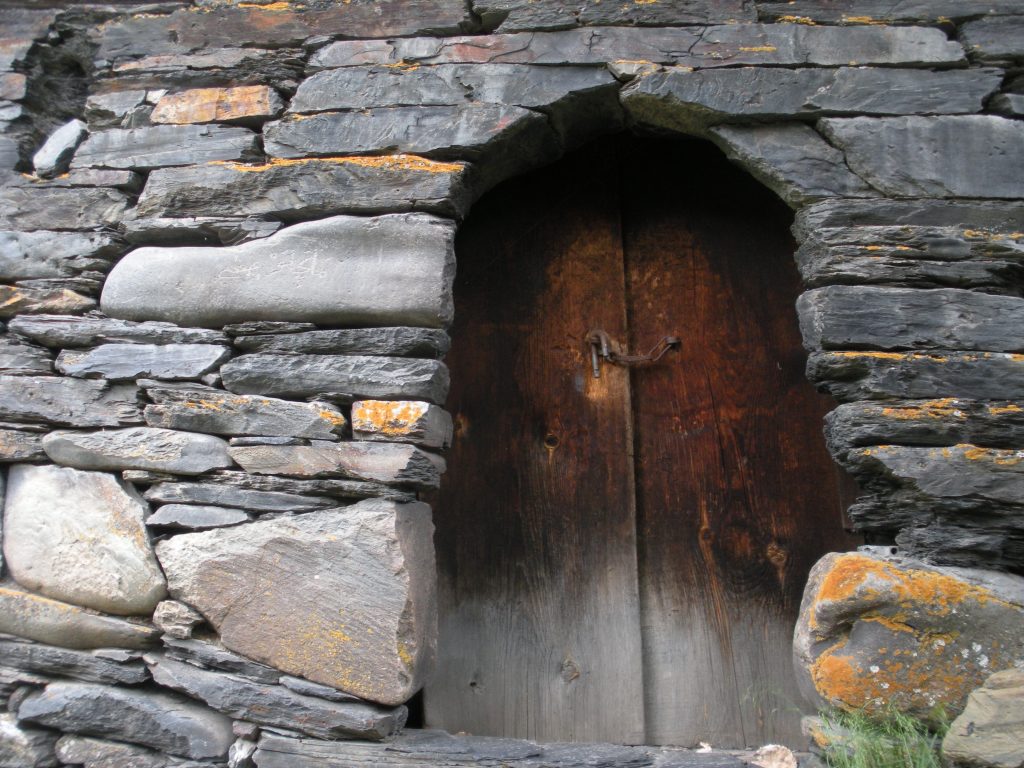
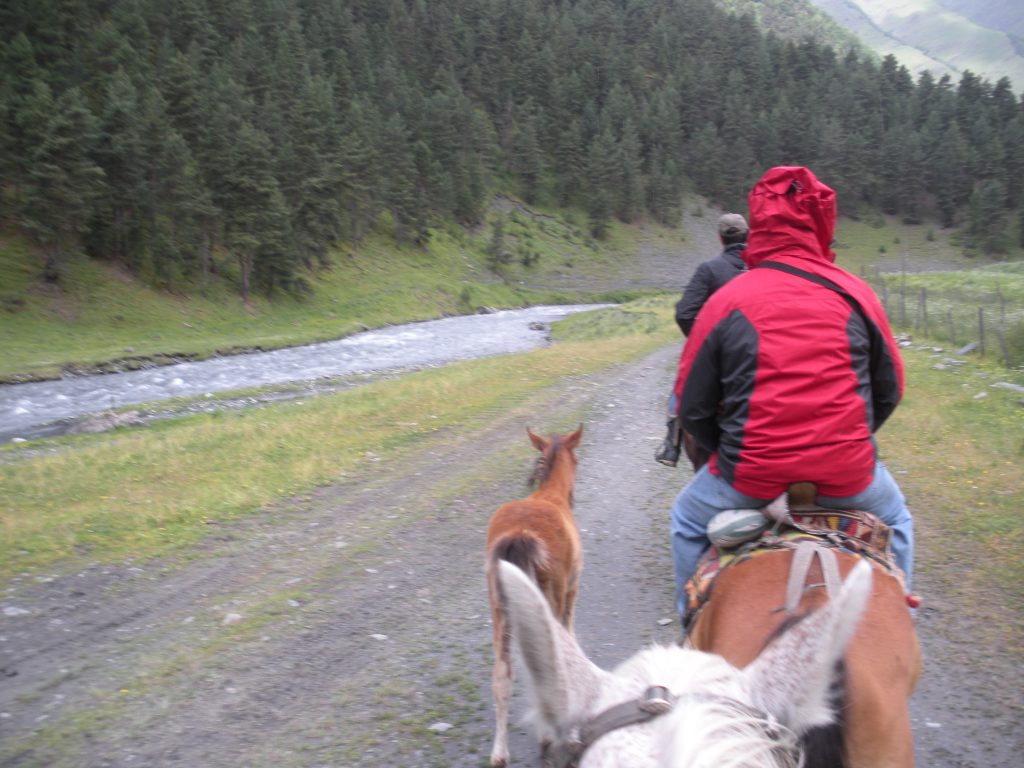
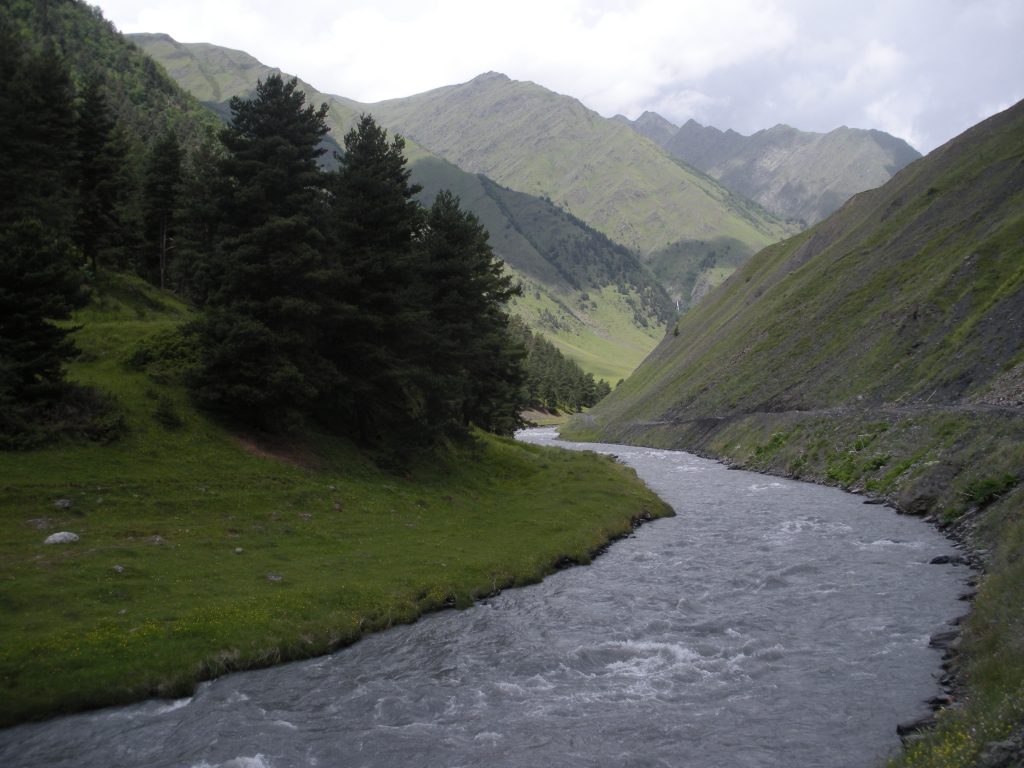
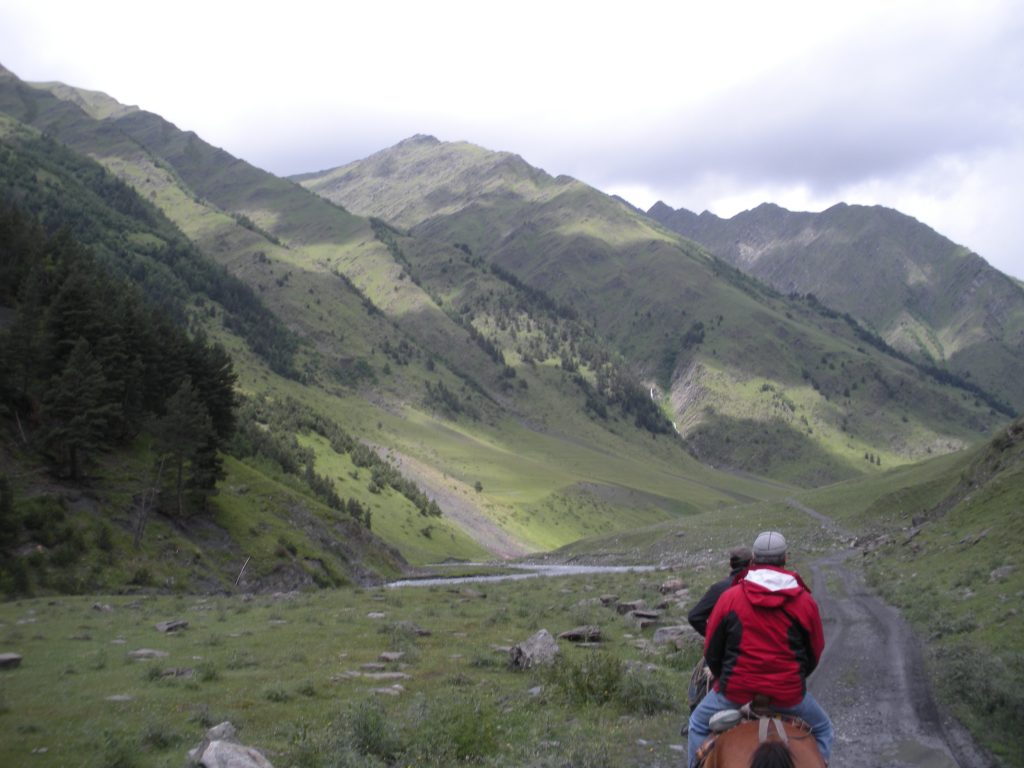
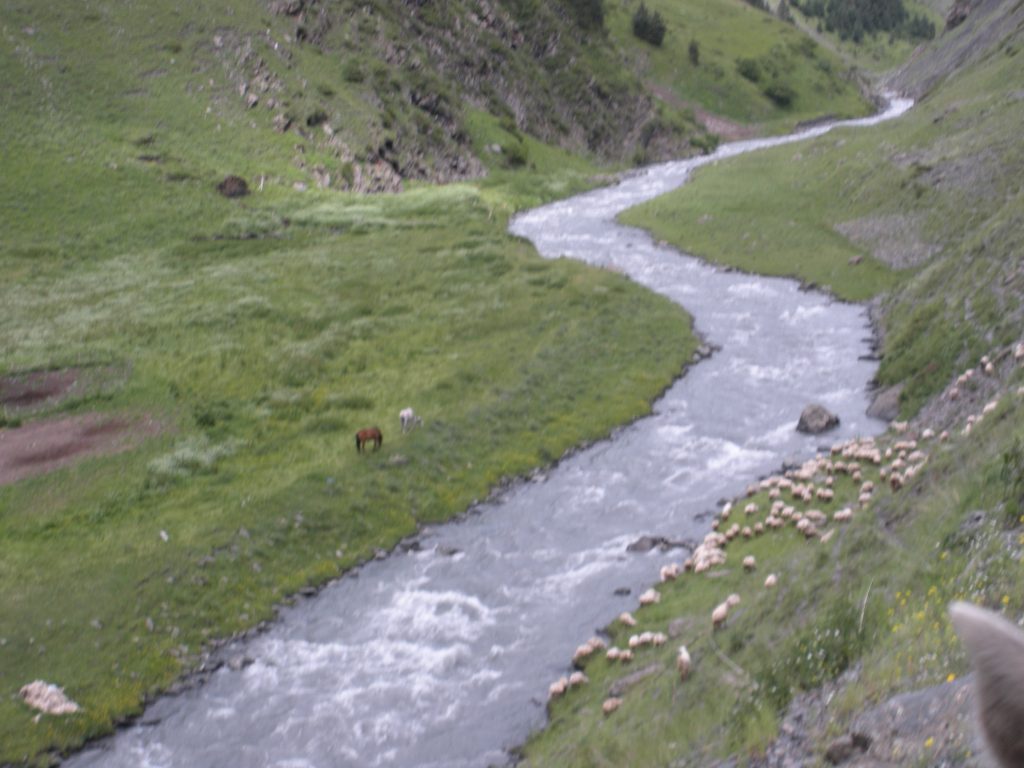
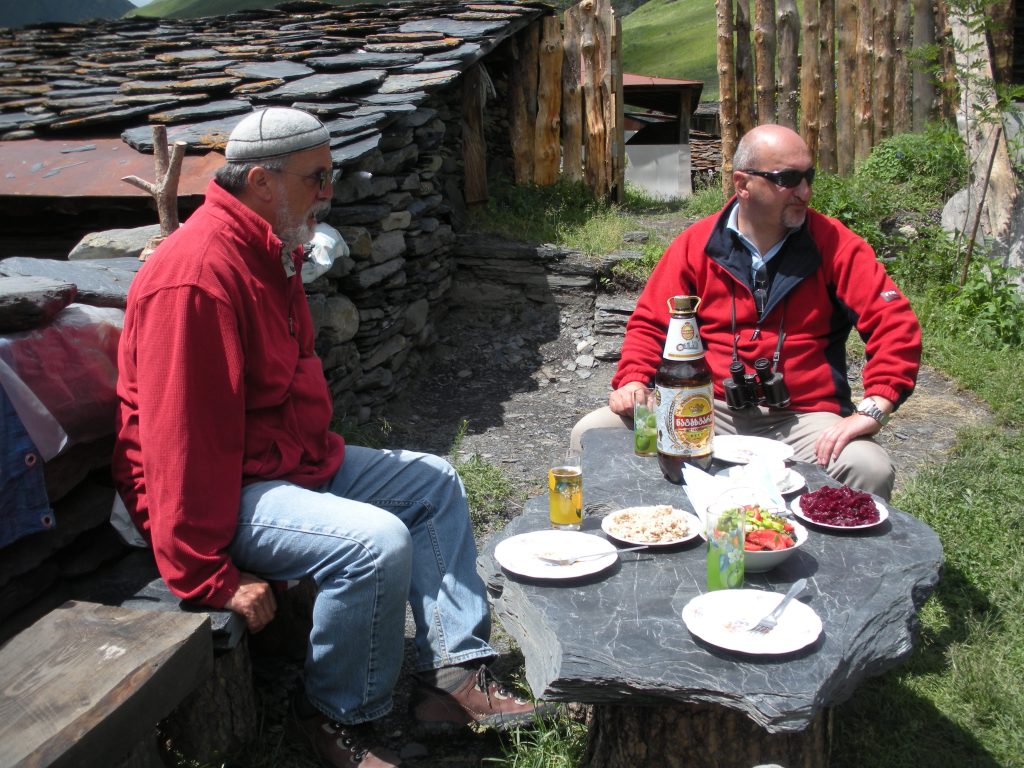
A sunny morning. We walked up into Dartlo village, arranged lunch at a guesthouse there. Extraordinary traditional architecture, built in stone with wooden trim. Three-hour trail ride to Chesko and back. Unsmiling guides lead us in file, one horse following the other. My mare foaled recently and her foal trots alongside, occasionally nursing then scampering on grassy riverbanks, never straying far. Layers of cloud, a few sprinkles of passing rain, sheepdogs. Back at Dartlo a delicious lunch of typical Georgian fare: tomato-cucumber salad with lots of fresh basil, scallions, green chilies; beet salad, cabbage with walnuts; wonderful stuffed peppers.
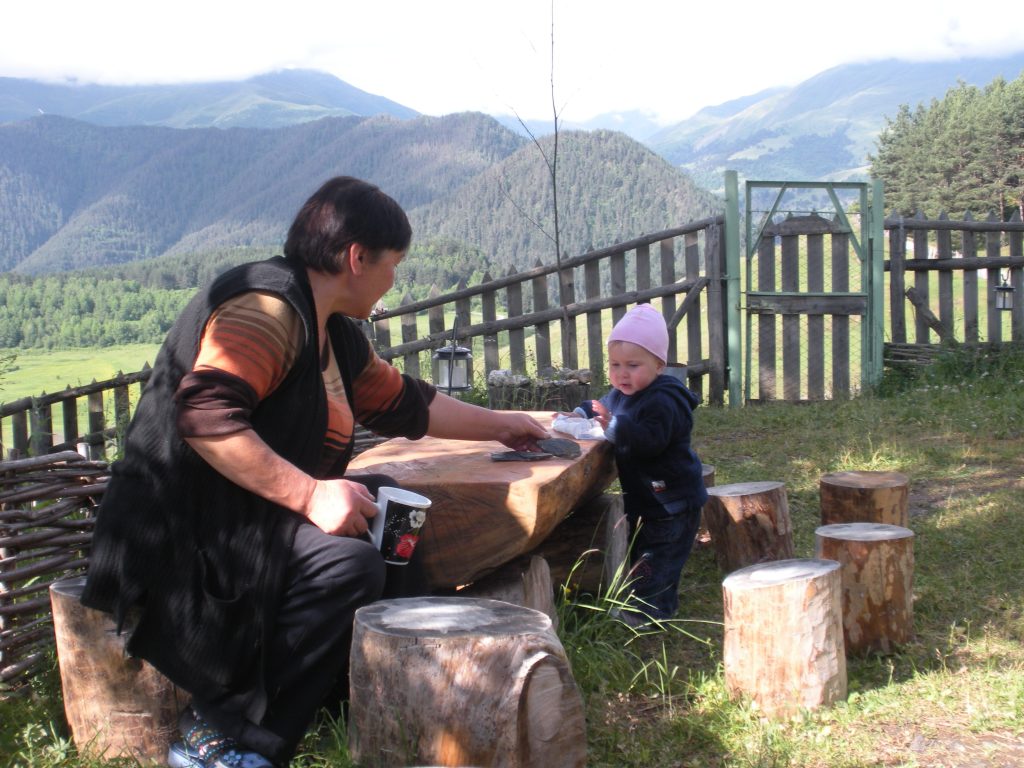
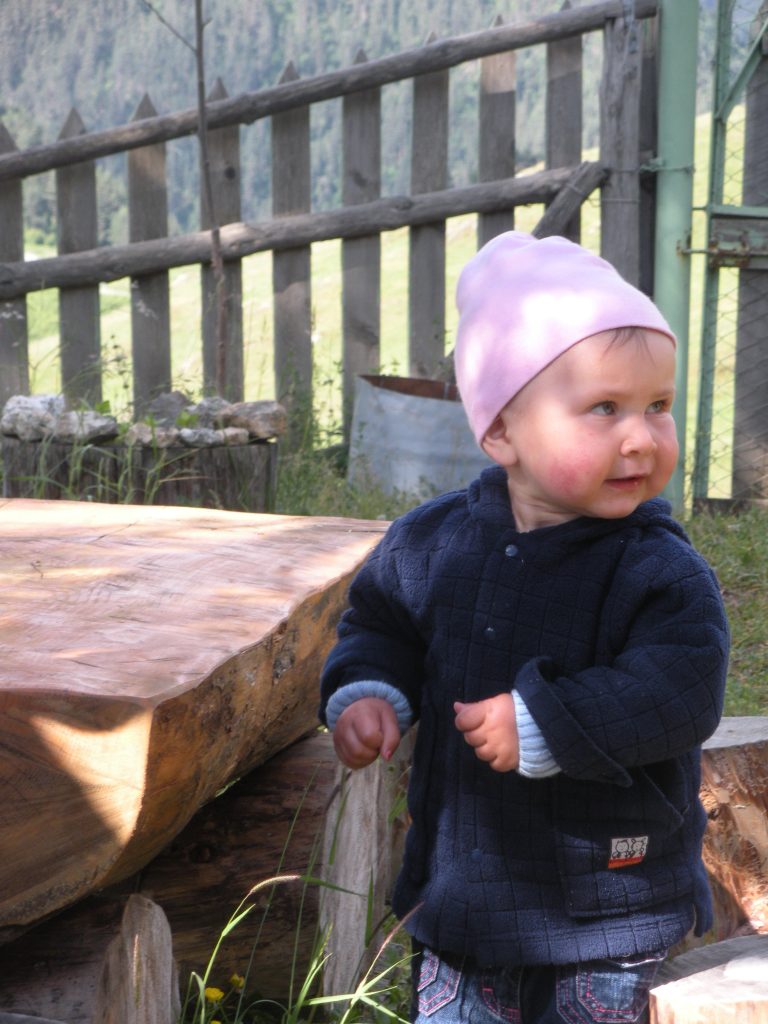
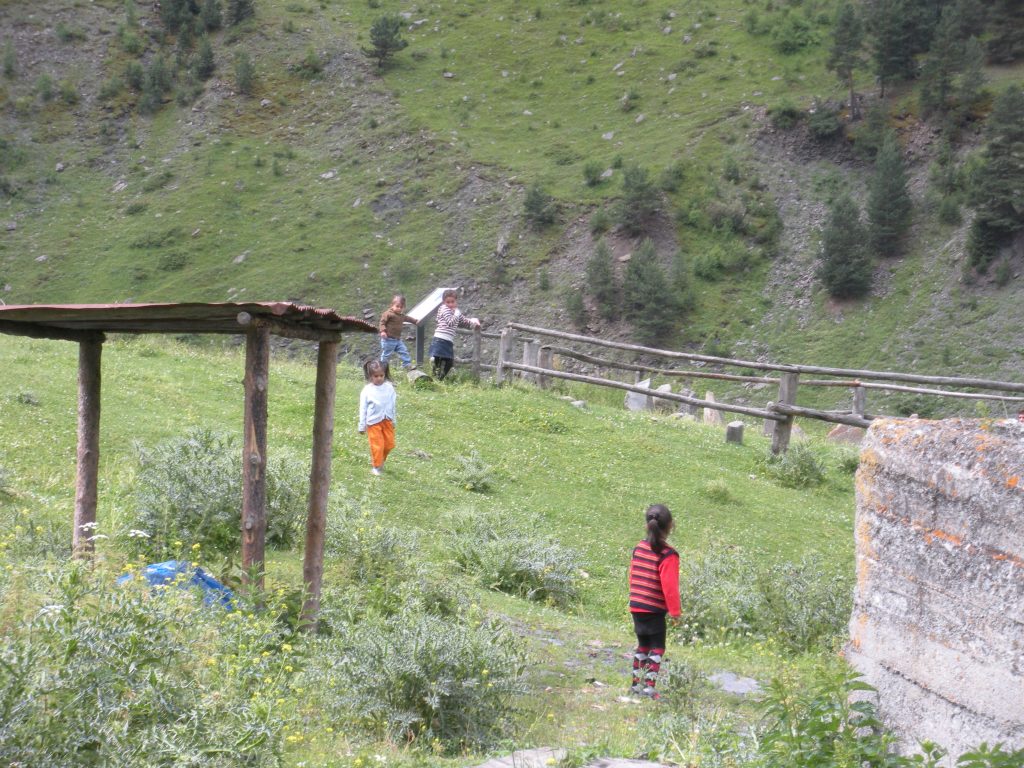
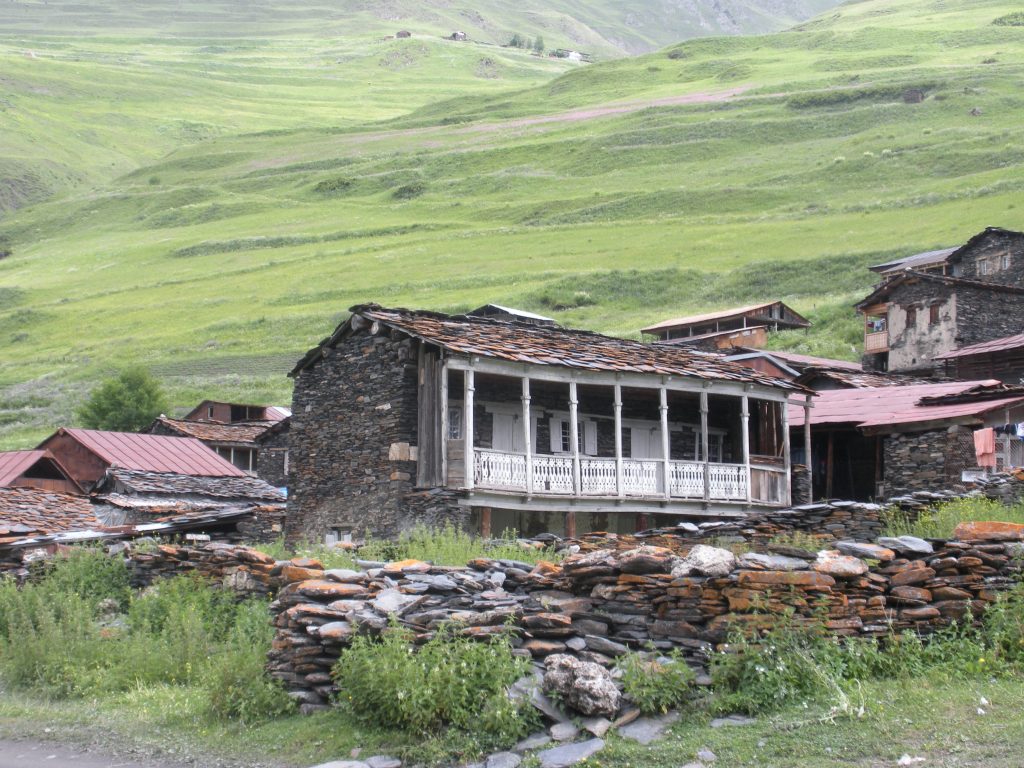
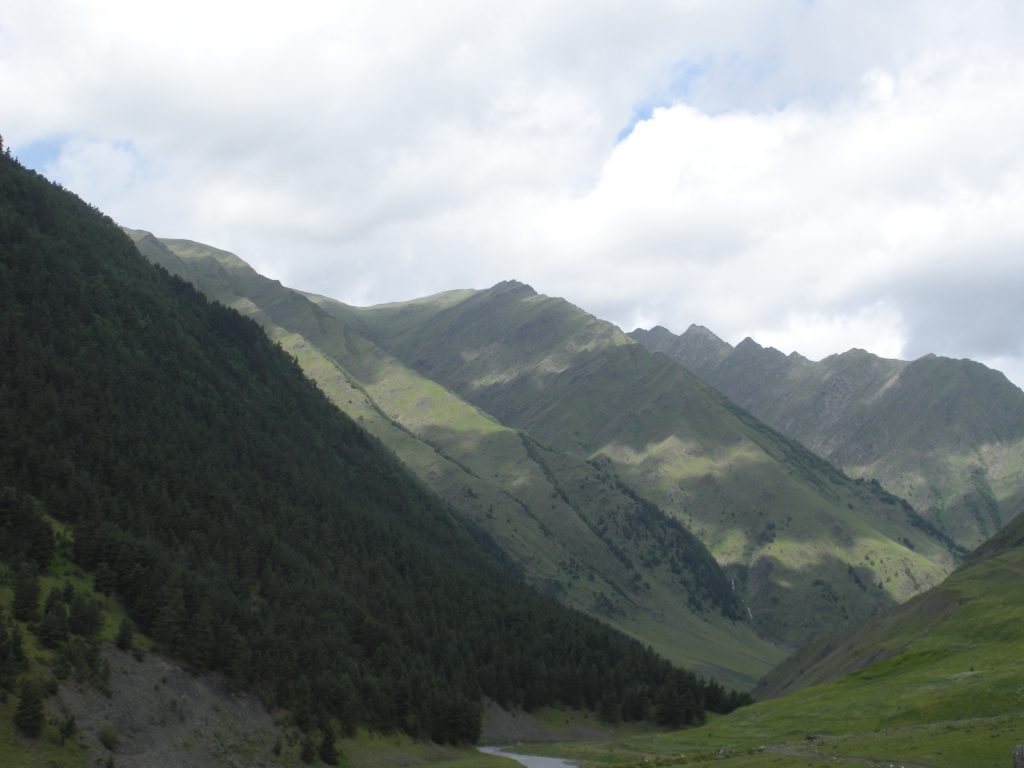
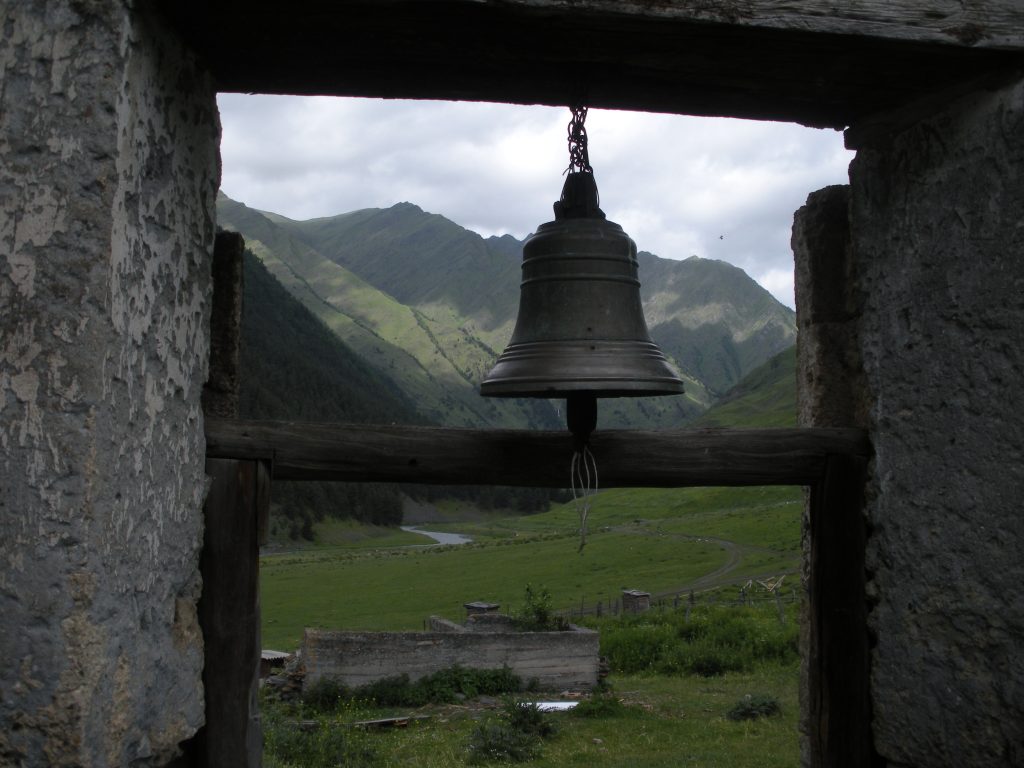
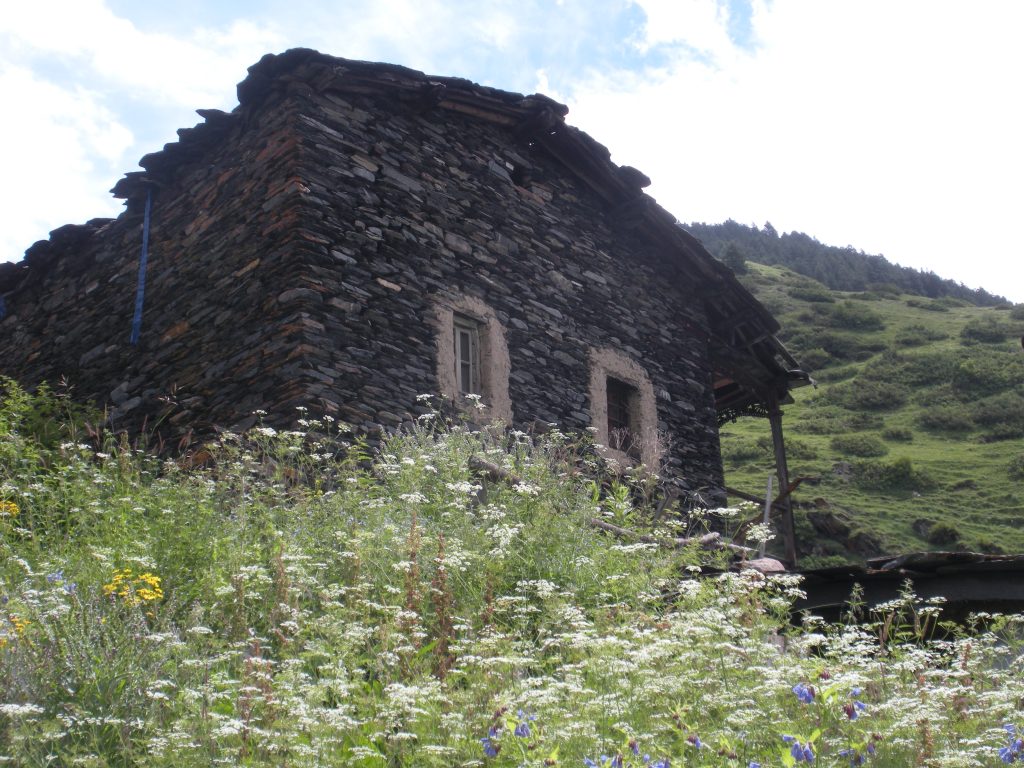
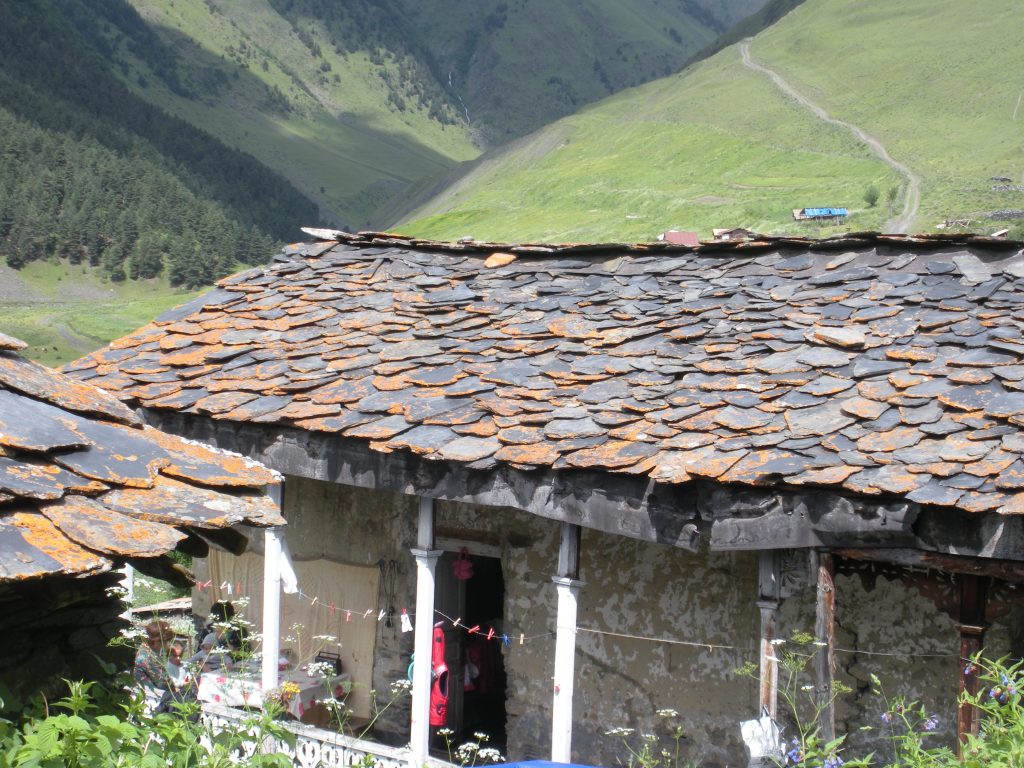
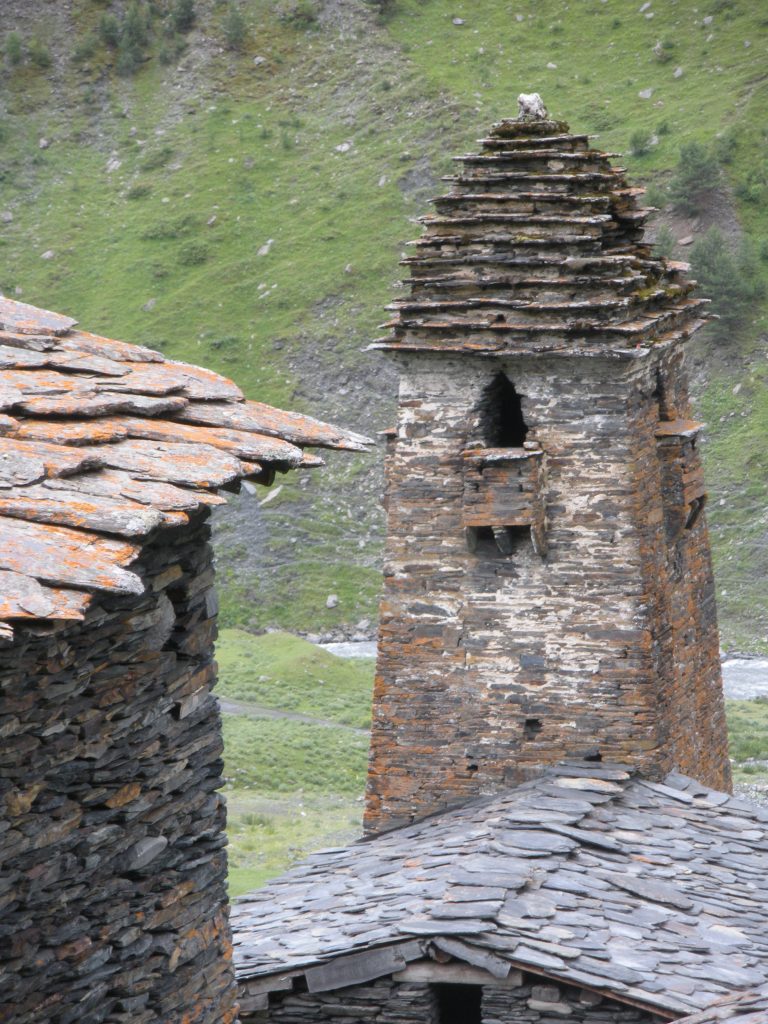
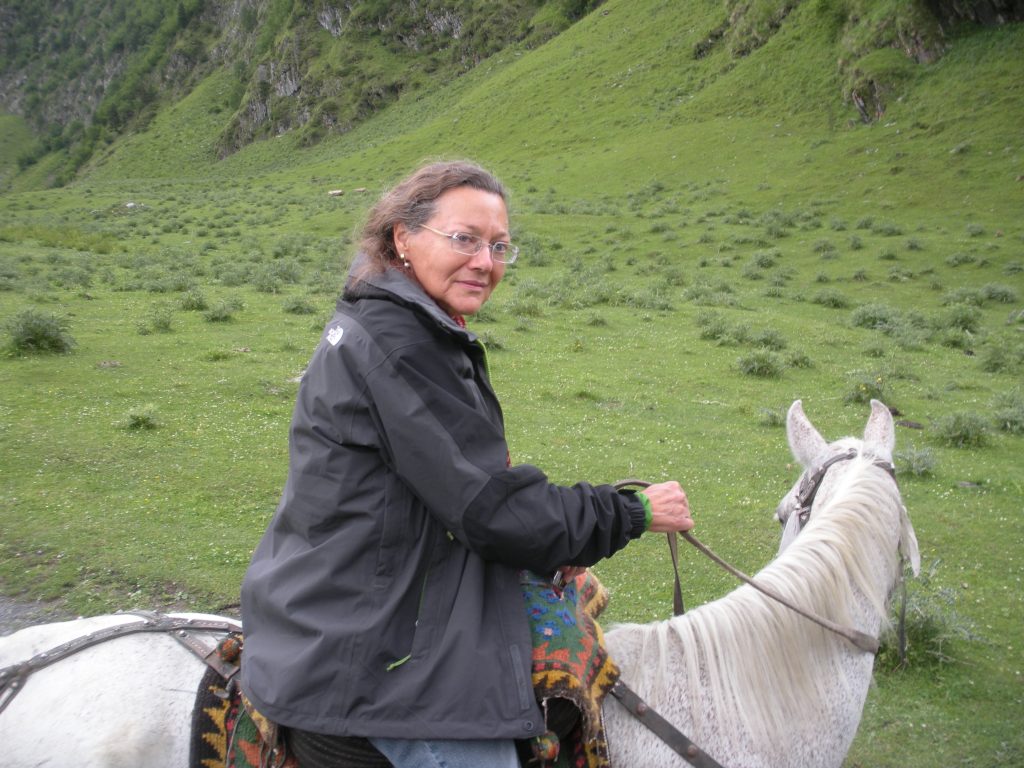
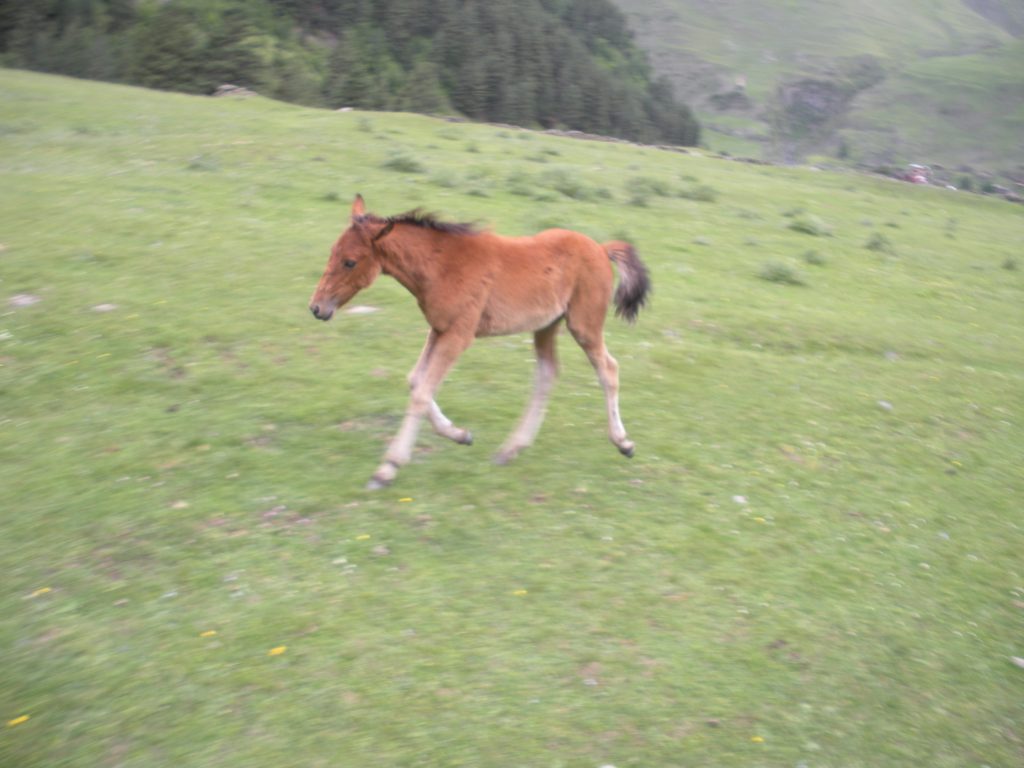
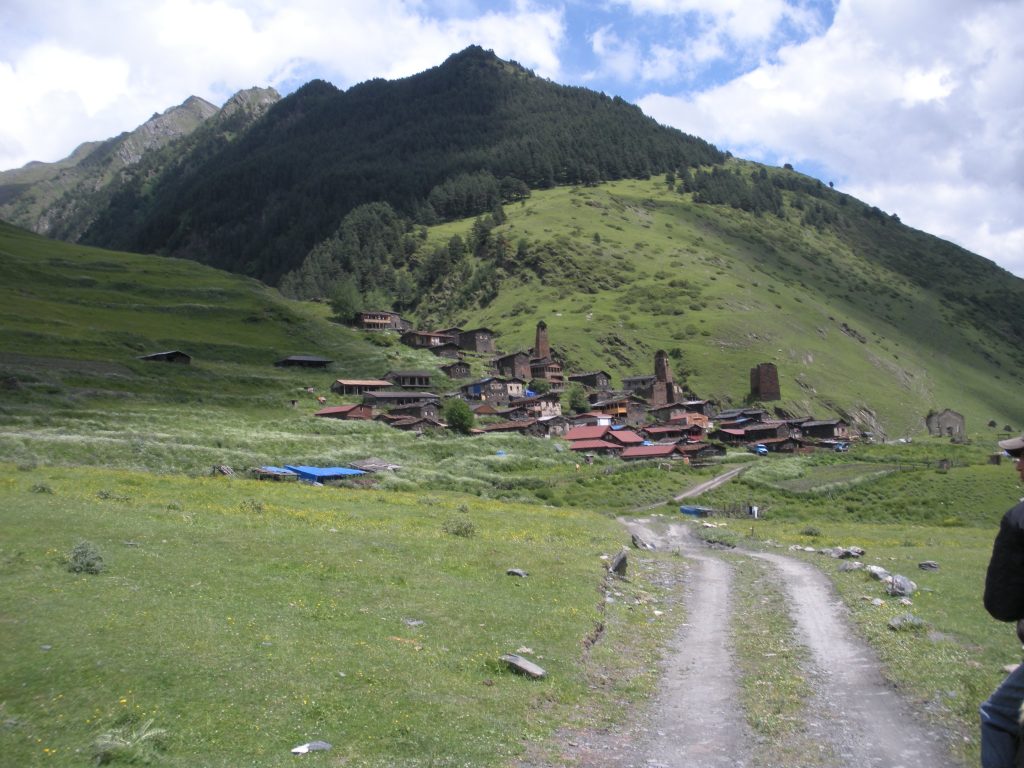
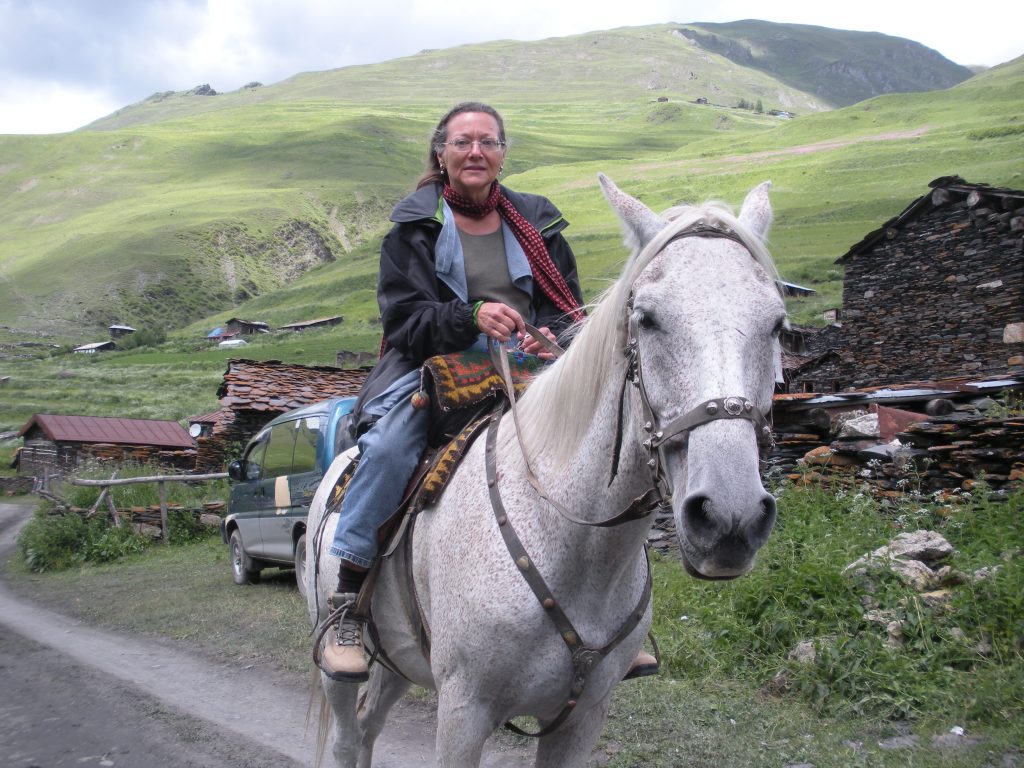
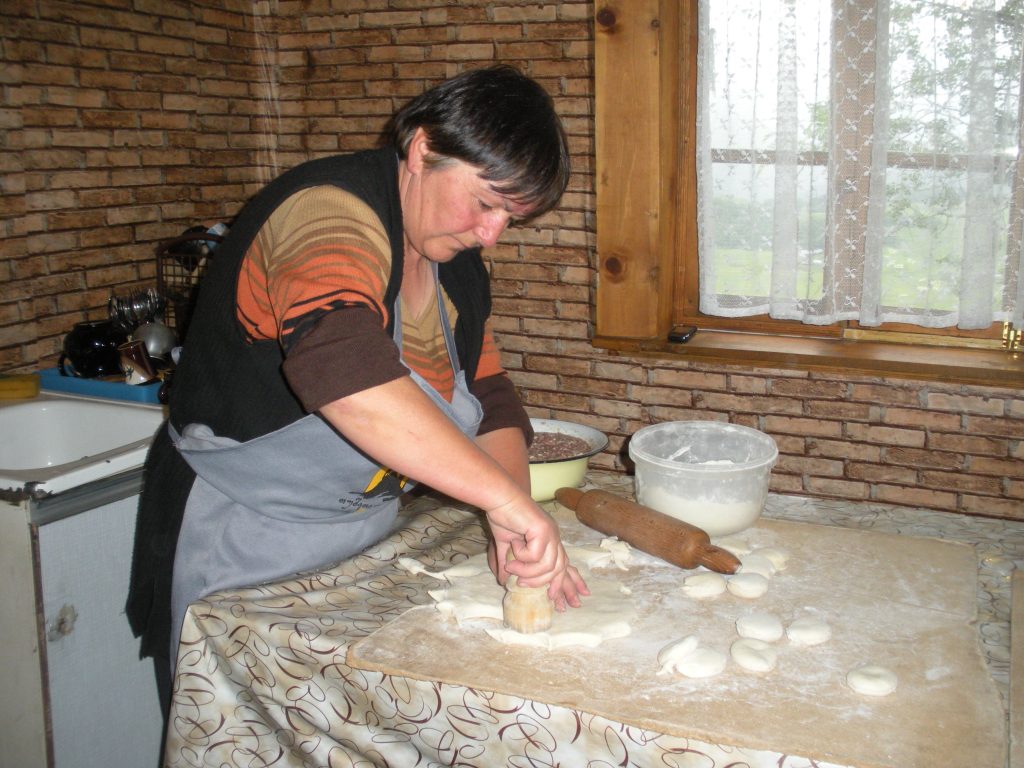
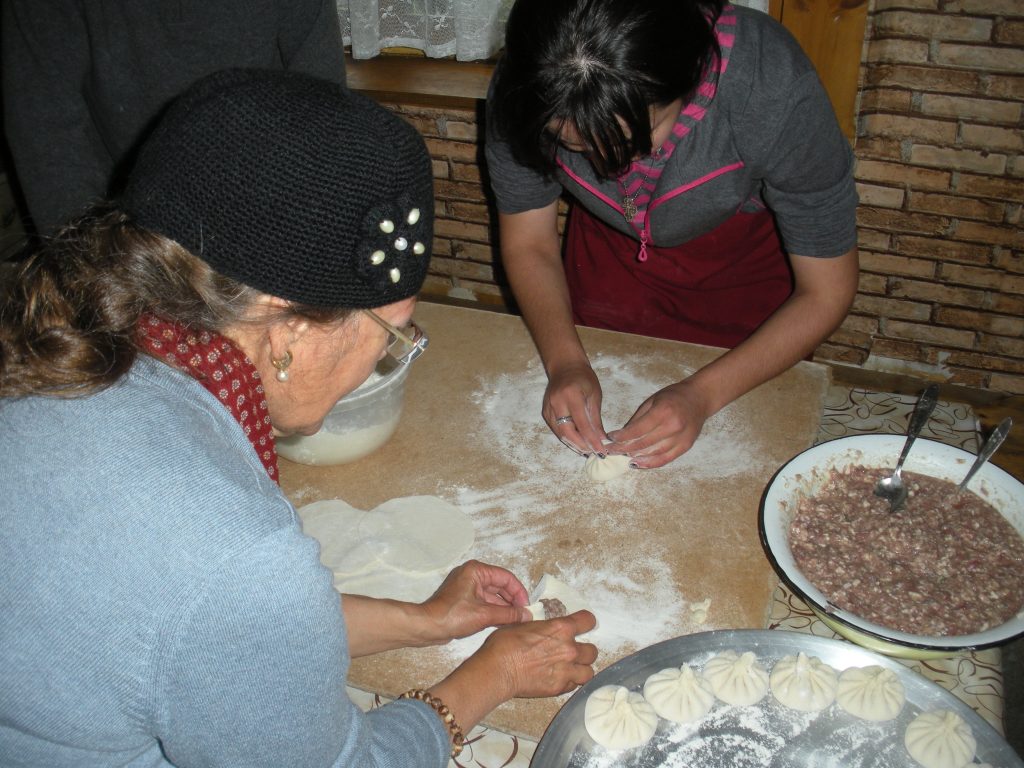
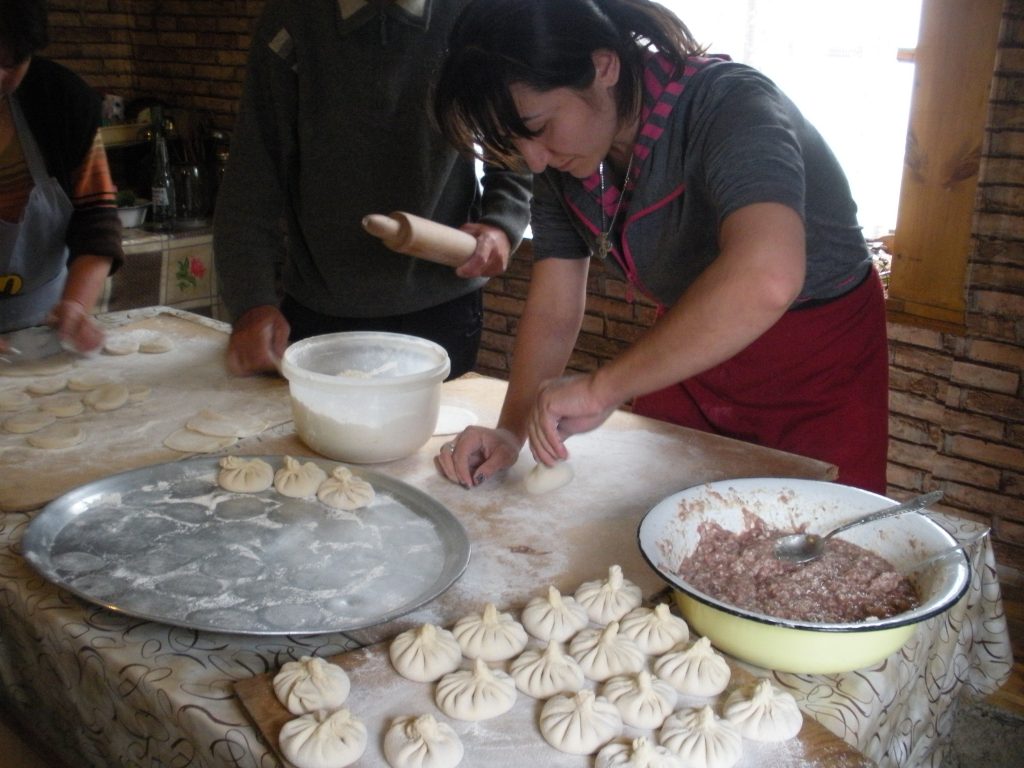
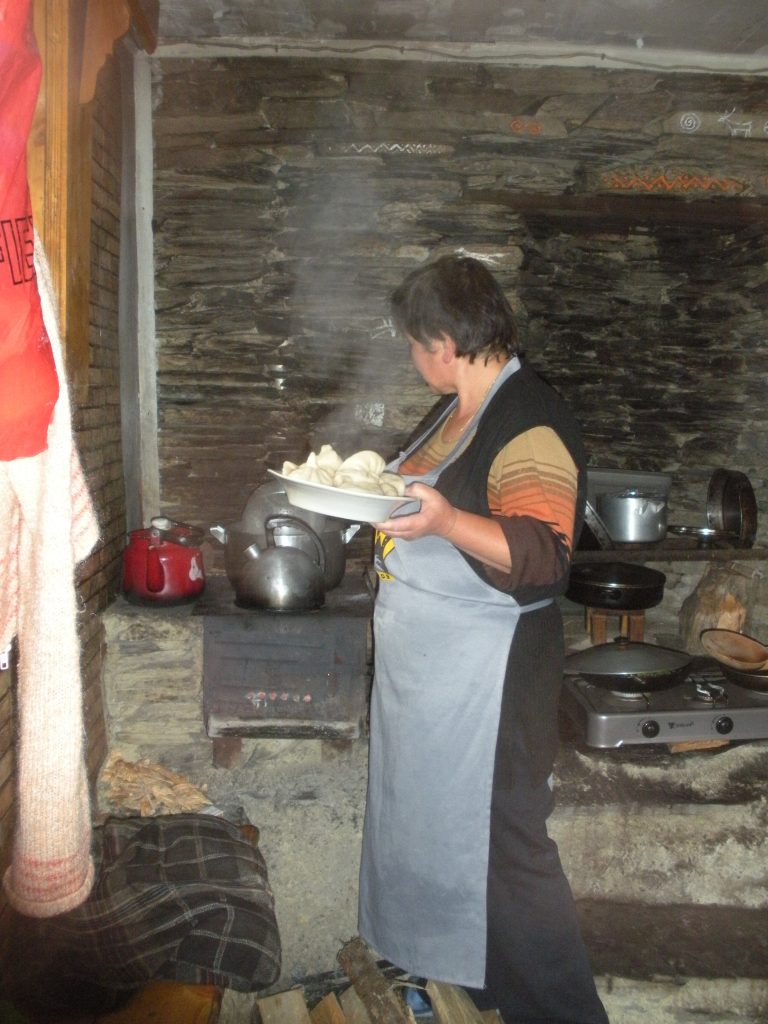
Down again in Omalo we napped through an afternoon rain shower, then joined Nino and family in the kitchen to make dozens of khinkali, Georgian dumplings filled with seasoned chopped pork or cheese and herbs. Pleating and sealing them so they won’t open when they are boiled is quite a trick; I tried but never quite got the knack.
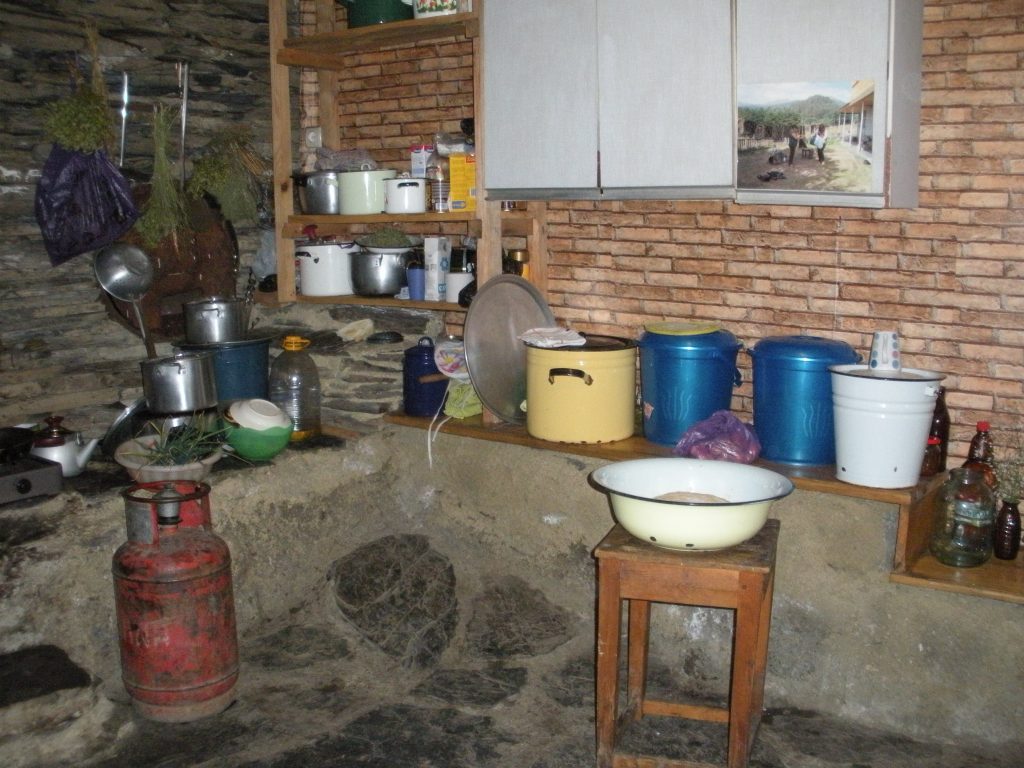
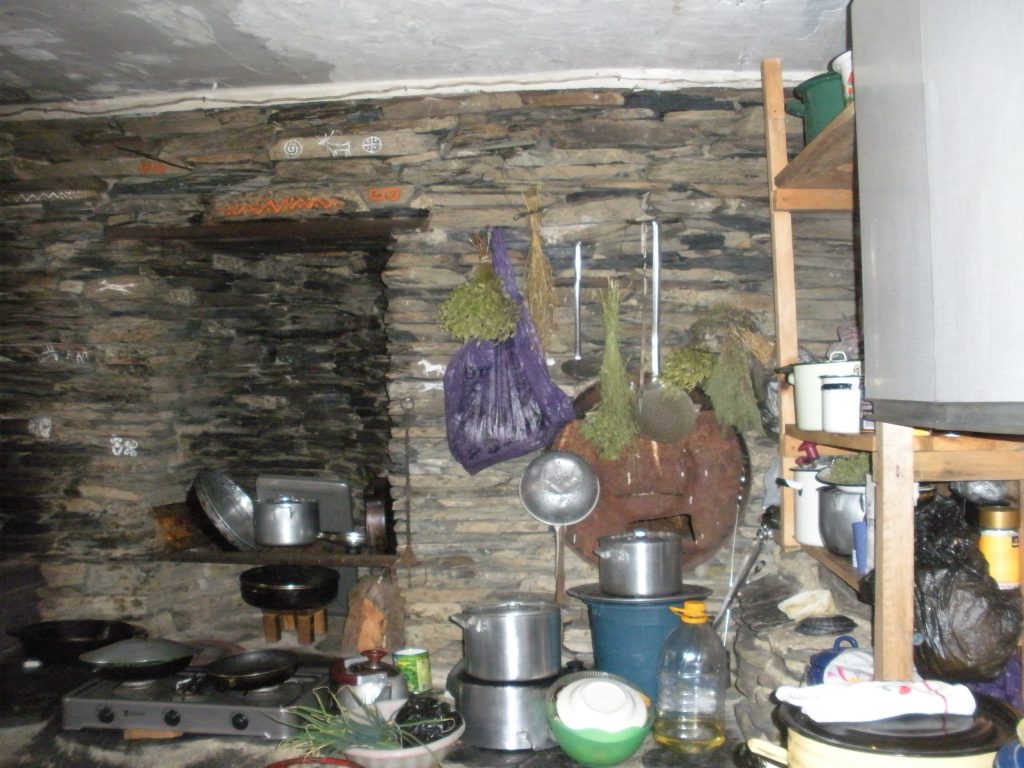
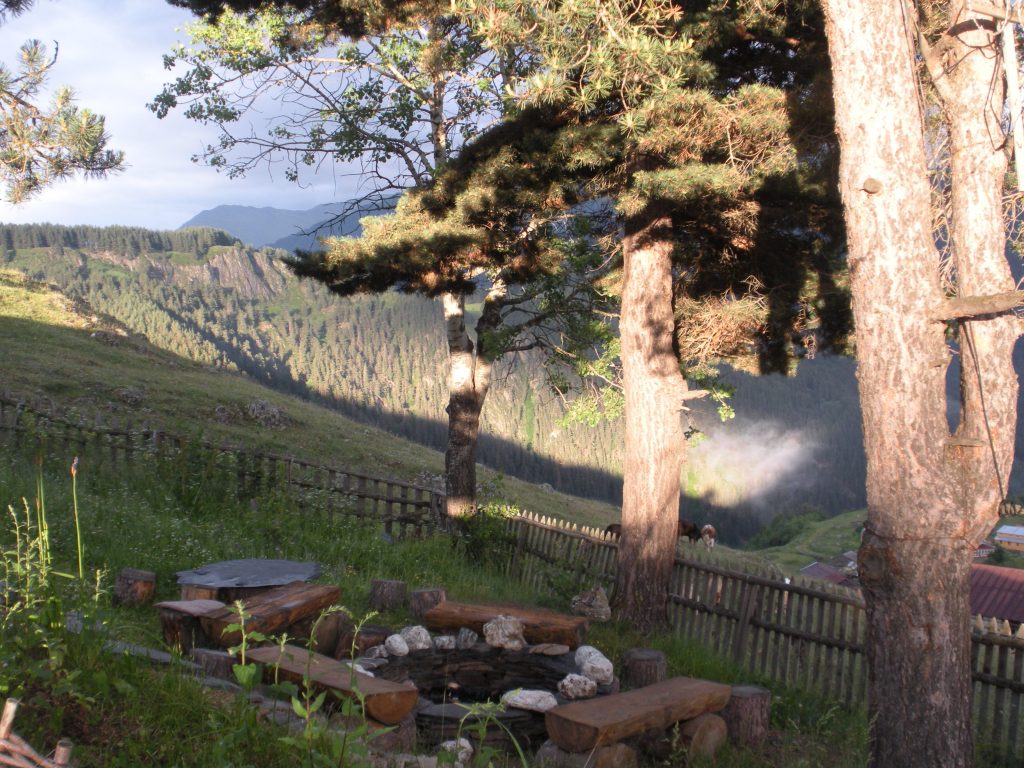
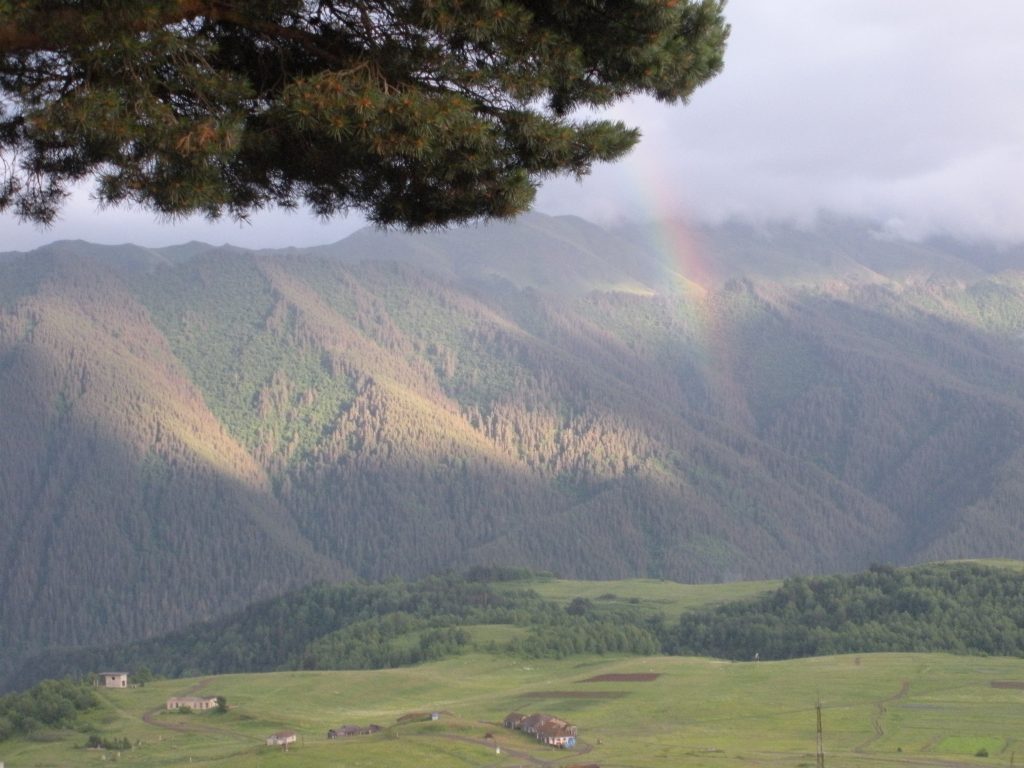
When the rain stopped my husband and I returned to the Soviet-era “camp” to take photos. Wispy pink clouds and a rainbow at day’s end.
DAY FIVE – Return to Tbilisi
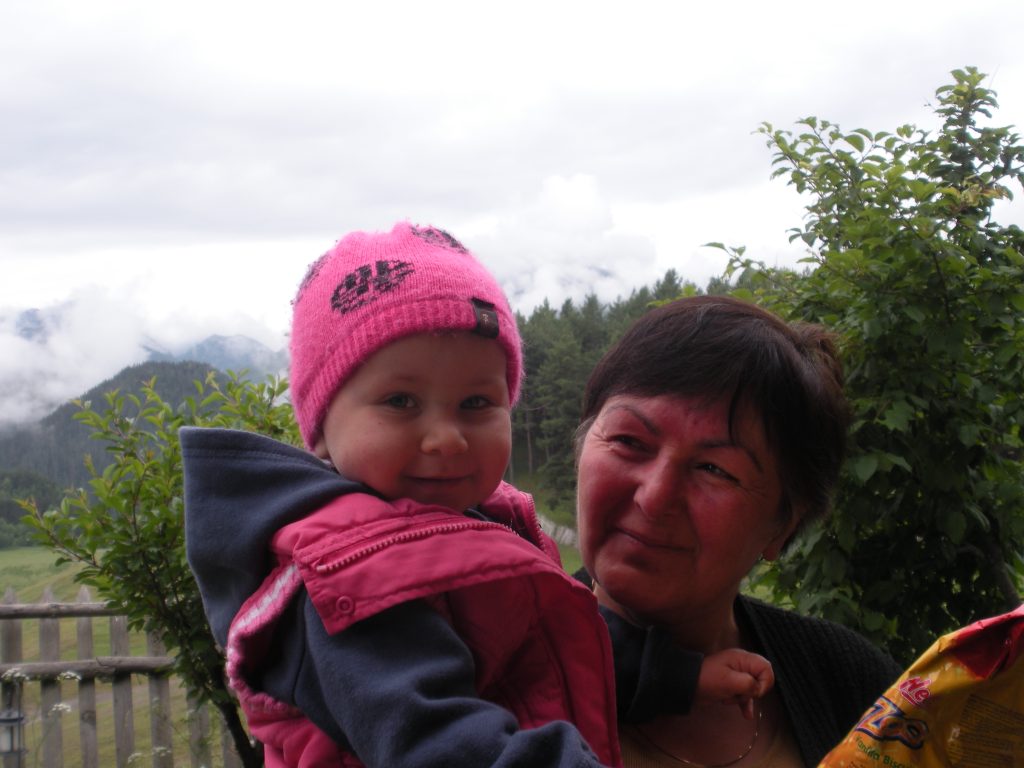
Farewell to Omalo, to Nino and Baby Nino, and down the mountain we go. At Kumelaurta Bridge a small golden eagle took flight up toward the village. River blue and sinuous, road follows each curve, at 15 km a riverside sawmill huddles in the shell of a framed-out house of raw lumber, color of water intensifies. Upper slopes all in cloud, our car noses straight down into potholes, straight up and out again. Koba fastens his seat belt.
River on left now, thread-like waterfalls slide through slabs of rock flipped vertical. Clumps of marsh marigold in the midst of streams rushing to join the river. “Blood on the Tracks” on the CD player. I have complete confidence in Koba and the vehicle, no anxiety driving through running water. Approaching a summit, barren shingle, tundra turf, fields and fills of dirty snow. Driving into cloud, valleys multiply, temperature 8 degrees C, deep fog at summit, valley filled with cloud. Road is rock-strewn, at 40 km we emerge from dense fog, Koba shifts out of 4WD.
Down now in forested slopes, valley sheer drop to river, brown saddle of glacier. Road widens, flattens, steady rain falls. At 61 km we are on asphalt! Downpour, two boys in ballcaps and jerseys shelter under a tree with their flatbed donkey cart.
At Pshaveli, dry roads, no sign of rain. A donkey cart and an old woman in blue wrapper with wheelbarrow. Eight men playing backgammon crowded under a road sign at T intersection: to left, Lagodekhi and Ninigori, to right Akhmeta and Ticineti.
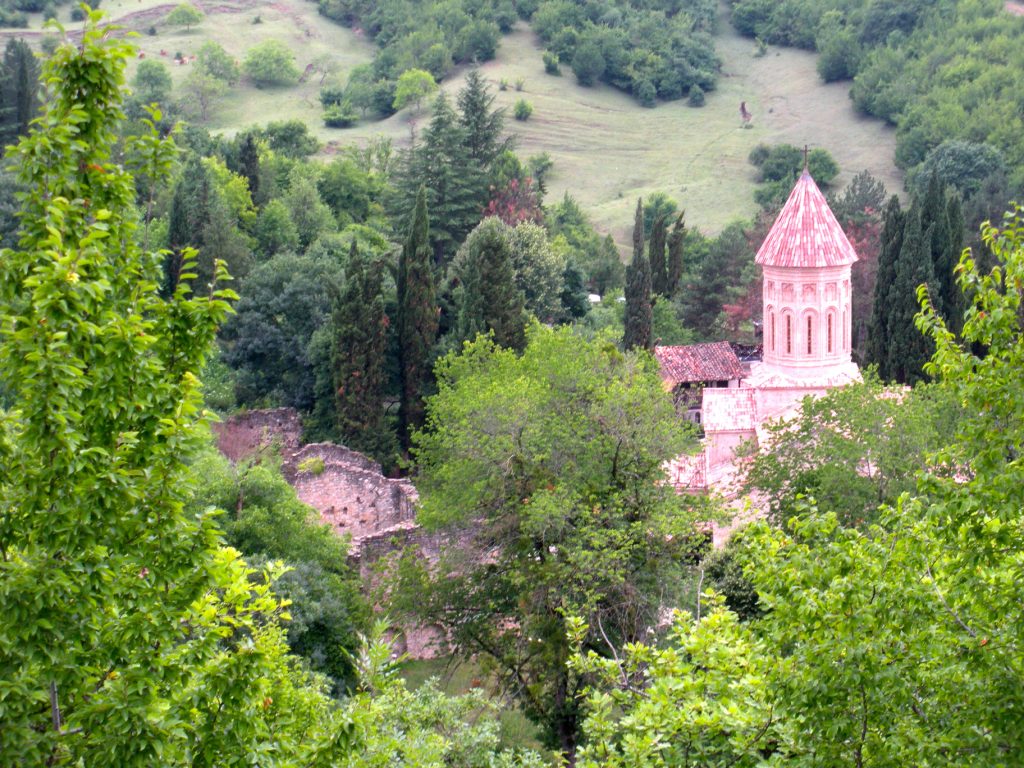
Alaverdi Monastery– frescoes in narthex, bas relief of bunches of grapes around single portal.
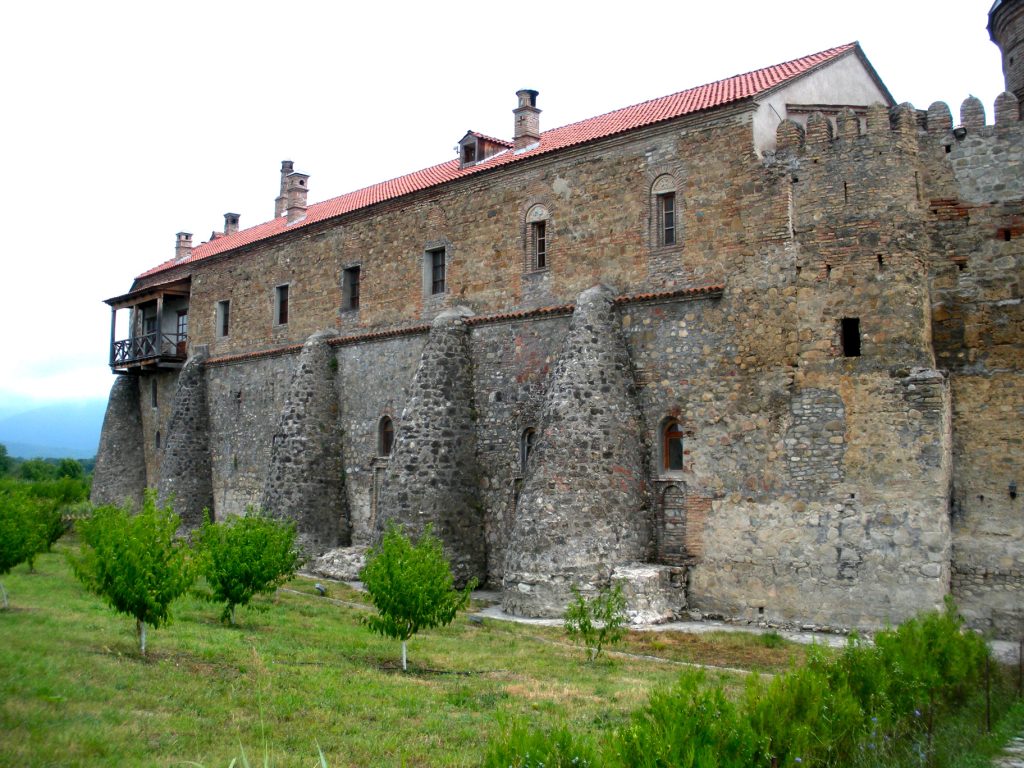
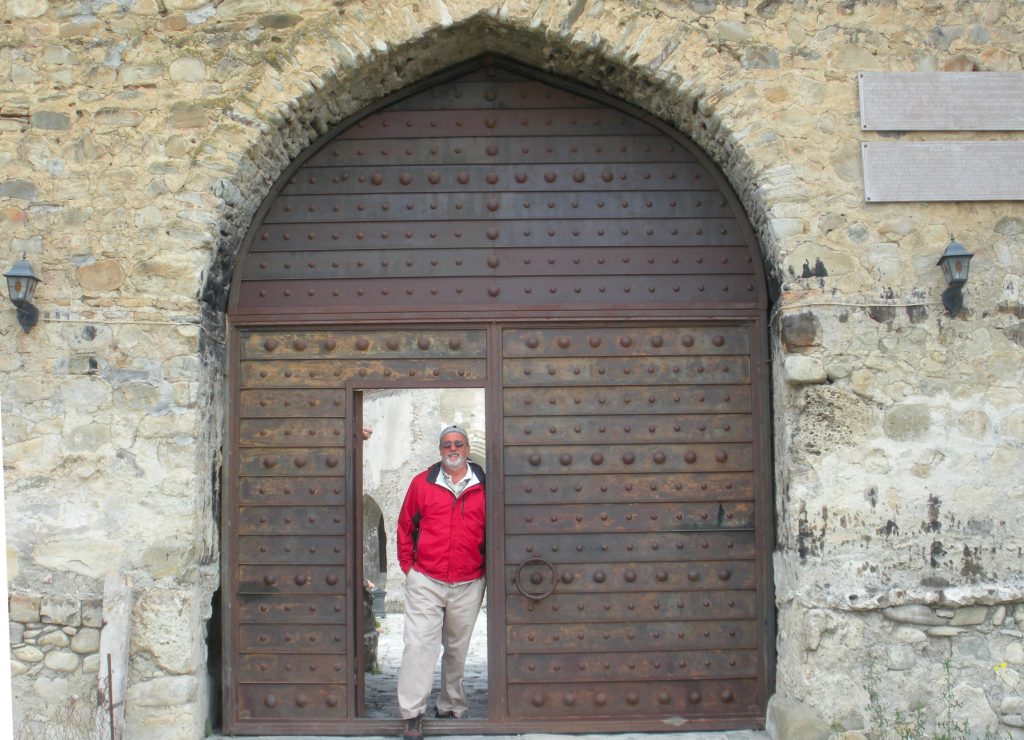
Coffee break at Ikalto, a 9th-century church dedicated to St George. Mountains now obscured by cloud as if a secret door in a wall has closed behind us. Climbing to Gombori Pass on smooth, paved road with white center line. At Gombori summit we break through into sunlight with high cloud cover and race for Tbilisi. At 1:45 pm we reach the city limits and Lilo Mall; our journey five hours and 20 minutes. Big crowds, road to Tbilisi clogged with Sunday traffic, heat (23 degrees C), watermelons for sale at roadsides from stepvans, trucks, boots of lopsided Ladas. Civilization, commerce, noise—we’re back.